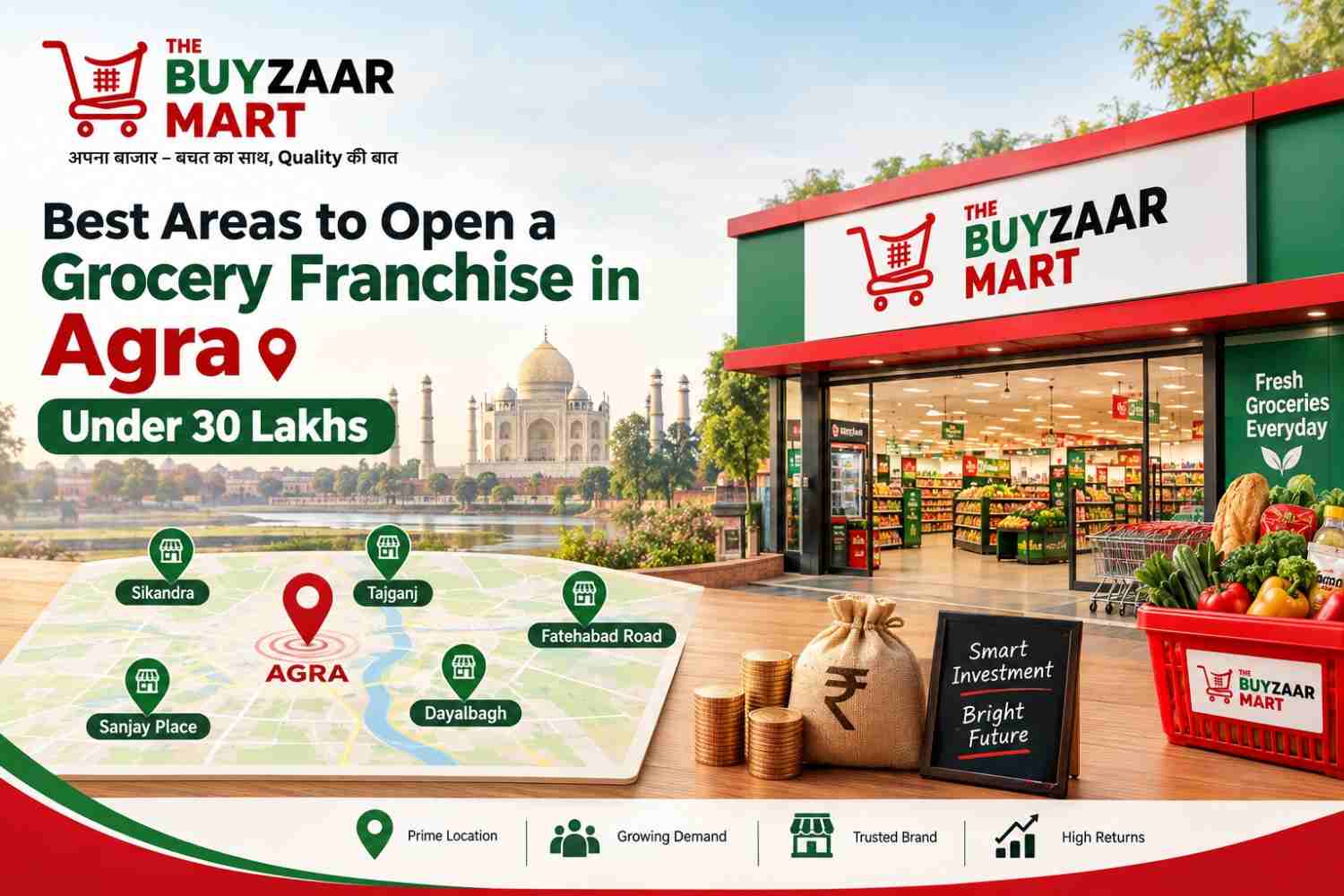
Best Areas to Open a Grocery Franchise in Agra Under 30 Lakhs
Explore the best localities to start a grocery franchise in Agra under ₹30 lakh — Sikandra, Dayalbagh, Shamshabad Road & more, with investment insights.
Agra is no longer just India's tourism capital — it is fast becoming one of Uttar Pradesh's most promising retail investment destinations. With rising residential development, improving connectivity through NH-2, NH-11, the Agra-Lucknow Expressway, and the upcoming Agra Metro, the city's neighborhoods are seeing a surge in organized housing projects and, with them, growing demand for modern grocery retail. For investors with a budget under ₹30 lakh, choosing the right locality is just as important as choosing the right franchise brand. Here's a location-wise breakdown of where a grocery franchise investment is most likely to succeed in Agra.
Why Location Selection Matters More Than Ever in Agra's Retail Market
- •A grocery store's profitability depends heavily on footfall density, so choosing a locality with a strong residential base is far more important than choosing a flashy commercial street with high rent but low daily grocery demand.
- •Agra's growth corridors are shifting away from the old congested city core toward newer developing zones, which means early franchise entry in these areas offers a first-mover advantage before competition increases.
- •Under a ₹30 lakh budget, rent and property cost efficiency matter as much as customer volume, so semi-developed residential corridors often outperform expensive central commercial zones on ROI.
- •Areas near schools, hospitals, and residential societies tend to generate consistent daily footfall for grocery and FMCG purchases, unlike tourist-heavy zones where footfall is seasonal and unpredictable.
Sikandra – Agra's Fastest-Growing Residential Corridor
- •Sikandra has emerged as one of Agra's most active real estate zones, with continuous residential project launches along Sikandra-Bodla Road and the NH-2/NH-11 bypass, creating a steadily expanding customer base.
- •The area's mix of new housing societies, independent floors, and villa developments means many households are still settling in, making them highly receptive to a new, organized neighborhood grocery option.
- •Connectivity via the NH-2 highway and nearby institutions such as schools and hospitals adds consistent daily footfall beyond just residents.
- •A Mini Mart or early-stage Super Mart format fits well here, since the locality is still developing and rental costs remain comparatively reasonable for a growth-stage investment.
Dayalbagh – Established Residential Demand With Steady Footfall
- •Dayalbagh is one of Agra's older, well-established residential and institutional neighborhoods, known for consistent population density and daily consumer demand.
- •The presence of educational institutions and a settled community base means grocery demand here is stable rather than speculative, reducing early-stage business risk for a franchise investor.
- •Because the area is already developed, competition from local kirana stores exists, so a franchise's advantage lies in organized shelving, better pricing transparency, and product variety rather than novelty alone.
- •This locality suits investors looking for a lower-risk, steady-demand location rather than a high-growth speculative bet.
Shamshabad Road – An Emerging Hub for Young Families
- •Shamshabad Road has been highlighted as one of Agra's emerging residential hubs, attracting new 2BHK and 3BHK housing projects aimed at young families and working professionals.
- •New residential corridors like this typically underserved by organized grocery retail, giving an early franchise entrant strong visibility with minimal direct competition.
- •Good road connectivity to central Agra makes this area convenient for daily commuting residents who prefer picking up groceries close to home rather than traveling into the city center.
- •Since the locality is still in a growth phase, property and rental rates tend to be more affordable, allowing an investor to stay comfortably within a ₹30 lakh budget while securing a reasonably sized store format.
Shastripuram – A Value-Focused Residential Pocket
- •Shastripuram, part of the broader Sikandra development corridor, has been positioned as an accessible, value-oriented residential zone with a wide range of property price points.
- •This affordability factor typically translates into price-sensitive consumers who actively seek out value-driven grocery options, aligning well with a franchise model built around competitive FMCG pricing.
- •The area's proximity to highway connectivity supports easier supply chain logistics for restocking inventory efficiently.
- •A Mini Mart format is particularly well suited here, keeping initial investment lean while tapping into a growing customer base.
Kamla Nagar and Civil Lines – Established Commercial-Residential Mix
- •Kamla Nagar and Civil Lines represent some of Agra's more established mixed-use areas, combining residential density with active commercial footfall.
- •These localities offer the advantage of immediate, ready-made customer volume rather than the slower ramp-up period typical of newly developing residential zones.
- •Property and rental costs in these established areas tend to run higher, so investors should lean toward the upper end of a ₹30 lakh budget or prioritize a smaller-format store to manage costs efficiently.
- •These areas work well for investors who prefer a proven, high-footfall location over the higher-risk, higher-reward profile of an emerging residential corridor.
Vibhav Nagar and Kalindi Vihar – Balanced Growth Zones
- •These residential pockets sit within Agra's broader expanding suburban belt, offering a middle ground between established neighborhoods and entirely new developments.
- •A steady influx of new housing combined with existing residential density creates a balanced demand profile, neither too speculative nor too saturated with competition.
- •Investors seeking a moderate-risk, moderate-reward location within a ₹30 lakh budget may find this zone offers a practical entry point with room for future expansion into a larger format as the area matures.
What to Evaluate Before Finalizing a Location in Agra
- •Check the density of residential societies and independent homes within a 1-2 km radius, since grocery retail thrives on proximity-driven repeat purchases.
- •Assess existing competition from local kirana stores and any other organized retail chains already operating nearby to understand your differentiation strategy.
- •Confirm road accessibility and parking availability, since ease of access directly affects daily walk-in customer volume.
- •Factor in rental cost against projected footfall rather than choosing the cheapest available space, since underpriced locations often come with correspondingly low customer density.
- •Align your store format, Mini Mart, Super Mart, or a scaled-down Hyper Mart, with both your budget ceiling and the population size of your chosen locality.
Matching Store Format to Budget and Location in Agra
- •A Mini Mart format (600–1000 sq. ft., roughly ₹15–23 lakh investment) fits well in emerging corridors like Sikandra, Shamshabad Road, and Shastripuram, where the customer base is still expanding.
- •A Super Mart format, at the higher end of a ₹30 lakh budget, is better suited to established, high-footfall zones like Kamla Nagar or Civil Lines, where the extra investment is justified by immediate customer volume.
- •Investors should also budget separately for inventory stocking and working capital beyond the base franchise investment to ensure smooth store operations in the first few months.
Why Agra Is a Strong Market for Grocery Franchise Investment Right Now
- •Rising residential construction across multiple corridors is creating fresh, underserved pockets of grocery demand across the city.
- •Improving infrastructure, including highway connectivity and the upcoming metro network, is expected to boost accessibility and property value across several emerging localities.
- •Agra's retail landscape still has relatively low organized grocery penetration compared to larger UP cities, giving early franchise investors a meaningful head start before national and regional chains scale up presence.
- •A structured franchise model with centralized supply chain support helps new investors compete effectively against unorganized local stores from day one.
Frequently Asked Questions
Which area in Agra is best for a first-time grocery franchise investor?
Sikandra and Shamshabad Road are strong choices due to fast-growing residential development and comparatively lower entry costs.
Can I open a grocery franchise in Agra under ₹30 lakh?
Yes, a Mini Mart or entry-level Super Mart format comfortably fits within a ₹30 lakh budget depending on the locality chosen.
Is Kamla Nagar a good location despite higher rent?
Yes, if budget allows, since it offers immediate high footfall from an already established residential-commercial base.
Do emerging areas like Sikandra carry more risk than established localities?
They carry slightly more ramp-up time but offer lower competition and stronger long-term growth potential as the area develops.
What store format works best for a growing residential corridor?
A Mini Mart format is ideal for emerging areas, allowing lower initial investment while the customer base expands.
How important is proximity to schools and hospitals for a grocery franchise?
Very important, since these institutions generate consistent daily footfall that supports steady grocery sales year-round.
Related Articles
Grocery Franchise Opportunities in Meerut: 2026 Locality Guide
Discover the best localities to open a grocery franchise in Meerut in 2026 — Shastri Nagar, Meerut Bypass, Ganga Nagar & more, with investment insights.
Prayagraj Retail Market 2026: Scope for Organized Grocery Stores
Explore Prayagraj's 2026 retail growth story and the scope for organized grocery stores in Naini-Jhalwa, Civil Lines & George Town for franchise investors.