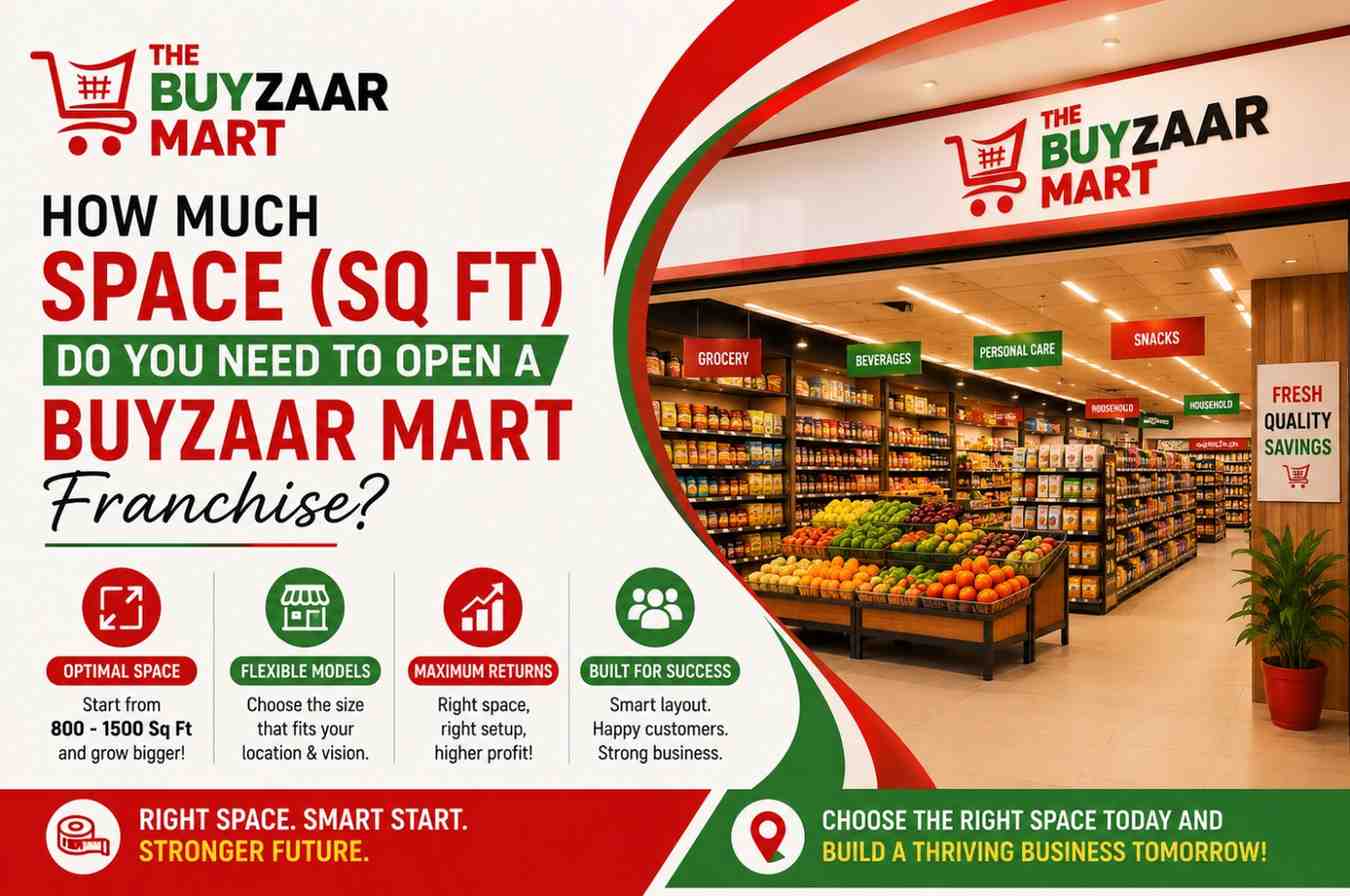
How Much Space (Sq Ft) Do You Need to Open a Buyzaar Mart Franchise?
Mini Mart, Super Mart, or Hyper Mart — see the exact sq ft requirements for each Buyzaar Mart format and how to choose the right size for your budget and location.
One of the first questions every prospective franchise owner asks is the most practical one: how much space will I actually need? It's a fair question, because store size drives almost everything else — investment amount, product range, staffing, and ultimately how much daily revenue the store can support. Buyzaar Mart operates three distinct store formats, each built for a different scale of investment and catchment area. Here is exactly how much space each format needs and how to decide which one fits your situation.
The Three Buyzaar Mart Store Formats
- •Mini Mart — 600 to 1,000 sq ft. Designed for compact, high-frequency neighbourhood retail focused on daily essentials and fast-moving categories
- •Super Mart — 1,001 to 3,000 sq ft. A mid-scale format that expands into fresh categories, wider FMCG range, and dedicated refrigeration for perishables
- •Hyper Mart — 3,001 to 8,000 sq ft. The largest format, built for wide category depth, dedicated sections per department, and higher footfall catchments
All three formats operate under the same FOCM (Franchise Owned Company Managed) system, meaning the space size changes the scale of operations, not the underlying support and supply chain model.
Mini Mart (600-1,000 Sq Ft): The Low-Investment Entry Point
- •Best suited for dense residential lanes, colonies, or micro-markets where footfall is frequent but shoppers are buying small basket sizes on quick, daily trips
- •Product range is concentrated on ambient, high-frequency categories — packaged staples, personal care, snacks, beverages, and household essentials. Refrigerated fresh categories are typically limited or absent at this size
- •Layout efficiency matters most here. Every shelf foot needs to earn its place, since there is no room for slow-moving or low-margin SKUs that a larger format could afford to carry
- •Staffing requirement is minimal, usually two to three staff members across a shift, since the compact layout means less ground for a customer or staff member to cover
- •This format works well as a first franchise for someone testing the business model with lower capital exposure before considering an upgrade to a larger format in the same or a different location
Super Mart (1,001-3,000 Sq Ft): The Balanced Mid-Scale Format
- •The most versatile format in the network, wide enough to introduce dedicated refrigeration for dairy, fresh produce, and packaged fresh categories, which meaningfully increases visit frequency
- •Suited for busy residential markets, mixed commercial-residential stretches, or locations near schools, offices, or transit points where basket sizes are larger and category range matters more to the customer
- •Space allows for proper category zoning — staples, personal care, fresh and dairy, snacks and beverages, and household items can each get dedicated, clearly signed sections rather than being compressed together
- •This is the format where a customer starts treating the store as their default weekly grocery destination rather than just a top-up shop, because the range genuinely reduces the need to visit anywhere else
- •Staffing typically scales to four to six team members, with role separation possible between billing, restocking, and floor assistance
Hyper Mart (3,001-8,000 Sq Ft): The Full-Scale Format
- •Built for high-footfall commercial stretches, main market roads, or catchments with a large surrounding residential population that can sustain a wider daily customer base
- •Supports the fullest category depth in the network — extended fresh and dairy sections, wider FMCG brand choice within each category, household and personal care range expansion, and space for seasonal or promotional product zones
- •At this scale, store layout becomes a genuine strategic decision — aisle flow, category adjacency, and checkout counter placement all materially affect basket size and customer dwell time
- •Requires the largest staffing base, typically six or more team members, along with more structured daily operations — dedicated refrigeration monitoring, more frequent restocking cycles, and higher inventory management demands
- •This format suits an investor or entrepreneur ready to run retail as a full-scale operation rather than a single-owner-operated shop, since the day-to-day complexity scales meaningfully with the space
How to Decide Which Format Fits You
- •Start with your catchment, not your budget. A Hyper Mart in a low-footfall lane will struggle regardless of investment capacity, while a Mini Mart in a high-footfall commercial stretch will underutilise the location's real potential. Match the format to what the location can actually support
- •Consider your available capital honestly. Investment scales directly with space — stock, interior, and security deposit all increase with sq ft. A format that stretches your capital too thin leaves no buffer for the first few operating months before the store stabilises
- •Think about your involvement level. A Mini Mart can often be managed hands-on by a single owner with light staff support. A Hyper Mart effectively requires either a full-time on-ground manager or your own consistent daily presence
- •Evaluate whether refrigeration categories matter in your market. If your catchment has strong demand for dairy, fresh produce, and chilled beverages, a Super Mart or larger format captures this demand meaningfully better than a Mini Mart can
- •Don't oversize for future ambition. It's generally more sustainable to start with a format matched to current footfall reality and expand into a second location later, rather than opening oversized on day one and carrying excess rent and inventory pressure
A Practical Way to Estimate Your Fit
- •Walk the actual location at different times of day — morning, evening, and weekend — and observe genuine foot traffic patterns rather than relying on assumptions about the area
- •Check what's already operating nearby. A cluster of small kirana shops with steady footfall but no organized supermarket often signals strong Mini Mart or Super Mart potential. An area already served by multiple large stores may need a differentiated Hyper Mart approach to compete
- •Use the store investment calculator to model numbers across all three formats for your specific sq ft option before finalising, so the decision is based on actual investment breakdown rather than format name alone
- •Speak with the Buyzaar Mart franchise team about the specific location under consideration — sq ft guidance works best when it's matched against the actual catchment data for that street or locality
Final Thoughts
- •Space size is the foundation every other franchise decision builds on — investment, category range, staffing, and daily revenue potential all follow from it
- •Mini Mart suits low-investment, high-frequency neighbourhood entry. Super Mart is the balanced format most franchise owners land on for its range and footfall capture. Hyper Mart suits investors ready to run a full-scale retail operation in a high-footfall location
- •The right choice comes from matching format to catchment reality, not from picking the largest size your budget technically allows
Frequently Asked Questions
What is the minimum space required to open a Buyzaar Mart franchise?
The smallest format, Mini Mart, requires 600 sq ft as the minimum starting space.
Can a Mini Mart be upgraded to a Super Mart later?
Format upgrades depend on the specific location's available space and lease terms. Many franchise owners start with a Mini Mart and later open a second, larger format store in a different location rather than expanding the same site.
Does store size affect the franchise fee?
Yes. Franchise fee, stock requirement, interior cost, and security deposit all scale with the sq ft and format chosen, since larger formats carry a wider product range and higher setup requirement.
Which format is best for a first-time franchise owner?
Super Mart is generally the most balanced starting point for first-time owners, offering meaningful category range and refrigeration capability without the operational complexity of a full Hyper Mart.