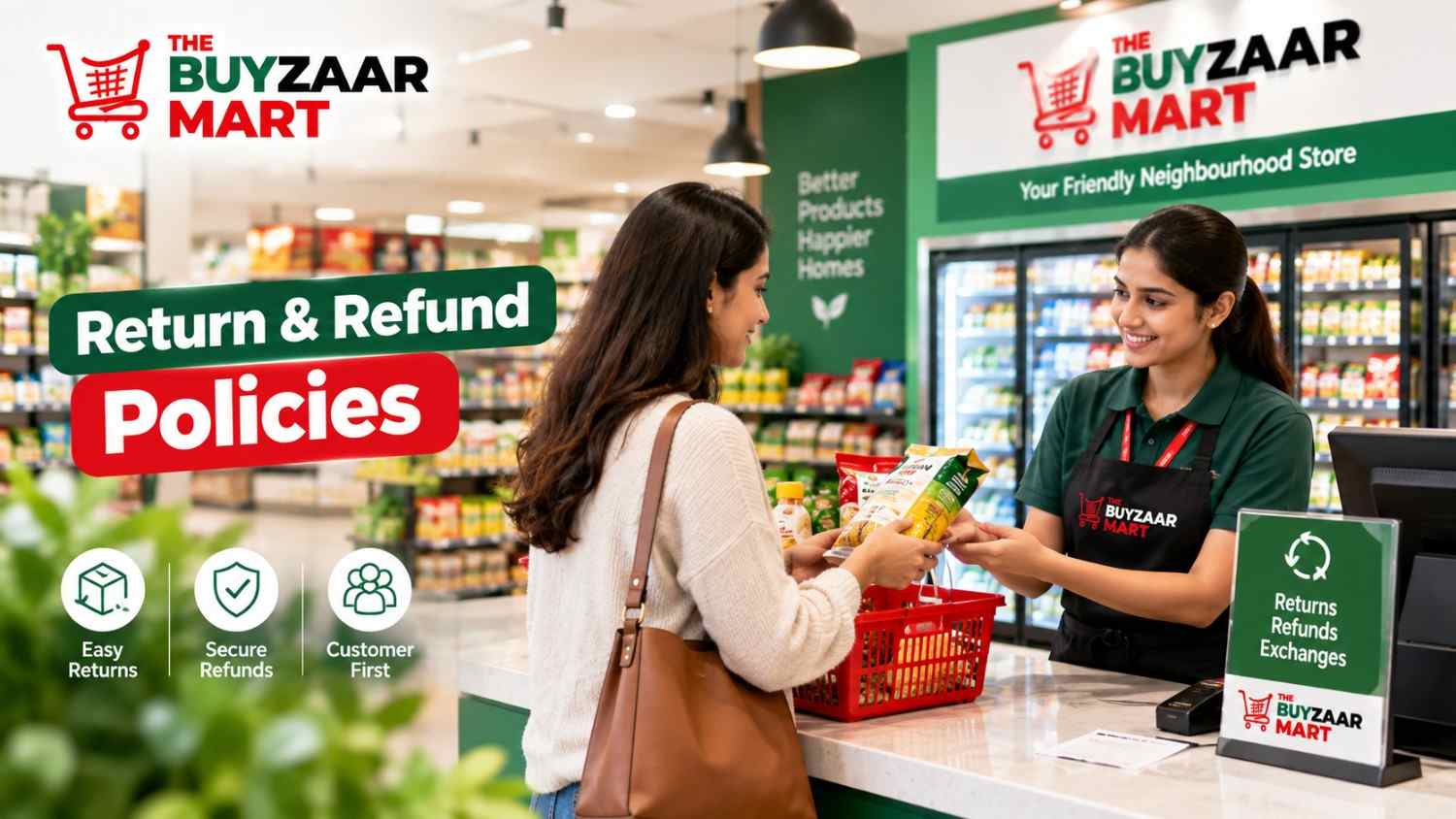
How Buyzaar Mart Franchise Stores Manage Returns & Refunds
Learn how Buyzaar Mart franchise stores handle return and refund policies, from perishables rules to POS-based tracking, ensuring consistent customer trust.
A clear, well-managed return and refund policy is one of the most important trust-building tools for any grocery retail brand. For franchise networks like Buyzaar Mart, where consistency across every outlet directly shapes customer perception of the brand, having a standardized approach to returns and refunds isn't just good customer service — it's essential for protecting brand reputation across every Mini Mart, Super Mart, and Hyper Mart location. This guide explains how grocery franchise stores typically structure their return and refund processes, and the best practices franchise owners should follow to keep operations smooth, compliant, and customer-friendly.
Why Return and Refund Policies Matter for Grocery Franchises
- •A transparent return policy reduces customer hesitation at the point of purchase, especially for higher-value or unfamiliar products
- •Consistent policy execution across outlets protects the overall brand identity, since customers expect the same experience whether they visit one franchise location or another
- •Poorly handled returns are one of the fastest ways to damage local word-of-mouth reputation for a neighborhood grocery store
- •A structured refund process reduces disputes between customers and staff, minimizing time lost to on-the-spot negotiations
- •For franchise owners, clear policies also protect against misuse and reduce unnecessary inventory losses
Core Principles Behind Grocery Franchise Return Policies
- •Category-based return rules — packaged and non-perishable goods typically follow different rules than fresh produce, dairy, or frozen items, since perishables usually cannot be resold once returned
- •Proof of purchase requirement — a valid bill or receipt is generally required to process any return or refund request
- •Time-bound return windows — most grocery retail policies set a defined window (commonly a few days) for raising return requests, particularly for packaged goods with manufacturing defects
- •Condition-based eligibility — items must usually be unused, unopened, or in original packaging to qualify for a return, except in cases of genuine quality issues
- •Exchange-first approach — many grocery franchises prioritize product exchange over cash refunds, especially for FMCG and packaged items, unless the issue is a manufacturing defect
Typical Categories and How They're Handled
- •Packaged FMCG products — eligible for exchange or refund mainly in cases of damaged packaging, expired stock sold in error, or manufacturing defects
- •Fresh produce and perishables — generally non-returnable once purchased, but replaced immediately if a genuine quality issue is identified at the time of sale
- •Dairy and frozen items — handled similarly to perishables, with quality issues addressed through immediate in-store exchange rather than delayed refund processing
- •Household and non-food items — follow closer to standard retail return timelines, provided items are unused and accompanied by a receipt
- •Billing errors — corrected instantly at the counter, since these are operational mistakes rather than product issues
Step-by-Step: How a Franchise Store Typically Processes a Return
- •Customer approaches the billing counter or customer service point with the product and original receipt
- •Staff verifies the purchase details against the billing system to confirm the transaction and pricing
- •The reason for return is reviewed — defect, wrong item, billing error, or quality concern — and matched against the applicable category rule
- •For eligible items, staff processes either a direct exchange or refund based on the payment method originally used
- •The transaction is logged in the POS/billing system to maintain an accurate audit trail for inventory and accounting purposes
- •Any defective stock identified is separated for return to the supplier or written off following standard inventory procedures
Role of POS and Billing Systems in Managing Refunds
- •A centralized billing system allows staff to instantly verify original purchase details, reducing fraudulent or duplicate return attempts
- •Digital transaction logging ensures every refund is traceable, which is critical for franchise owners managing accounts and inventory reconciliation
- •Real-time integration between billing and inventory systems helps track returned stock accurately, preventing mismatches during audits
- •Automated refund logging reduces manual paperwork and speeds up the customer-facing process at the counter
- •For multi-outlet franchise owners, centralized systems make it easier to monitor return patterns across locations and identify recurring product or supplier issues
Staff Training for Consistent Refund Handling
- •Train billing and floor staff on category-specific return rules so decisions are consistent regardless of which staff member handles the request
- •Set clear escalation paths for unusual or high-value return requests that need manager approval
- •Encourage staff to handle return requests with patience and clarity, since how a refund is handled often matters as much to the customer as the outcome itself
- •Conduct periodic refreshers whenever return policy details are updated at the brand level
- •Empower staff to resolve simple billing errors on the spot without requiring manager intervention, to keep the process fast and efficient
Preventing Return Policy Misuse
- •Always require proof of purchase before processing any refund or exchange
- •Set clear internal guidelines for handling repeat or suspicious return requests from the same customer
- •Cross-check high-value item returns against CCTV footage and billing records where necessary
- •Maintain a return log to identify unusual patterns that may indicate policy misuse
- •Ensure perishable and non-returnable category rules are clearly communicated to reduce disputes at the counter
Communicating Return Policies Clearly to Customers
- •Display return and refund policy details visibly near the billing counter or customer service point
- •Print key return conditions on the purchase receipt itself, so customers have a reference at hand
- •Train staff to proactively inform customers about category-specific rules at the time of purchase, especially for perishable or discounted items
- •Maintain consistency between in-store signage and any policy details shared through the brand's official channels
- •Address customer queries about returns calmly and clearly, since confusion at this stage is a common source of dissatisfaction
Why Consistency Across Franchise Outlets Matters
- •Franchise customers often shop across multiple locations, and inconsistent return handling between outlets creates confusion and erodes trust in the overall brand
- •Standardized policies make it easier for new franchise owners to train staff quickly without building processes from scratch
- •Centralized guidelines reduce the risk of individual outlets setting informal, inconsistent rules that conflict with brand standards
- •A consistent approach strengthens the overall brand promise of reliability that grocery franchise customers expect from a recognized retail name
Building Long-Term Customer Trust Through Fair Returns
- •A well-structured return and refund process does more than resolve individual complaints — it signals to customers that a store stands behind the products it sells. For Buyzaar Mart franchise owners, following consistent, category-aware return practices helps protect both customer relationships and day-to-day operational efficiency, reinforcing the brand's reputation for reliability at every outlet.
- •Note: Specific return and refund timelines, eligible categories, and approval workflows may vary based on the official Buyzaar Mart franchise agreement. Franchise owners should always refer to their brand operations manual for exact policy terms.
Frequently Asked Questions
Q1. Can perishable items be returned at a grocery franchise store?
Generally no, unless a genuine quality issue is identified at the time of purchase, in which case an immediate exchange is usually offered.
Q2. Is a receipt mandatory for processing a return?
Yes, proof of purchase is typically required to verify the transaction before any refund or exchange is processed.
Q3. Do grocery franchises prefer refunds or exchanges?
Most grocery franchises prioritize product exchange over cash refunds, especially for packaged FMCG items.
Q4. How are billing errors handled differently from product returns?
Billing errors are usually corrected instantly at the counter, since they are operational mistakes rather than product quality issues.
Q5. How does POS integration help with refund management?
It allows instant verification of purchases, accurate inventory tracking, and a clear audit trail for every refund processed.
Q6. Why is policy consistency important across franchise outlets?
Because customers expect the same experience at every location, and inconsistency can weaken trust in the overall brand.