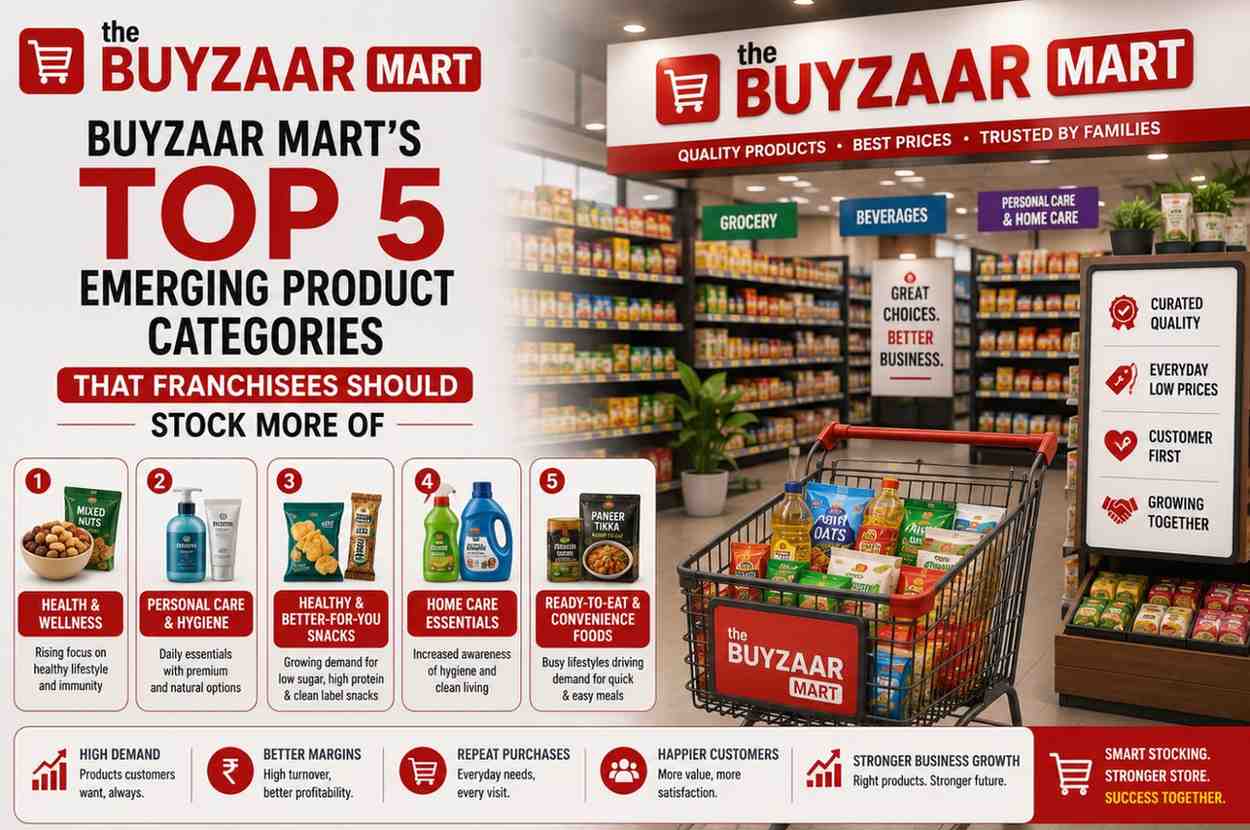
Buyzaar Mart's Top 5 Emerging Product Categories That Franchisees Should Stock More Of (2026)
The grocery store that stocks what consumers are buying tomorrow — not just today — wins the most loyal customers. Here are the 5 fastest-growing product categories Buyzaar Mart franchise partners should be stocking more of in 2026.
There is a version of grocery franchise ownership that is entirely reactive — stock what customers ask for, reorder what runs out, keep doing what worked last month. It is a functional approach. It is not a growth approach. The franchise partners who build the fastest-growing Buyzaar Mart stores are the ones who do something more: they watch where consumer demand is moving before it arrives at full volume, stock those categories early, and build the reputation of being the store that always has what customers are beginning to look for. India's FMCG market is at a genuinely interesting inflection point in 2026. Within its overall growth, the most interesting story is not in the established high-volume categories — staples, beverages, and standard personal care will always move. The most interesting story is in the emerging categories, where consumer demand is growing at a fast clip annually, where tier-2 city adoption is just beginning, and where the franchise store that gets there first builds a loyal customer relationship that competitors cannot easily break. Here are the five categories every Buyzaar Mart franchise partner should be actively expanding shelf space for right now.
Category 1 — Health Snacks and Functional Foods: The Fastest-Growing Segment in FMCG
Health and wellness products are emerging as one of the fastest-growing segments in India's FMCG market, driven by increasing consumer awareness and lifestyle changes. Within this broad category, the snacking segment is where the most immediate and actionable shelf opportunity exists for grocery franchise stores. The healthy snacks segment, particularly makhana and millet-based products, is an emerging category with significant headroom for growth as consumers begin to adopt premium, health-oriented snacks — offering one of the most attractive growth-to-competition ratios of any FMCG category in India right now.
What is driving this
- •The post-pandemic health consciousness shift is translating directly into snack purchasing behaviour — consumers who previously bought chips and fried namkeen without a second thought are now actively reading labels and seeking alternatives
- •There is a significant uptick in health-focused products and protein-rich foods as consumers are no longer just buying more, they are buying better
- •Makhana — fox nuts or lotus seeds — has seen sharp volume growth in organised retail over the last two years, crossing from being a Navratri fasting food to an everyday premium snack that working professionals and health-aware homemakers buy week on week
- •Millet-based products — ragi biscuits, jowar puffs, bajra cookies — are growing fast, driven by both health positioning and government-backed promotion of millets as superfoods
- •Protein bars, roasted nut mixes, seed-based snack packs, and low-sugar granola are all seeing early but fast-accelerating demand in tier-2 North Indian cities
What to stock specifically
- •Makhana in multiple flavours and pack sizes — plain, peri peri, cheese, and caramel variants from brands including Farmley, Happilo, and Haldiram's premium range
- •Ragi and millet-based biscuits from ITC Sunfeast's millet range, Britannia's NutriChoice line, and emerging health brands
- •Roasted nut and dry fruit mixes in 100 g and 200 g snacking packs, positioned near the billing counter for impulse purchase
- •Protein bars from RiteBite, Yoga Bar, and similar brands, growing fastest among young working professionals aged 22 to 35
Shelf strategy: Create a dedicated Healthy Snacking section — even a half-bay of shelving — rather than scattering these products across the snack aisle. The visual grouping signals to health-aware customers that your store takes this category seriously, drives discovery of products they did not know you stocked, and consistently increases basket attachment from customers who come in for one health snack and leave with three.
Category 2 — Ayurvedic and Herbal Personal Care: Premium Growth With Mass Market Reach
Ayurvedic personal care is seeing rapid growth alongside healthy snacks as a high-momentum FMCG category. This is not a fringe trend — it is one of the most structurally durable shifts in Indian personal care purchasing. Personal care products dominate the FMCG segment due to increased consumer interest in grooming and wellness, and with heightened awareness of skincare and hygiene and brands emphasising premiumization, this category has witnessed significant traction. Major players like Hindustan Unilever and Dabur have fortified their brand presence by offering diverse ranges catering to various consumer needs.
What is driving this
- •Indian consumers across income levels are actively seeking products that combine modern efficacy with traditional herbal and Ayurvedic credentials — natural, chemical-free, herbal, and Ayurvedic are among the highest-performing claim words on personal care packaging in both urban and tier-2 markets
- •Patanjali's explosive growth over the last decade educated an entire generation of North Indian consumers about Ayurvedic personal care alternatives, and that consumer education has now created demand for a broader range of herbal and natural brands beyond Patanjali itself
- •Ayurvedic wellness products in contemporary packaging appeal to modern Indian consumers, with ashwagandha and adaptogenic herbs integrated into convenient formats showing strong growth potential
- •HUL has responded by building out its Lever Ayush range, Dabur has doubled down on its herbal personal care portfolio, and Himalaya Drug Company continues expanding its FMCG presence — these major brand investments confirm that the Ayurvedic personal care shift is a mainstream purchasing movement, not a niche preference
What to stock specifically
- •Patanjali personal care range — shampoos, face washes, body lotions, and toothpaste, which remain consistently high-velocity across North Indian tier-2 markets
- •Lever Ayush — HUL's dedicated Ayurvedic personal care line covering hair care, face care, and skin care, with strong brand recognition and growing distribution
- •Himalaya personal care — face wash, moisturiser, and hair care range with strong loyalty among female shoppers aged 20 to 40
- •Dabur's Vatika hair care range and Gulabari skin care products — established trust with North Indian consumers over decades
- •Emerging brands like Wow Skin Science, Mamaearth, and Biotique are growing fast among younger urban consumers and are worth stocking in one or two SKUs per brand to test demand in your specific locality
Shelf strategy: Do not merge Ayurvedic personal care into the standard personal care aisle without distinction. Create clear Herbal and Natural shelf labels within the personal care section — customers who are specifically seeking Ayurvedic products will scan for this label rather than scanning the entire aisle.
Category 3 — OTC Healthcare and Nutritional Supplements: The Pharmacy Category That Walks Into Grocery Stores
OTC healthcare items are part of the FMCG product set, including medicines, nutritional supplements, health drinks, vitamins, and first-aid products. This category is seeing strong value growth and represents one of the most structurally interesting opportunities for grocery franchise stores because of where it sits in the customer's mental shopping map.
What is driving this
- •Post-pandemic preventive health consciousness has permanently elevated the importance of immunity, nutrition, and everyday wellness products in Indian household purchasing
- •The global wellness market has grown substantially and India is a significant participant, with preventive healthcare solutions and clean label foods gaining sustained market attention
- •OTC products — glucose sachets, antacids, pain relief balms, antiseptic liquids, vitamin supplements, protein powders, and health drinks — are increasingly purchased at neighbourhood grocery stores rather than exclusively at pharmacies. The consumer's mental model has shifted: if it is available at the grocery store, the grocery store is where she will buy it
- •Vitamin and protein supplement demand, particularly among urban millennials, drives category expansion as preventive healthcare investment through nutritional supplements reflects changing health priorities
What to stock specifically
- •Glucose and energy — Dabur Glucon-D, Heinz Complan, Horlicks, and Bournvita in multiple pack sizes, among the highest-repurchase-frequency products in the OTC health category
- •Immunity and wellness — Dabur Chyawanprash, Himalaya Septilin, Patanjali Chyawanprash, and Dabur Honey with immunity claims, with peak demand during winter and monsoon seasons
- •Pain relief and antacids — Iodex, Moov, fast relief balms, Eno, and Digene, which are habitual repurchase products with extremely consistent demand
- •Antiseptic — Dettol liquid and Savlon, post-pandemic household staples that have moved from pharmacy to grocery
- •Basic vitamins and supplements — Revital, Supradyn, and Himalaya's supplement range for the entry-level supplement buyer who does not want to go to a pharmacy or specialist store
Shelf strategy: The OTC section is a footfall anchor — customers who come in specifically for a glucose sachet or a pain relief balm very often make a full grocery purchase. Position the OTC section in a clearly visible, well-organised corner of your store, not near staples where it gets lost, but in a dedicated space with clear category signage.
Category 4 — Ready-to-Cook and Convenience Foods: The Dual-Income Family Category
Indian families want products that are tasty and quick to prepare. Ready-to-eat and quick-cook subsegments are growing at a strong pace within the food segment. This is the category that most directly reflects the structural household change underway in North India's tier-2 cities — the rise of the nuclear, dual-income family with limited cooking time and strong taste preferences.
What is driving this
- •As more women in tier-2 North Indian cities enter the workforce, the time available for traditional extended cooking is compressing. The consumer who previously made dal from scratch every day is now supplementing with ready-to-cook gravy mixes, spice pastes, and instant preparations without feeling she has compromised on flavour or quality
- •The ready-to-cook market in India is growing at one of the highest rates of any food subcategory, driven by urbanisation, nuclear family formation, and the increasing normalisation of convenience cooking across income levels
- •FMCG companies have invested heavily in this category: Tata Consumer's Tata Sampann cooking pastes and spice mixes, ITC's Kitchens of India and Aashirvaad cooking pastes, Nestlé Maggi's expanded range of noodles, sauces, and masalas, MTR Foods' ready-to-cook range, and MDH and Everest's spice paste innovations
What to stock specifically
- •Instant noodles and pasta — Nestlé Maggi in every variant, still the highest-velocity ready-to-cook product in India and continuing to grow year on year
- •Cooking pastes and gravies — Tata Sampann curry pastes, ITC Aashirvaad range, and MTR masala mixes, positioned near the spices section to encourage complementary purchase
- •Spice mixes and masalas — Everest, MDH, and Catch continue as trusted brands. Add newer convenience-positioned formats like single-use masala sachets for smaller households
- •Ready-to-eat and retort pouches — MTR's heat-and-eat range, Gits, and Haldiram's ready-to-eat packs for working professionals and students who want a quick meal option
- •Breakfast convenience — Quaker Oats, Kellogg's, and MTR poha and upma mixes for the time-constrained nuclear family morning
Shelf strategy: Create a Quick & Easy meal solutions section that groups instant noodles, cooking pastes, spice mixes, and breakfast convenience foods together, organised by meal occasion rather than brand. A customer who comes for Maggi noodles and sees Tata Sampann curry paste and MTR upma mix in the same visual zone will regularly leave with all three.
Category 5 — Premium and Functional Beverages: The Highest-Margin Emerging Category
The beverages category in Indian grocery retail is bifurcating rapidly. Standard carbonated drinks and packaged juices continue to grow steadily. But within beverages, a new tier of functional and premium products is growing significantly faster than standard variants, and carrying margins that are significantly higher. Premiumization and wellness are driving a significant uptick in health-focused products and protein-rich foods across the FMCG sector, and nowhere is this more visible than in the beverage aisle.
What is driving this
- •Functional beverages — drinks that claim health benefits beyond hydration — have moved from being a gym culture phenomenon to a mainstream consumer category. Electrolyte drinks, probiotic beverages, protein shakes, immunity drinks, and herbal teas are all seeing sustained volume growth across income levels
- •The sugar consciousness shift — driven by diabetes awareness, weight management concern, and general health awareness — is pushing consumers away from standard sugary drinks toward alternatives that taste good but carry a better nutritional profile
- •Rising incomes in tier-2 North Indian cities are making premium beverages a regular rather than occasional purchase. A working professional who buys a premium green tea variant or an electrolyte drink three times a week is a significantly more valuable beverage customer than one who buys a basic cold drink once
What to stock specifically
- •Electrolyte and hydration drinks — Gatorade, Powerade, and Enerzal, growing fastest among young working professionals and fitness-aware consumers
- •Probiotic and cultured dairy drinks — Yakult, Amul Kefir, and Mother Dairy probiotic variants, positioned near the dairy section and near the OTC health section simultaneously
- •Herbal and green teas — Lipton Green Tea, Tata Tea Premium Green, Organic India Tulsi Tea, and Himalaya's herbal tea range, with strong demand from health-conscious women aged 25 to 50
- •Protein and nutrition shakes — Horlicks Protein Plus, Complan, and entry-level protein drink mixes, growing among both fitness-aware millennials and parents buying for teenagers
- •Flavoured and premium water — Evocus black water, Himalayan sparkling water, and coconut water packs — niche but fast-growing among aspirational upper-middle-income households in tier-2 cities
Shelf strategy: Premium beverages need refrigeration visibility to sell at their highest velocity — a refrigerated display unit at the front of the store with premium functional beverages prominently displayed captures both planned purchases and impulse buys from customers who see the cooler on their way to the billing counter.
The Cross-Category Principle — How to Build These Five Categories Together
The most effective way to build these five emerging categories is not to treat them as five separate shelf decisions but as a single connected strategy that tells a coherent story to the growing segment of health-aware, quality-conscious, convenience-seeking consumers in your neighbourhood.
- •Position health snacks, Ayurvedic personal care, OTC healthcare, and functional beverages close enough in your store layout that a customer browsing one category naturally encounters the others — this is the cross-category discovery principle that large format retailers have used for decades and that neighbourhood franchise stores can execute in a smaller but equally effective form
- •Create a Wellness Corner — even six to eight square feet of dedicated shelf space — that aggregates health snacks, immunity products, herbal personal care, and functional beverages into a single browseable zone
- •Use your WhatsApp customer broadcast list to introduce new products in these categories — a simple message about new healthy snacking arrivals reaches your customers at zero marketing cost and drives purposeful visits from exactly the customers who are most likely to buy
Final Thoughts
- •The grocery franchise stores that grow fastest are not the ones that stock the most products — they are the ones that stock the right products at the right time, before demand has fully peaked and while their neighbourhood's consumers are just beginning to discover these categories
- •Health and wellness products are among the fastest-growing segments in India's FMCG market, driven by increasing consumer awareness and lifestyle changes — and this growth is moving from metros into exactly the tier-2 North Indian cities where Buyzaar Mart franchise stores are positioned
- •The five categories in this guide — health snacks and functional foods, Ayurvedic personal care, OTC healthcare, ready-to-cook foods, and premium beverages — are all backed by structural consumer behaviour shifts that will not reverse. They are growing because of forces — rising incomes, health consciousness, nuclear family formation, and convenience demand — that are themselves structural and compounding
- •A Buyzaar Mart franchise partner who builds strong shelf presence in all five categories in 2026 is not just adding SKUs to her store — she is positioning her store as the most relevant, most current, and most trusted grocery destination in her neighbourhood
- •Buyzaar Mart's 50+ FMCG brand partnerships give franchise partners direct access to the leading brands in every one of these categories, without the negotiation, relationship management, and minimum order complexity that an independent store owner would face trying to build the same supplier relationships
Build a store stocked for 2026 and beyond. Apply at thebuyzaarmart.com/franchise or call 9217991727 (Monday to Saturday, 9 AM to 7 PM)
Frequently Asked Questions
Should I stock these emerging categories even if my current customers are not asking for them?
Yes — with measured initial quantities. Consumer awareness of these categories is growing every month. Stocking two or three SKUs per emerging category costs very little, signals that your store is current, and positions you for the demand that is building rather than waiting until it arrives at full volume and competitors are already established.
Which of the five categories has the highest margin potential for a Buyzaar Mart franchise store?
Premium and functional beverages carry the highest per-unit margins among the five. OTC healthcare is the most consistent margin performer because it drives the highest repurchase frequency. Health snacks offer the best balance of margin and velocity for a tier-2 city store in 2026.
How much shelf space should I allocate to emerging categories versus established staples?
Start with 10 to 15% of your total shelf space dedicated to emerging categories. Monitor monthly POS data and gradually increase the allocation for categories showing strong velocity in your specific catchment. Never reduce staple shelf space below its functional minimum — emerging categories should expand into previously underutilised shelf areas first.
Are these emerging categories relevant for a Mini Mart format or only Super Mart and above?
All five categories are relevant for Mini Mart formats — but with tighter SKU selection. Stock the top two or three best-selling SKUs in each emerging category rather than a full range. A Mini Mart's emerging category section should be curated and reliable rather than broad and partially stocked.
How do I know which specific SKUs within these categories are moving in my locality?
Review your POS sales velocity data monthly for any SKUs you have introduced, monitor what quick commerce platforms are promoting in your area for product discovery signals, and ask your regular customers directly — a brief conversation with five to ten regular shoppers gives you more locally relevant intelligence than any national market report.