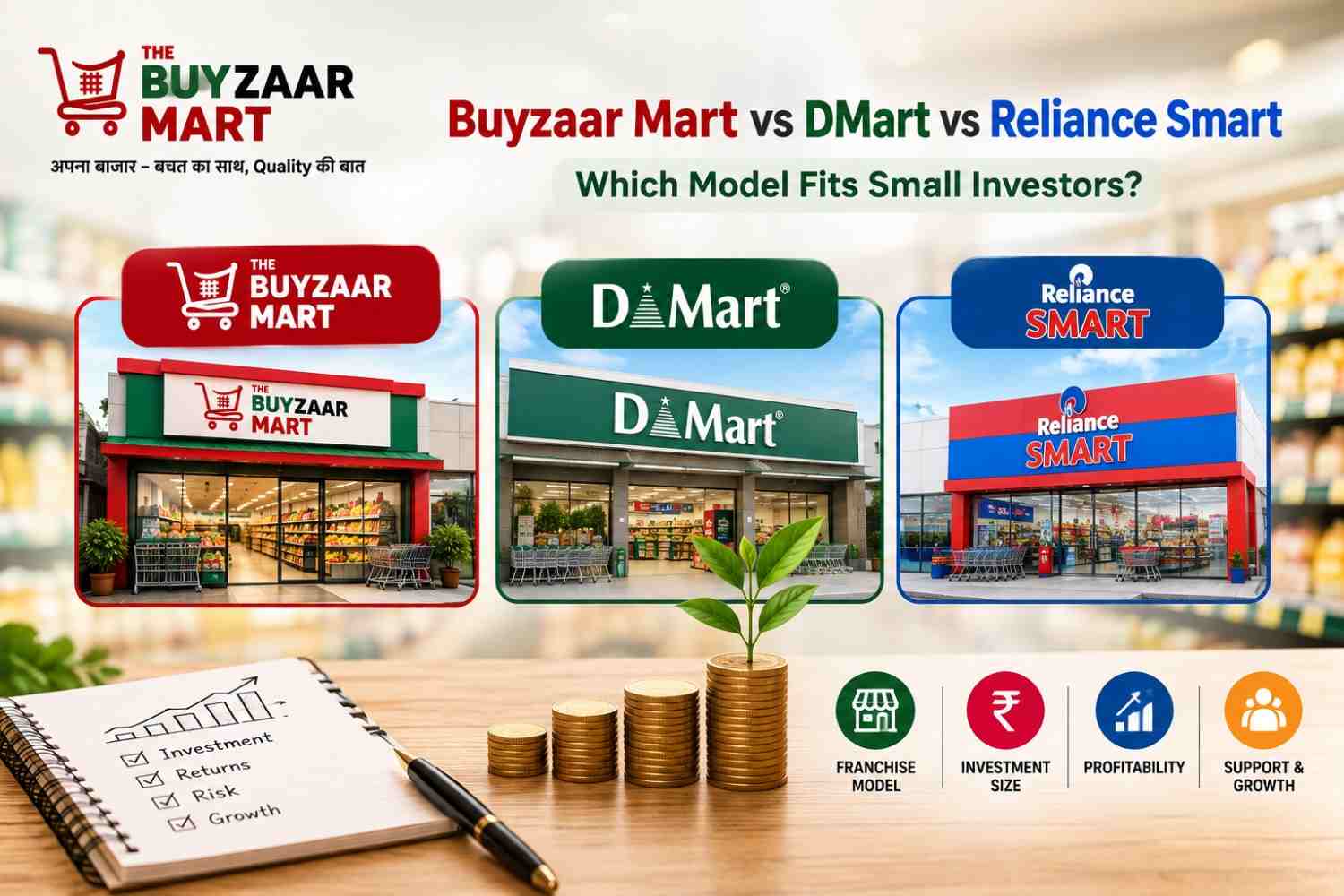
Buyzaar Mart vs DMart vs Reliance Smart: Which Model Fits Small Investors?
Compare Buyzaar Mart, DMart & Reliance Smart franchise models. Find out which grocery retail investment fits small investors with ₹15 lakh capital.
India's organized grocery retail sector is expanding rapidly, and many first-time investors are asking the same question: should I try to get a DMart franchise, a Reliance Smart outlet, or look at a growing regional brand like The Buyzaar Mart? The answer depends heavily on how each brand structures its business model, how much capital it demands, and how open it actually is to individual investors. This guide breaks down all three models point by point so small investors can make an informed decision before committing their savings.
Understanding the Three Retail Models
- •DMart (Avenue Supermarts Ltd.) is a publicly listed, company-owned supermarket chain built on a self-owned-store, no-franchise philosophy, which keeps it largely out of reach for individual investors looking for a franchise-style partnership.
- •Reliance Smart is part of Reliance Retail's supermarket format, also predominantly company-operated, expanding through corporate capital rather than individual franchise investment in most regions.
- •The Buyzaar Mart is a new-age FMCG retail franchise brand built specifically to bring organized grocery retail ownership to individual entrepreneurs through structured FOCM (Franchise Owned Company Managed) and FOCO (Franchise Owned Company Operated) models.
DMart Business Model – Why It Isn't a True Franchise Opportunity
- •DMart operates almost entirely on self-owned and self-leased stores, meaning the brand rarely partners with outside investors to open new outlets under the DMart name.
- •Its core strategy, cluster-based expansion into densely populated urban pockets, is designed to be managed centrally by Avenue Supermarts rather than distributed to franchise partners.
- •Any "DMart franchise" opportunities advertised online typically refer to smaller delivery or pickup-point tie-ups (like DMart Ready), not full-format retail store ownership.
- •For a small investor with ₹15–30 lakh, there is effectively no direct path into DMart's core retail business — the brand's growth benefits shareholders of the listed company, not local entrepreneurs.
Reliance Smart Business Model – Corporate-Owned Retail Expansion
- •Reliance Smart stores are primarily developed and operated by Reliance Retail's own capital, giving the parent company full control over pricing, supply chain, and store operations.
- •Store expansion decisions are driven by Reliance's internal real estate and category strategy, not by local investor applications.
- •While Reliance Retail has experimented with limited franchise-style arrangements for a few of its smaller formats, these opportunities are inconsistent, region-specific, and generally require significantly higher capital and corporate approval processes.
- •For most small investors, breaking into the Reliance Smart ecosystem as a franchise owner is neither straightforward nor guaranteed, making it a less accessible route compared to purpose-built franchise brands.
The Buyzaar Mart Franchise Model – Built for Small Investors
- •The Buyzaar Mart was designed from the ground up as a franchise-first FMCG retail brand, meaning individual investors are the backbone of its expansion strategy rather than an afterthought.
- •The FOCM (Franchise Owned Company Managed) model lets an investor fund the store while The Buyzaar Mart's trained team handles day-to-day operations, ideal for passive or first-time investors.
- •The FOCO (Franchise Owned Company Operated) model gives franchise partners more operational involvement alongside company support, suited to investors who want a hands-on role in their local business.
- •Store formats are tiered to match different investment capacities: Mini Mart, Super Mart, and Hyper Mart, so an investor can choose a format that fits their available capital instead of being locked into one size.
- •Entry-level investment starts around ₹15 lakh, a fraction of what it would take to compete for a corporate retail tie-up, making organized grocery retail genuinely accessible to first-generation entrepreneurs.
Investment Comparison: Buyzaar Mart vs DMart vs Reliance Smart
- •Entry accessibility: The Buyzaar Mart actively invites individual investors; DMart and Reliance Smart largely do not offer a comparable open franchise pathway.
- •Capital requirement: The Buyzaar Mart starts around ₹15 lakh for a Mini Mart format; DMart and Reliance Smart require corporate-level capital that is out of reach for most individual investors even if a tie-up were available.
- •Ownership control: Buyzaar Mart franchise partners own their store asset and brand rights for their territory; DMart and Reliance Smart store assets remain with the parent corporation.
- •Support system: All three brands offer supply chain and operational backing, but only The Buyzaar Mart structures this support specifically around helping a small investor run a profitable local business.
- •Scalability for the investor: With Buyzaar Mart, a franchise partner can start with a Mini Mart and later expand into a Super Mart or Hyper Mart format as revenue grows, offering a clear investor growth path that corporate chains simply don't extend to outside partners.
Why Small Investors Are Choosing The Buyzaar Mart Over Corporate Chains
- •Small investors get real ownership of a retail business instead of chasing rare, inconsistent franchise slots at large corporate chains.
- •The lower entry investment means less financial risk exposure while still tapping into the organized FMCG retail boom happening across Tier 2 and Tier 3 Indian cities.
- •Local market knowledge becomes an advantage rather than a barrier, since The Buyzaar Mart's model is designed around neighborhood-level retail rather than metro-centric corporate expansion.
- •Faster onboarding timelines mean an investor can move from application to store launch much quicker than waiting on corporate approval cycles associated with larger retail groups.
Risk Factors Every Small Investor Should Consider
- •Franchise success still depends on location selection, so investors should evaluate footfall, competition, and local demand before signing on for any format.
- •Working capital for inventory and staffing should be planned separately from the initial franchise investment to avoid cash flow strain in the first few months.
- •Investors should review agreement terms carefully, including revenue-sharing structure, minimum investment tenure, and support commitments, regardless of which brand they choose.
- •Corporate-run chains like DMart and Reliance Smart offer brand strength but little direct financial upside for outside investors, while franchise brands offer ownership upside paired with the responsibility of active business management.
Which Model Fits Your Investment Goals?
- •If you have limited capital and want direct ownership: The Buyzaar Mart's FOCM or FOCO model, starting at ₹15 lakh, is the most realistic entry point into organized grocery retail.
- •If you want a passive, low-involvement investment: The FOCM format allows company-managed daily operations while you retain ownership benefits.
- •If you want hands-on control of your local store: The FOCO model suits investors who want to be actively involved in running the business.
- •If you have very large corporate-level capital and connections: DMart or Reliance Smart tie-ups may occasionally be explored, though these remain rare, inconsistent, and generally not designed for individual small investors.
Frequently Asked Questions
Does DMart offer a franchise to individual investors?
No, DMart operates almost entirely through self-owned stores and does not offer a standard franchise model for individual investors.
Can a small investor get a Reliance Smart franchise?
Reliance Smart is largely company-operated, and any franchise-style arrangements are limited, region-specific, and not broadly open to small investors.
What is the minimum investment for a Buyzaar Mart franchise?
Investment starts around ₹15 lakh for the Mini Mart format, with Super Mart and Hyper Mart options available for larger budgets.
What is the difference between FOCM and FOCO models?
FOCM means the franchise is company-managed for a more passive investment, while FOCO means the franchise owner is more actively involved in daily operations.
Is The Buyzaar Mart a good option compared to corporate grocery chains?
For small investors seeking real ownership, lower entry investment, and structured support, The Buyzaar Mart offers a more accessible path than corporate chains like DMart or Reliance Smart.
Does The Buyzaar Mart provide inventory and compliance support?
Yes, franchise partners get centralized supply chain support, Hassle-Free Inventory Assurance, and assistance with FSSAI and GST compliance.
Related Articles

Top 7 Benefits of Investing in a Company-Managed Supermarket
Discover the top 7 benefits of investing in a company-managed supermarket and why this structured retail model is becoming one of the most preferred choices for investors in India in 2026.

How to Apply for a Buyzaar Mart Franchise: Step-by-Step Process (2026)
Want to open a Buyzaar Mart franchise in India? Read our complete 2026 step-by-step guide covering eligibility, investment, documentation, and store launch process.
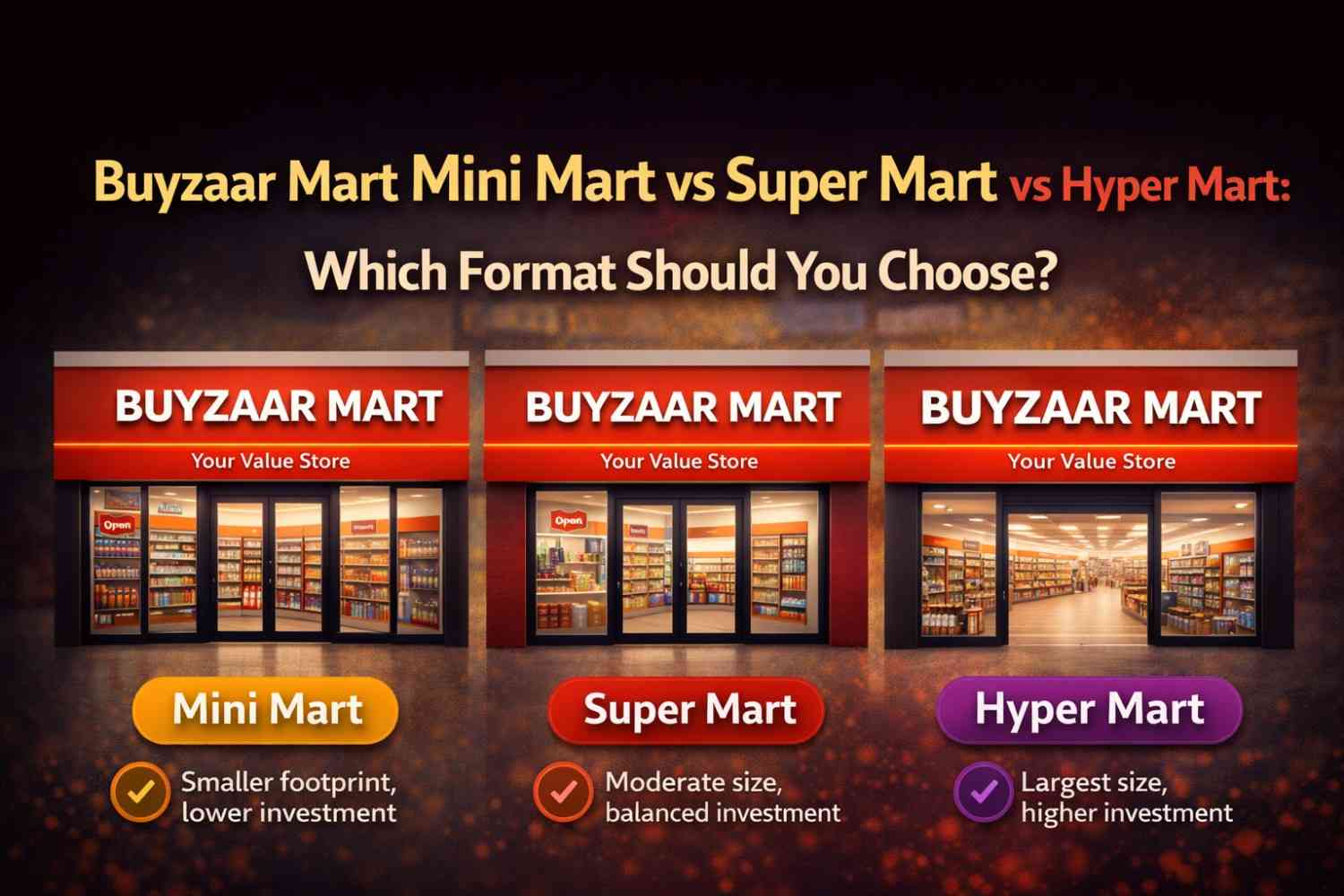
Buyzaar Mart Mini Mart vs Super Mart vs Hyper Mart: Which Format Should You Choose?
Confused between Buyzaar Mart's Mini Mart, Super Mart, and Hyper Mart formats? Compare investment, space, product range & profits to pick the right franchise for you.