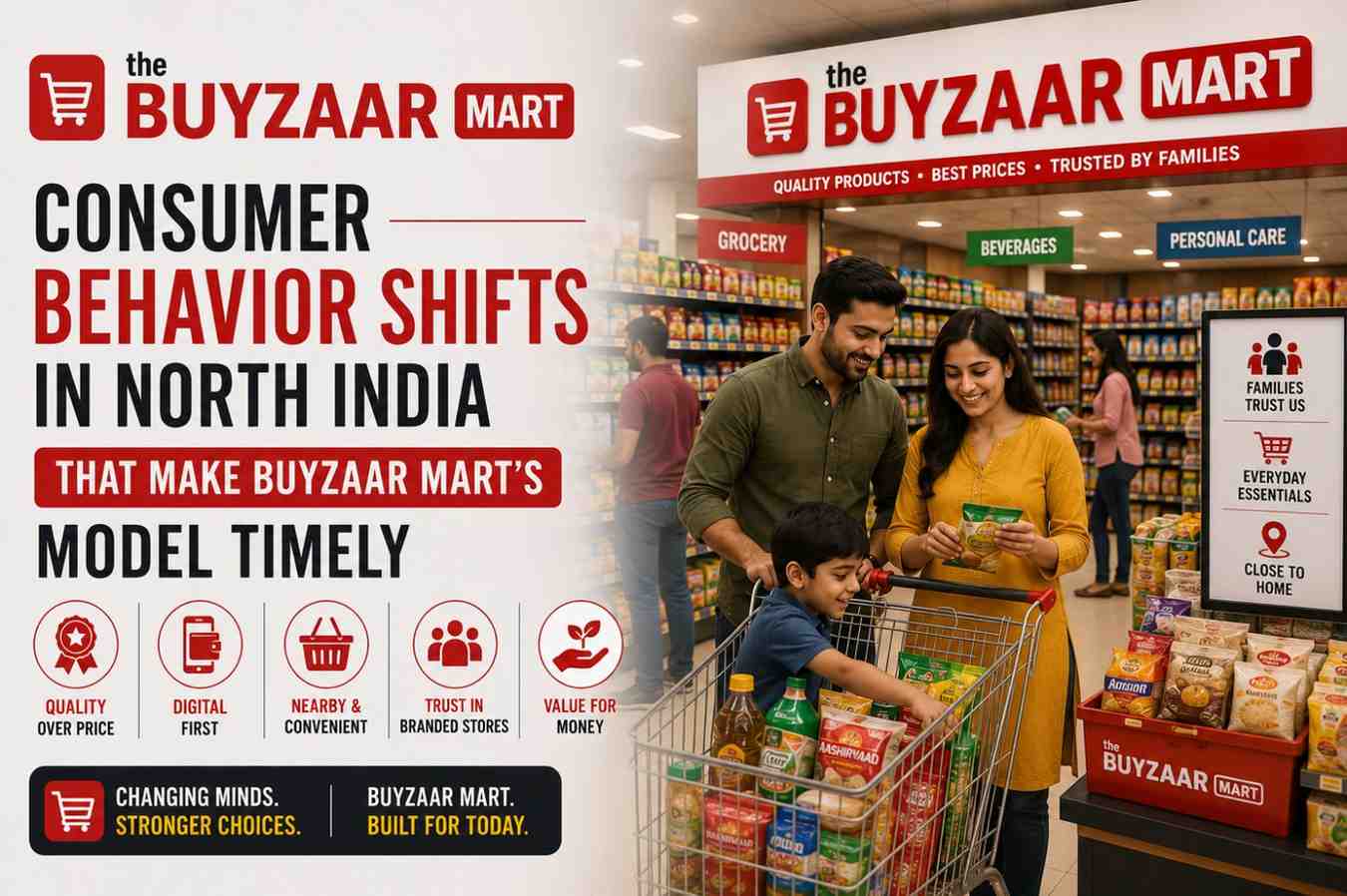
Consumer Behavior Shifts in North India That Make Buyzaar Mart's Model Timely (2026)
Seven deep consumer behaviour shifts are reshaping how North India's middle class shops for groceries in 2026 — and every single one points toward exactly what Buyzaar Mart's franchise model is built to deliver.
Timing is one of the most underrated elements of business success. The right product in the wrong market moment can struggle for years. The same product in the right moment — when consumer behaviour has shifted to meet it — can grow almost on its own momentum. Buyzaar Mart is not a new idea in grocery retail. Organised, branded, tech-enabled neighbourhood grocery stores have existed in various forms for decades in Indian metros. What is new in 2026 is the consumer behaviour environment in North India's tier-2 cities — and that environment has shifted in seven distinct, measurable, and largely permanent ways that make Buyzaar Mart's franchise model not just viable but exceptionally timely. Understanding these shifts is not just useful context for a franchise investor. It is a genuine business case — explaining why a Buyzaar Mart store opened in the right North Indian neighbourhood in 2026 will grow faster, build loyalty deeper, and sustain profitability longer than the same store would have in 2018 or even 2022. Here is what has changed — and why it matters.
The Big Picture First
India's overall retail market is large and growing fast, and the country's middle class — defined by rising discretionary incomes — is expanding rapidly and expected to grow substantially further by the end of the decade. Regional data shows North India posting some of the strongest recent annual retail growth of any region in the country, confirming that North India is not just participating in India's retail expansion but leading it. These headline numbers matter. But they do not tell you why consumers in Lucknow, Kanpur, Meerut, Dehradun, and Saharanpur are behaving differently in 2026 than they did three years ago. The seven shifts below do.
Shift 1 — The Premiumization of Everyday Products Has Reached Tier-2 Cities
This is perhaps the most consequential consumer behaviour shift of the last two years, and it is happening faster than most retail brands anticipated.
- •India's upgrade behaviour — where consumers trade up from economy to mid-premium SKUs — has migrated well beyond the metros, with major FMCG and paint brands reporting premiumization-led volume growth from tier-2 and tier-3 cities
- •A family in Kanpur that bought loose atta two years ago is now buying a branded packaged atta. A family buying local hair oil is now buying a branded advanced oil or serum. A family buying loose dal is now buying a branded packaged dal. This is not aspiration — it is a permanent, income-driven behavioural change
- •Branded goods across categories such as beverages, food, and cosmetics are increasingly becoming part of everyday consumption and lifestyle for Indian consumers
The critical implication for organised grocery retail: premiumizing consumers need a store that stocks the brands they are upgrading to. An unorganised kirana that carries three varieties of loose atta and one brand of refined oil cannot serve a consumer who is now brand-specific and variant-conscious in her purchasing. A Buyzaar Mart store with 50+ FMCG brand partnerships and a structured, well-displayed branded product range is precisely what this consumer has been looking for. Buyzaar Mart's product catalogue — HUL, ITC, Nestlé, Tata Consumer, Dabur, Patanjali, P&G, Adani Wilmar, Britannia, Marico, Haldiram's — is essentially a map of where tier-2 North India's premiumization journey is headed, product by product.
Shift 2 — Digital Payment Adoption Has Made Organised Retail Feel Natural
The UPI revolution has done something that few commentators initially predicted: it has not just changed how people pay, it has changed where they feel comfortable shopping.
- •India's retail market is witnessing a gradual shift from cash-on-delivery to digital payment modes such as UPI, reflecting rising adoption of digital transactions across all shopping contexts
- •A consumer who regularly uses PhonePe, Google Pay, and UPI for everyday payments has fundamentally different expectations of a retail environment — she expects digital payment options to work seamlessly, a proper receipt, and billing that is fast, transparent, and error-free
- •These expectations are naturally met by a Buyzaar Mart store's POS-enabled billing system, and are fundamentally incompatible with the informal, cash-dominated, no-receipt culture of most unorganised kirana stores
The practical effect: digital payment adoption in tier-2 North India has created a large consumer population that is behaviourally pre-adapted to organised retail, even if many of them have not yet encountered a quality organised grocery store in their own neighbourhood. Every digital payment app transaction a North Indian middle-class consumer makes is making her slightly more comfortable with — and slightly more expectant of — the organised retail experience that a Buyzaar Mart store delivers.
Shift 3 — Post-Pandemic Hygiene Consciousness Has Become Permanent Consumer Infrastructure
COVID-19 changed Indian consumer behaviour in many ways that proved temporary. The shift in food hygiene expectations proved permanent.
- •Before 2020, a large share of North Indian grocery consumers accepted loose, unpackaged staples from unorganised retail without significant concern. The pandemic experience — with its intense focus on contamination, surface hygiene, and product handling — permanently recalibrated what acceptable food purchasing looked like for millions of households
- •The pandemic drove significant acceleration in consumer adoption of organised grocery formats, driven by the need for contactless delivery and packaged products — and even after the pandemic, these preferences have ensured continued patronage of organised retail
- •A consumer who switched to packaged atta from a branded store during the pandemic because she was concerned about contamination in loose products has largely not switched back. Her hygiene threshold has been permanently raised
This shift benefits Buyzaar Mart directly and structurally — every product in a Buyzaar Mart store is packaged, sealed, FSSAI-compliant, and from a verified manufacturer. The store environment itself — uniform design, clean floors, organised shelving — communicates hygiene standards that reinforce the consumer's post-pandemic purchasing logic every time she walks in.
Shift 4 — The North Indian Middle Class Is Expanding at Its Fastest-Ever Rate
The consumer base that Buyzaar Mart's franchise model is designed to serve is not stable — it is actively growing in the specific geographies where Buyzaar Mart operates.
- •A large and growing share of India's population now lives in urban areas, and a significant share of Indians are entering middle-income brackets, with the middle class expected to expand substantially by the end of the decade
- •This expansion is concentrated in exactly the tier-2 North Indian cities — Lucknow, Kanpur, Meerut, Gurgaon, Faridabad, Dehradun, Saharanpur, Agra, Bareilly — where Buyzaar Mart is building its franchise network
- •The households entering the middle class in these cities are not just gaining income — they are gaining the consumption behaviours, brand preferences, and quality expectations that come with middle-class status. They are the natural new customer base for an organised grocery franchise
A Buyzaar Mart franchise store opened in a developing residential colony in 2026 will have a larger and more affluent catchment in 2028 than it does today — the consumer base is not static, it is actively expanding around the store.
Shift 5 — Nuclear Family Formation Is Driving Convenience-First Grocery Shopping
The structure of the North Indian household is changing — and this structural change has direct implications for how and where families shop for groceries.
- •The joint family — multiple generations sharing a single large household — has been the dominant residential unit across North India for generations. It is giving way, in urban and semi-urban tier-2 cities, to smaller nuclear family units of two to four people
- •Nuclear families have different grocery shopping patterns than joint families: smaller basket sizes per trip, higher trip frequency, stronger preference for convenience, lower tolerance for inconvenience or unreliability, and higher per-capita spending on branded products
- •A nuclear family in a Lucknow apartment does not have a grandmother who knows every kirana owner in the neighbourhood by name and has a thirty-year relationship with her regular shopkeeper. She is choosing her grocery store based on product availability, pricing transparency, and shopping experience — all of which favour an organised Buyzaar Mart franchise over an unorganised kirana
- •Urbanisation has led to a shift from traditional retail formats to modern retail platforms, with urban consumers seeking convenience and variety — and demand for premium products is rising as urban consumers increasingly seek products that enhance quality of life
The nuclear family formation trend in North India's tier-2 cities is creating exactly the consumer demographic that Buyzaar Mart's neighbourhood store model is optimally designed to serve.
Shift 6 — Health and Wellness Consciousness Is Reshaping FMCG Purchase Decisions
The health and wellness trend in Indian consumer behaviour is not a niche phenomenon confined to metro gym-going millennials. It has entered the mainstream consciousness of middle-class households across North India, and it is directly reshaping what people buy at their grocery store.
- •A post-pandemic wave of health consciousness has swept through product categories from biscuits to dairy, and is one of the defining consumer behaviour trends in India heading into 2026
- •In practical terms: a consumer who previously bought regular refined flour is now considering multigrain atta. A consumer who bought standard toor dal now looks for the unpolished or organic variant. A consumer buying biscuits now reads the ingredients list — this health awareness is purchasing awareness, and it drives consumers toward organised retail where product information is visible, labelling is complete, and branded health variants are stocked
- •The health-conscious North Indian grocery shopper needs to see nutritional information, ingredient lists, and product certifications on everything she buys — standards that packaged, branded FMCG products deliver and that loose, unorganised kirana retail structurally cannot
Buyzaar Mart's product portfolio — which includes health-positioned products from Dabur, Patanjali, Tata Consumer's Tata Sampann, and HUL's wellness range — directly addresses this shift. A well-organised Buyzaar Mart store with a visible health and wellness section is not just meeting a consumer preference, it is serving a growing, income-supported consumer demand that unorganised retail cannot satisfy.
Shift 7 — Brand Loyalty Is Weakening — But Quality Loyalty Is Strengthening
This is the most nuanced of the seven shifts, and the one most directly relevant to how a Buyzaar Mart franchise builds its customer base.
- •Brand loyalty is decreasing in the Indian consumer market as customers actively pursue different brands and alternative products — across demographics, quality and value are increasingly weighed above brand loyalty
- •At first glance, weakening brand loyalty sounds like bad news for a franchise model built on FMCG brand partnerships. But the nuance matters: what is weakening is unconditional brand loyalty — automatic purchase of a specific brand out of habit. What is strengthening is quality and value loyalty — a consistent preference for products and stores that deliver reliable quality at fair prices
- •For a Buyzaar Mart franchise store, this is actually an advantage. Consumers who are no longer unconditionally loyal to a specific branded product are more open to discovering new products — a well-stocked, well-displayed Buyzaar Mart store carrying strong alternatives across every category can earn basket share from consumers who previously went to a specific store for a specific brand
- •The store itself — as a reliable, quality-assured, fairly priced, well-organised shopping environment — becomes the quality constant that the consumer is loyal to, even as her product choices within the store evolve. This is the deeper loyalty that Buyzaar Mart franchise stores are positioned to build — loyalty to the store, not just to a product on its shelf
Consumer preferences in India are rapidly evolving, with a growing inclination toward digital shopping and branded products — a shift that is compelling traditional retailers to modify their strategies. The organised franchise store that adapts to this preference naturally wins the consumers that traditional kirana stores are structurally unable to retain.
How These Seven Shifts Combine — and Why the Timing Is Exceptional
Each of these seven shifts individually creates a tailwind for organised grocery franchise retail in North India. Together, they create something more powerful — a convergent consumer moment where multiple independent forces are all pointing in the same direction at the same time. The North Indian middle-class consumer in 2026 is:
- •Buying branded products instead of loose alternatives — Shift 1
- •Comfortable with digital payments and tech-enabled retail environments — Shift 2
- •Expecting packaged, hygienically stored, quality-assured products — Shift 3
- •Part of an expanding middle class that is growing every month — Shift 4
- •Living in a smaller nuclear family that prioritises convenience and reliability — Shift 5
- •Health-conscious and reading labels and ingredient lists — Shift 6
- •Loyal to quality and value rather than habit and familiarity — Shift 7
This consumer does not yet always have a Buyzaar Mart store in her neighbourhood. When she does, the alignment between her evolved preferences and what that store delivers is immediate, obvious, and sticky. She does not need to be convinced that organised grocery retail is better than what she has been using — she already knows. She just needs a quality organised store to appear in her neighbourhood. That is the opportunity that Buyzaar Mart franchise partners are stepping into in 2026 — not a market they need to create, but a market that has already created itself and is waiting for the right store to show up.
What This Means for a Franchise Investor Evaluating 2026 as Their Entry Point
- •The consumer behaviour shifts described in this guide are not speculative trends — they are observable, data-supported, and already in motion across North India's tier-2 cities
- •They are also structural rather than cyclical, meaning they will not reverse when economic conditions change. A consumer who has moved from loose atta to a branded packaged atta does not go back. A consumer who has adopted UPI does not return to cash-only retail. A consumer who has developed post-pandemic hygiene expectations does not lower them again
- •The franchise investor who enters the North Indian organised grocery market in 2026 is entering at the inflection point — when consumer behaviour has shifted sufficiently to make demand reliable and sustainable, but before organised retail supply has caught up with that demand in most tier-2 localities
- •India's organised retail is expected to capture a significantly larger share of the total market by 2030 than it does today, driven by rising incomes, faster digital adoption, and the rise of an aspirational consumer class. The gap between where organised retail is today and where it will be in 2030 is the market opportunity that Buyzaar Mart franchise partners are investing into right now
Final Thoughts
- •Consumer behaviour does not shift on a schedule that waits for business readiness. It shifts when social, economic, and technological forces converge, and in North India's tier-2 cities, that convergence is happening right now, in 2026, across seven distinct and measurable dimensions
- •North India's food and grocery sector has posted some of the strongest recent growth of any region, part of a broader organised retail expansion driven by changing consumer behaviour and a growing trend towards organised shopping. That growth is not accidental — it is the measurable output of the seven consumer behaviour shifts documented in this guide
- •Buyzaar Mart's franchise model is not ahead of its time — it is precisely on time. The neighbourhood, tech-enabled, FMCG-brand-stocked, quality-controlled, transparently priced organised grocery store is exactly what North India's evolved consumer is actively looking for in 2026
- •The franchise investor who understands these shifts is not making a bet on the future. She is making an informed decision about a consumer transformation that has already happened, and building a business to serve it before her local market fills with competition
Build the store North India's new consumer is already looking for. Apply at thebuyzaarmart.com/franchise or call 9217991727 (Monday to Saturday, 9 AM to 7 PM)
Frequently Asked Questions
Are these consumer behaviour shifts happening in smaller tier-2 cities or only in large ones like Lucknow and Kanpur?
The shifts are most advanced in larger tier-2 cities but are actively spreading to smaller ones — Saharanpur, Moradabad, Bareilly, Hapur — driven by smartphone adoption, UPI penetration, and infrastructure development that follows the same arc slightly behind the leading cities.
Does premiumization mean consumers in tier-2 cities are spending more on every grocery trip?
Yes — average basket sizes are rising as consumers add branded variants of products they previously bought in loose or unbranded form. This directly benefits organised franchise stores that stock the premium variants consumers are upgrading to.
How does the weakening of brand loyalty affect a Buyzaar Mart store's product range decisions?
It means stocking a strong range across categories rather than betting heavily on one brand per category. Consumers want quality options — a Buyzaar Mart store that carries two or three credible options per subcategory serves the quality-loyal consumer better than one that stocks a single brand per shelf.
Is health consciousness among North Indian consumers creating demand for specific product types?
Yes — multigrain atta, unpolished pulses, herbal personal care, immunity-boosting beverages, and low-sugar snack variants are all seeing faster growth in tier-2 markets. A well-managed Buyzaar Mart store should dedicate visible shelf space to these variants and stock at least two or three health-positioned SKUs per key category.
Why is 2026 specifically the right time to open a grocery franchise in North India rather than waiting?
Because the consumer behaviour shifts are already in place but organised retail supply has not caught up in most tier-2 localities — first-mover advantage is still available. Waiting means entering a market where competitors have already claimed the loyalty of consumers who are currently unserved.