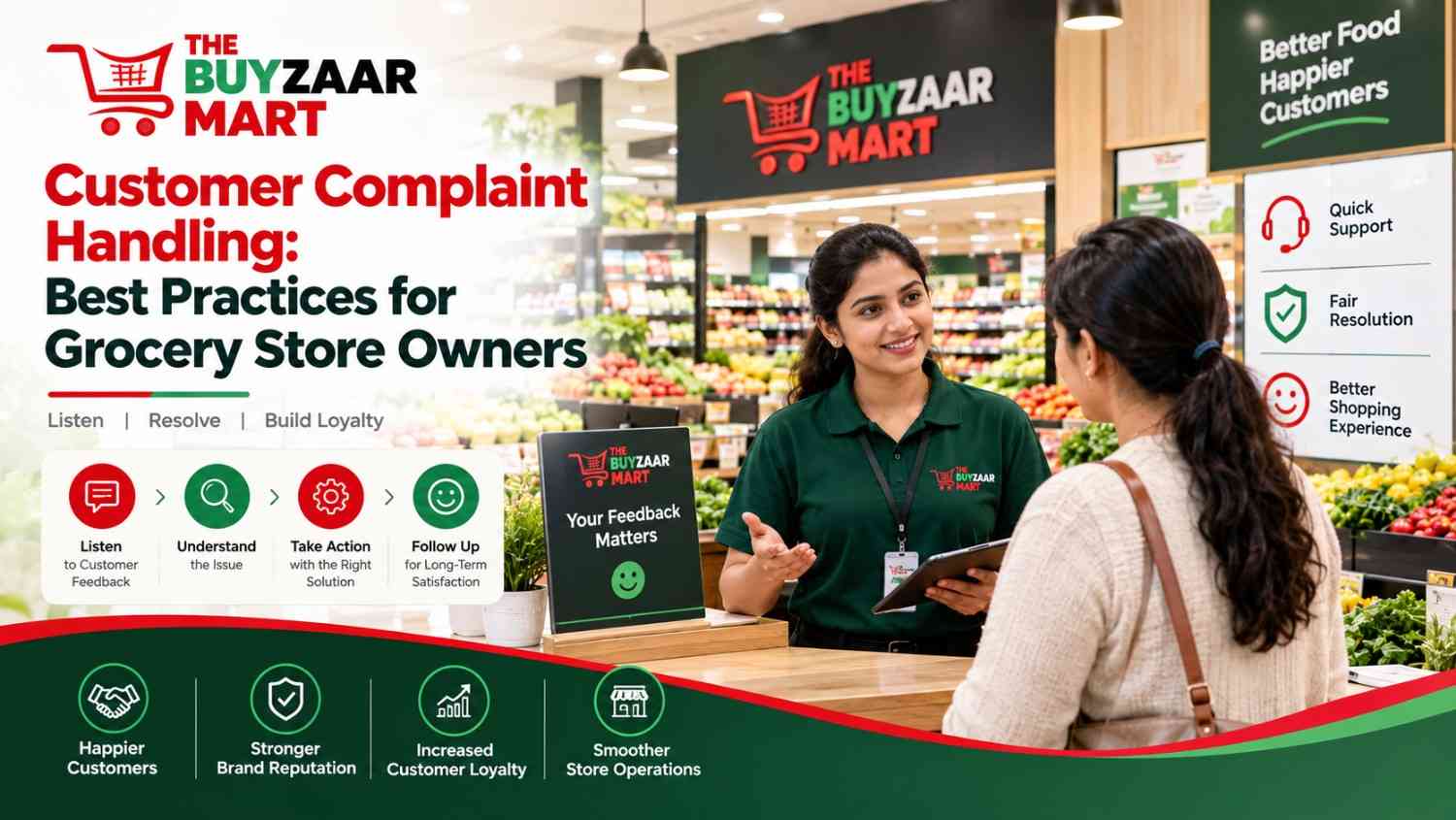
Customer Complaint Handling: Best Practices for Grocery Store Owners
Learn customer complaint handling best practices for grocery store owners: listen, resolve fast, track issues, train staff and turn complaints into loyalty.
A grocery store serves the same households again and again, so one unresolved complaint can cost many future visits. Complaints show exactly where the store is falling short, from expired products and billing errors to rude service or missing stock. Customers who see a problem fixed quickly and politely often become more loyal than customers who never had a problem. Strong complaint handling protects the store's reputation in the neighbourhood, where word-of-mouth travels fast. The Buyzaar Mart's neighbourhood retail approach is built on trust, transparency and consistent service standards, and complaint handling is where that promise is tested every day.
Why Complaints Are a Business Opportunity
- •A grocery store serves the same households again and again, so one unresolved complaint can cost many future visits.
- •Complaints show exactly where the store is falling short, from expired products and billing errors to rude service or missing stock.
- •Customers who see a problem fixed quickly and politely often become more loyal than customers who never had a problem.
- •Strong complaint handling protects the store's reputation in the neighbourhood, where word-of-mouth travels fast.
- •The Buyzaar Mart's neighbourhood retail approach is built on trust, transparency and consistent service standards, and complaint handling is where that promise is tested every day.
Why Customers Complain in a Grocery Store
Product and Quality Issues
- •Expired, damaged, stale or wrongly stored products are the most serious complaints in a food retail business.
- •Fresh items that look or smell poor quickly reduce customer confidence in the whole store.
- •Wrong pack sizes, missing seals and mislabelled items also lead to disputes.
Billing and Pricing Problems
- •Customers complain when the billed price differs from the shelf price or when offers are not applied.
- •Double billing, wrong quantities and missing change create instant frustration at the counter.
- •A modern POS-enabled billing system helps reduce such errors and makes verification easier.
Service and Availability Issues
- •Rude behaviour, slow checkout, long queues and unhelpful staff are common service complaints.
- •Frequent stock-outs of daily-need items push customers to shop elsewhere.
- •Untidy aisles, blocked passages and poor cleanliness affect the overall shopping experience.
Build a Complaint-Friendly Store Culture
Treat Every Complaint as Feedback
- •Train the team to see complaints as useful information, not as personal criticism.
- •Encourage staff to report every complaint, even small ones, so patterns are visible early.
- •Share common issues in short team meetings so everyone learns from them.
Make It Easy to Complain
- •Display a clear contact number or email on the counter and on the bill, so customers know where to reach you.
- •Give customers a simple, direct way to speak up, whether at the counter, by phone or through a feedback form.
- •Customers who can complain easily are less likely to vent publicly on social media or review sites.
The Core Steps of Handling a Complaint
Step 1: Listen Without Interrupting
- •Let the customer explain the full issue before you respond.
- •Maintain calm body language, make eye contact and avoid arguing or defending the store too early.
- •Listening shows respect and often cools down an angry customer on its own.
Step 2: Acknowledge and Apologise Sincerely
- •Use simple, genuine phrases such as 'I understand, and I am sorry for the inconvenience.'
- •Accept responsibility on behalf of the store, even if the cause is still unclear.
- •Avoid blaming the customer, the supplier or the staff member in front of the customer.
Step 3: Clarify the Facts
- •Ask short, polite questions to understand the product, bill number, date and what went wrong.
- •Check the product, packaging, expiry date and bill on the spot.
- •Note the details clearly so the customer does not have to repeat the story to another staff member.
Step 4: Offer a Fair Solution
- •Offer a clear remedy such as a replacement, refund, exchange, credit note or correction of the bill.
- •Give the customer a choice where possible, since it restores a sense of control.
- •Be honest about what you can and cannot do, and avoid promises you cannot keep.
Step 5: Act Quickly and Follow Up
- •Resolve simple issues immediately at the counter without sending the customer from person to person.
- •For complex issues, give a specific time by which you will respond and keep that promise.
- •Follow up by phone or message after the fix to confirm the customer is satisfied.
Handling Common Grocery Complaints
Expired or Damaged Products
- •Replace the item or refund the amount immediately after verifying the product and bill.
- •Remove similar items from the shelf and check the whole batch and storage area.
- •Retail models that include a buyback approach for expired or damaged goods make this easier, because the store is not left carrying the loss alone.
Billing and Price Disputes
- •Re-check the bill and compare it with the shelf price and the POS record.
- •Correct genuine mistakes at once and refund any excess amount without argument.
- •Review price labels and system updates regularly to prevent the same error from repeating.
Poor Service or Staff Behaviour
- •Apologise to the customer first, then speak to the staff member privately.
- •Use the incident as a coaching opportunity and not just a reason for punishment.
- •Repeat training on greeting, patience and problem-solving where needed.
Out-of-Stock and Availability Complaints
- •Offer a suitable alternative, or promise to arrange the item and inform the customer when it arrives.
- •Review sales and demand data to understand why the product ran out.
- •Smart stocking based on demand prediction helps reduce these complaints in the first place.
Train Your Team to Handle Complaints Confidently
Basic Skills Every Staff Member Needs
- •Active listening, calm communication and polite language.
- •Product knowledge, so staff can answer questions and spot real quality problems.
- •Clear knowledge of the store's return, refund and replacement policy.
Empower Staff to Solve Problems
- •Give front-line staff authority to solve small issues immediately, within a set limit.
- •Define when a complaint should be passed on to the store owner or manager.
- •Quick decisions at the counter prevent small issues from becoming big arguments.
Practise with Real Scenarios
- •Use short role-play sessions based on real complaints, such as an expired item or a billing mistake.
- •Review what was said well and what could be improved.
- •Repeat the practice regularly, especially when new staff join.
Use Systems and Technology to Track and Prevent Complaints
Record Every Complaint
- •Maintain a simple complaint register or digital log with date, customer details, issue, action taken and result.
- •Tag complaints by type, such as quality, billing, service or availability.
- •A record makes it easier to prove what was done and to spot repeat problems.
Use POS and CRM Data
- •POS-enabled billing helps verify purchases, prices and quantities quickly.
- •Customer relationship management tools help stores recognise repeat customers and follow up on past issues.
- •Data on returns, refunds and complaints shows which products, shifts or suppliers need attention.
Review Patterns Every Week
- •Check which issues appear most often, and fix the root cause instead of repeating the same apology.
- •Share findings with suppliers when a product or batch causes repeated complaints.
- •Track how long complaints take to resolve, and aim to shorten that time.
Prevent Complaints Before They Happen
Keep Quality and Hygiene High
- •Check expiry dates daily and rotate stock using the first-in, first-out method.
- •Follow FSSAI-aligned storage, cleanliness and handling practices.
- •Stores that are FSSAI licensed, GST registered and MSME certified signal compliance and credibility to customers.
Maintain Organised Shelves and Reliable Stock
- •Neat shelves, clear price labels and visible categories reduce confusion and billing disputes.
- •Predict demand, stock smart and keep daily essentials consistently available.
- •Reliable supply and a wide range under one roof reduce frustration for regular shoppers.
Keep Pricing Fair and Transparent
- •Value-conscious pricing builds trust and reduces price-related arguments.
- •Display offers clearly, with dates and conditions, so customers know what to expect.
- •Make sure the shelf price, the system price and the bill always match.
Turn Complaints into Customer Loyalty
- •Thank customers for bringing the issue to your attention, because many customers simply stop shopping without saying anything.
- •Follow up a few days later to confirm that the solution worked.
- •Offer a small gesture of goodwill when the mistake was serious, such as a replacement or a courtesy discount on the next visit.
- •Share improvements with your team, so everyone sees how customer feedback made the store better.
- •Over time, a reputation for fair and friendly problem-solving becomes a strong competitive advantage.
Handling Online Complaints and Reviews
- •Respond to online reviews politely and promptly, using a calm and professional tone.
- •Acknowledge the issue, apologise where needed and invite the customer to contact the store directly.
- •Avoid arguing in public. Move the conversation to a phone call or direct message.
- •Use positive and negative reviews as free market research for the store.
Final Thoughts
- •Customer complaint handling is a core retail skill: listen, apologise, verify, solve, follow up and learn.
- •Trained staff, simple processes and data-backed tracking turn complaints into a source of improvement.
- •Prevention through quality control, smart stocking, clear pricing and good hygiene reduces complaints at the source.
- •Store owners who build a consistent, transparent complaint process earn lasting customer trust, which is the foundation of every successful neighbourhood grocery store.
- •Entrepreneurs who want a store model with tested systems for billing, supply chain, training and support can explore the franchise opportunity at The Buyzaar Mart.
Frequently Asked Questions
Q1. What is the first step in handling a grocery store complaint?
Listen calmly to the full complaint without interrupting, then apologise sincerely.
Q2. How quickly should a grocery store resolve a complaint?
Resolve simple issues immediately at the counter. For complex ones, give a clear time and keep it.
Q3. Should staff be allowed to give refunds or replacements?
Yes, within a set limit. This lets staff fix small problems quickly without waiting for approval.
Q4. How can a store reduce repeat complaints?
Keep a complaint log, review patterns weekly, fix root causes and train staff regularly.
Q5. How should store owners respond to negative online reviews?
Reply politely, acknowledge the issue and invite the customer to continue the conversation privately.
Related Articles

What is FOCM Franchise Model? Complete Guide for Investors
The FOCM Franchise Model — Franchise Owned, Company Managed — is reshaping how investors enter organized retail in India. Learn how Buyzaar Mart's structured system works.

Buyzaar Mart vs Traditional Kirana Store – Which is More Profitable?
Is a traditional kirana store still the most profitable option, or does an organized retail format like Buyzaar Mart offer better long-term growth? A detailed comparison of both retail models.

How to Apply for a Buyzaar Mart Franchise: Step-by-Step Process (2026)
Want to open a Buyzaar Mart franchise in India? Read our complete 2026 step-by-step guide covering eligibility, investment, documentation, and store launch process.