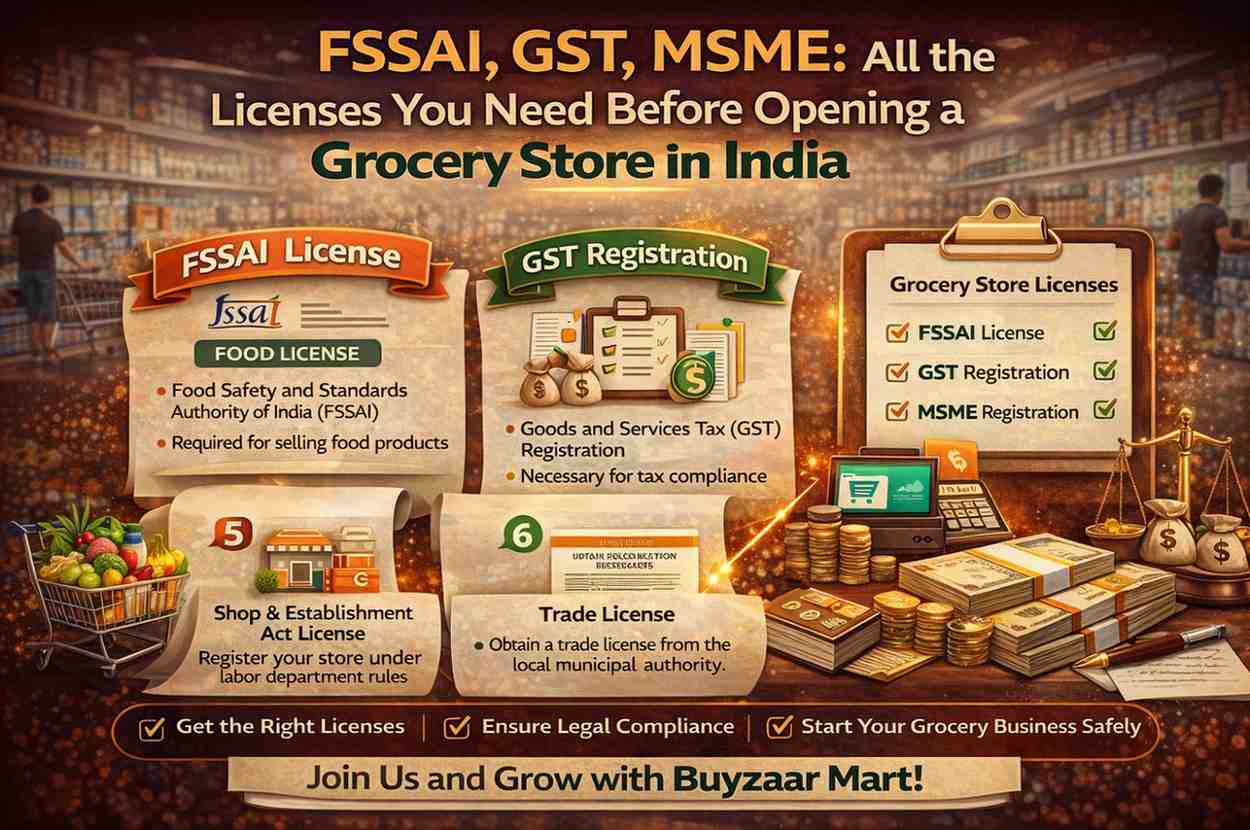
FSSAI, GST, MSME: All the Licenses You Need Before Opening a Grocery Store in India
From FSSAI Registration and GST Compliance to MSME Benefits and Trade Licenses — A Complete Legal Checklist for New Grocery Store Owners in India (2026)
So you have decided to open a grocery store in India. You have scouted a location, done rough math on investment, and started thinking about suppliers. But there is one critical step most first-time store owners either rush through or completely ignore — getting the right licenses in place before Day 1. This is not just paperwork. Running a grocery store without proper licenses can lead to fines, store closure, and legal action. More importantly, the right registrations open doors for you — bank loans, government schemes, supplier credit, and franchise partnerships all require verified compliance documents. At The Buyzaar Mart, we have helped dozens of franchise partners across India — from Noida to Haridwar to Gangoh — navigate this exact process. Whether you are opening an independent kirana or joining a retail franchise model, this checklist applies to you.
Why Legal Compliance Matters Before You Open
Many new store owners ask: 'Do I really need all of this before I open?' The honest answer is yes. Here is why:
Selling packaged food without FSSAI registration is a criminal offence under the Food Safety and Standards Act, 2006. Penalties start at ₹25,000 and can escalate to store seizure. GST registration is mandatory once your annual turnover crosses ₹40 lakhs, and operating without it means back taxes plus interest and penalties. MSME registration is not mandatory, but without it you are leaving subsidised loans, priority sector lending, and government scheme eligibility on the table.
Proper licensing also builds supplier and customer trust. FMCG distributors prefer GST-registered retailers. Banks process loan applications faster for MSME-registered entities. Franchise systems like The Buyzaar Mart require confirmed compliance during onboarding — because we are building a network that customers and regulators can trust.
License 1: FSSAI Registration or License (Most Critical)
The Food Safety and Standards Authority of India (FSSAI) regulates every business that sells food — which includes every grocery store. Before you stock a single shelf, you need FSSAI compliance.
There are three levels based on annual turnover. FSSAI Basic Registration covers businesses with turnover below ₹12 lakhs. Most small kirana stores in semi-urban areas start here. It is state-specific and renewed annually at just ₹100 per year. FSSAI State License is required when turnover is between ₹12 lakhs and ₹20 crores. This is where the majority of growing neighbourhood stores fall. Fee ranges from ₹2,000 to ₹5,000 depending on the state. FSSAI Central License applies to businesses with turnover above ₹20 crores or those operating across multiple states. Most store owners will not need this at launch.
Apply online at foscos.fssai.gov.in. You will need PAN, address proof of premises, identity proof, a passport-size photo, and a list of food products you intend to sell. Basic registration arrives in 7 to 10 working days. State licenses take 30 to 60 days.
Important: Display your FSSAI number on all signage, invoices, and packaging. It is legally required and builds immediate customer trust.
License 2: GST Registration
GST is India's unified indirect tax that replaced VAT, Service Tax, and Central Excise. If your annual turnover crosses ₹40 lakhs (₹20 lakhs in special category states), GST registration becomes mandatory.
Even below the threshold, voluntary GST registration is strongly recommended because it lets you claim Input Tax Credit on purchases, enables B2B invoicing with large distributors, and signals credibility to FMCG brands and wholesale suppliers.
Apply at gst.gov.in. Documents needed include PAN, Aadhaar, proof of business address, bank details with a cancelled cheque, and a passport-size photo. Your GSTIN is typically issued within 3 to 7 working days. Registration is completely free — no government fee.
One thing many new store owners miss: most staple foods like fresh vegetables, fruits, rice, wheat, and pulses are GST-exempt or attract 0% GST. Packaged and branded products attract 5% or 12%. You must correctly classify your inventory under HSN codes when filing monthly GSTR-1 and GSTR-3B returns.
File returns on time every month. Late filing costs ₹50 per day plus 18% annual interest on dues. Consistent compliance history matters enormously when you later apply for a business loan or franchise.
License 3: MSME / Udyam Registration
MSME stands for Micro, Small, and Medium Enterprises. Udyam Registration (formerly Udyog Aadhaar) is the government's digital certification that your business qualifies as an MSME — and it is completely free and instant.
Most independent grocery stores qualify as Micro Enterprises — investment below ₹1 crore and turnover below ₹5 crores.
Why every store owner should register, even though it is not mandatory: You get access to priority sector lending from banks and NBFCs at lower interest rates. You receive legal protection against delayed payments under the MSMED Act. You become eligible for subsidies on ISO certification and government procurement schemes. Most importantly, you can access collateral-free loans up to ₹2 crores under the CGTMSE scheme — a game-changer for first-time entrepreneurs.
For grocery franchise owners, MSME registration directly strengthens your loan application for the franchise investment. Banks like SBI, Bank of Baroda, and Canara Bank have dedicated MSME lending desks that process registered businesses faster and at better rates.
Apply at udyamregistration.gov.in using just your Aadhaar number. The portal is integrated with Income Tax and GST databases, so other details are auto-populated. Your Udyam Registration Certificate arrives the same day. Beware of third-party websites that charge for Udyam registration — the government portal is the only legitimate source and it costs nothing.
License 4: Shop and Establishment (S&E) Act Registration
Every state in India has its own Shops and Commercial Establishments Act. This license regulates working hours, employee wages, leave policies, and labour standards for retail stores — and it is one of the first things a municipal inspector will ask for.
Registration is mandatory in virtually every state and must be done within 30 days of starting operations. States like Maharashtra, Delhi, Karnataka, and Uttar Pradesh enforce this strictly. The registration is done with your local labour department or through state government portals (many states now use Shram Suvidha integration).
Documents needed: identity and address proof of proprietor, proof of business premises, number of employees, nature of business, and PAN. Processing takes 7 to 15 days and fees typically range from ₹125 to ₹1,000 per year for a small store.
If you are opening in Uttar Pradesh — The Buyzaar Mart's primary operating region — registration under the UP Dukaan Aur Vanijya Adhisthan Adhiniyam is mandatory. UP's single-window clearance mechanism makes this straightforward.
License 5: Trade License from Local Municipal Body
A Trade License (also called a Municipal License or Business License) is issued by your local municipal corporation or panchayat. It certifies that your business is permitted to operate in that commercial zone and that premises comply with local bylaws.
Without it, you risk closure notices from the municipal authority. It is also required when applying for a business bank account, commercial utility connections, and fire safety certificates.
Apply at your local municipal office or through the state's urban development portal. You need identity proof, address proof of premises, NOC from the building owner, and a nature-of-business declaration. Processing takes 15 to 30 days. Annual fees typically range from ₹500 to ₹5,000 depending on city and store size.
License 6: Legal Metrology (Weights and Measures) Certification
If your grocery store sells loose commodities by weight — rice, pulses, flour, dry fruits — or uses weighing scales of any kind, you must register under the Legal Metrology Act, 2009 with the state Weights and Measures Department.
Your weighing equipment must be verified and stamped by an authorized inspector at least once a year. Selling with uncertified equipment can attract fines of ₹10,000 or more. This is a license many first-time store owners overlook — do not be one of them.
License 7: Fire Safety NOC (Larger Stores)
If your store is larger than 300 square meters or located inside a commercial complex, you will need a No Objection Certificate from the local fire department. Even for smaller stores, having basic fire safety infrastructure — extinguishers, clearly marked exits — is good practice, especially if you stock flammable products or cooking gas cylinders.
Complete License Checklist — In the Right Order
1. PAN Card (proprietor or entity) — Day 1 prerequisite. 2. MSME / Udyam Registration — Free and instant, apply first. 3. FSSAI Basic Registration or State License — Before stocking any inventory. 4. GST Registration — Once PAN and business address are confirmed. 5. Shop and Establishment License — Within 30 days of opening. 6. Trade License (Municipal Corporation) — Before or at launch. 7. Legal Metrology Registration — If selling loose goods by weight. 8. Current Account Opening — Use all above documents. 9. Fire Safety NOC — For stores over 300 sq ft or in commercial complexes.
How The Buyzaar Mart Franchise Makes This Easier
The most common question from aspiring franchise partners is: 'Will I handle all of this on my own?' Not when you join The Buyzaar Mart.
As part of our complete franchise support model, our operations team provides a state-specific compliance checklist, connects you with verified consultants for FSSAI and GST at preferential rates, reviews your documents before submission to avoid rejections, and flags state-specific requirements most first-time owners miss. You focus on building your customer base. We handle the backend complexity.
This is the Buyzaar Mart promise — every partner opens with confidence, not confusion.
Conclusion: Open Your Store the Right Way
Opening a grocery store in India in 2026 is one of the smartest business decisions you can make — especially in Tier 2 and Tier 3 cities where organised retail is still underpenetrated and demand is rising. But sustainable success starts with a legal foundation.
FSSAI protects your customers and reputation. GST keeps you supplier-ready and penalty-free. MSME unlocks the financial system. Shop Act and Trade License keep local authorities off your back.
The stores that struggle are the ones that said 'I will sort compliance later.' The stores that thrive walked in fully prepared. Start your checklist today. And if you want a franchise partner who handles every step with you — from legal setup to grand opening — The Buyzaar Mart is ready.
Ready to Open Your Store the Right Way? Take Action Now!
You now have the complete licensing checklist to open your grocery store legally and confidently in India. Don't let compliance confusion delay your launch — especially when prime locations in cities like Bareilly, Moradabad, and Lucknow are filling up fast.
Apply for a Buyzaar Mart franchise today and get complete compliance support from Day 1.
Get a customized state-specific compliance checklist for your location.
Access verified FSSAI and GST consultants at preferential rates.
Book a free 15-minute consultation with our franchise operations team.
📞 Phone: 9217991727
📧 Email: info@thebuyzaarmart.com
Frequently Asked Questions
Can I start selling before my FSSAI registration is approved?
No. Selling food without at least a pending FSSAI application is a violation of the Food Safety and Standards Act. Apply before purchasing your opening inventory.
What if I skip GST registration and my turnover crosses the limit?
You become liable for all GST owed from the date your turnover crossed the threshold, plus 18% annual interest and penalties. Register voluntarily if you expect your store to grow quickly.
How long does the full licensing process take?
If you apply for everything simultaneously, expect 30 to 45 days. MSME is instant. GST takes 7 days. FSSAI takes 7 to 60 days. Shop Act takes 7 to 15 days. Trade License takes 15 to 30 days.
What is the total cost of all licenses to open a grocery store?
Handling applications yourself through government portals costs approximately ₹3,000 to ₹10,000 for a small to mid-size store. MSME and GST are free. Adding professional consultancy typically costs another ₹5,000 to ₹15,000.
Can a grocery store operate as a sole proprietorship without registering a company?
Yes. Most kirana stores and small grocery shops in India operate as sole proprietorships. You do not need to register a private limited company or LLP. Your personal PAN, FSSAI, GST, and Shop Act registration are sufficient to operate legally as a sole proprietor.
Is a Trade License the same as a Shop and Establishment License?
No, they are different. The Shop and Establishment License is issued by the state labour department and covers employee-related compliance. The Trade License is issued by the local municipal corporation and certifies that your business is permitted to operate at that premises. You need both.
Is MSME registration mandatory to open a grocery store?
No, it is not legally mandatory. But it is highly recommended because it gives you access to collateral-free loans, government subsidies, priority sector lending, and protection against delayed payments — all of which directly benefit a grocery store owner.
Do I need a separate FSSAI license for each product category I sell?
No. Your FSSAI registration or license covers all food categories you declare at the time of application. However, if you later add a new category — such as dairy products or packaged meat — you must amend your FSSAI license to include it.
What is the penalty for running a grocery store without a Trade License?
Penalties vary by state and municipality but most local bodies impose fines ranging from ₹500 to ₹10,000 for operating without a Trade License. Repeated violations can lead to a formal closure notice from the municipal authority.
If I join a grocery franchise like Buyzaar Mart, do I still need my own licenses?
Yes. Even as a franchise partner, all licenses — FSSAI, GST, Shop Act, Trade License, and MSME — must be registered in your own name or your business entity's name. The franchise brand cannot share its licenses with you. However, The Buyzaar Mart franchise team guides you through the entire process so you are never navigating it alone.