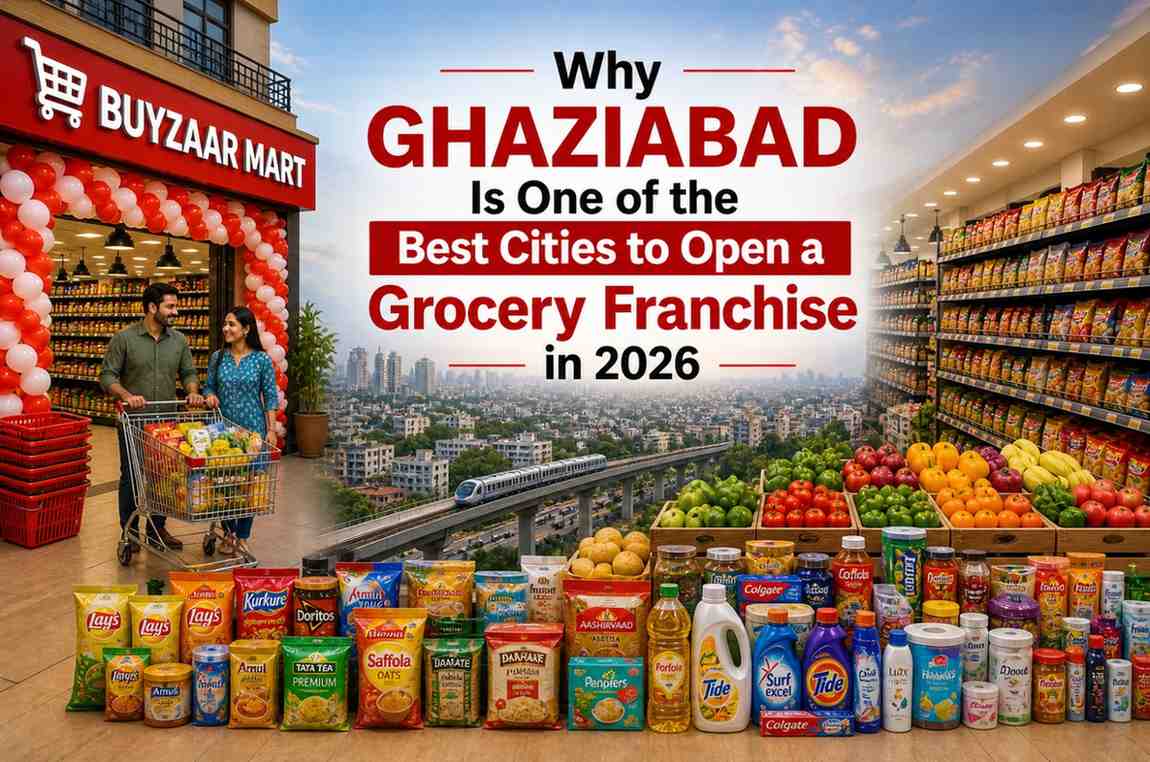
Why Ghaziabad Is One of the Best Cities to Open a Grocery Franchise in 2026
Ghaziabad's booming population, RRTS connectivity, rising incomes & low rental costs make it one of India's top grocery franchise destinations in 2026. Here's the full data-backed case.
Ask most people to name the best cities for retail investment in the Delhi NCR region and they will say Noida. Or Gurugram. Or Delhi itself. Ghaziabad rarely makes the first answer. That is exactly what makes it one of the most compelling franchise investment opportunities in 2026. Ghaziabad — officially the 'Gateway of Uttar Pradesh' — sits at the eastern edge of Delhi, carrying a population of over 3.4 million people, a per capita income of ₹2,11,505, a literacy rate of 84.78%, and a retail economy that is structurally underserved by organised grocery chains relative to its size and spending power. It is the second-largest industrial city in Uttar Pradesh after Kanpur. It is part of the fastest-growing urban region in the country. And as of February 2026, it sits at the junction of the fully operational Delhi-Meerut RRTS — a transit revolution that is reshaping population movement, property values, and consumer catchment areas across the entire western UP corridor. This blog makes the data-backed case for why Ghaziabad is not just a good city to open a grocery franchise — it is one of the best cities in India to do it right now.
Reason 1: A Population of 3.4 Million — With Demand That Organised Retail Has Not Yet Fully Served
The foundational reason any retail franchise succeeds is simple: enough people, close enough, spending often enough. On all three counts, Ghaziabad delivers. According to official data from the Ghaziabad Municipal Corporation, the city's population stood at approximately 34,06,061 as of January 2025 — and that figure continues to grow rapidly, driven by affordable housing relative to Delhi, consistent job creation in Ghaziabad's industrial sector, and a steady flow of migrants from across western and central Uttar Pradesh.
Ghaziabad's decadal population growth rate has historically outpaced the Uttar Pradesh state average. In the 2001 to 2011 census period, the city's population grew by 42.3 percent — significantly above UP's average of 25.8 percent. That growth trajectory has continued in the years since, as new residential developments have expanded the city's footprint across zones like Raj Nagar Extension, Indirapuram, Vaishali, Vasundhara, Kavi Nagar, and Vijay Nagar.
Here is the key insight for a grocery franchise investor: a large, growing, dense population with daily grocery needs represents recurring, predictable, weather-proof demand. Unlike discretionary retail categories, grocery and FMCG retail is purchased by every household, multiple times per week, 365 days a year. In a city of 3.4 million people — spread across dozens of residential colonies — the demand for organised neighbourhood grocery stores is essentially infinite relative to the current supply. The organised retail penetration in Ghaziabad still lags significantly behind Delhi and Noida. That gap is not a warning sign. It is a white space — and white space is where franchise opportunity lives.
Reason 2: The Delhi-Meerut RRTS Is Fully Operational — And It Changes Everything for Retail
In February 2026, one of the most significant infrastructure milestones in NCR's modern history was completed. The full 82.15 km Delhi-Meerut Regional Rapid Transit System corridor — connecting Sarai Kale Khan in Delhi to Modipuram in Meerut via Ghaziabad — became entirely operational on 22 February 2026. The Namo Bharat rapid rail trains run at speeds of up to 160 km/h, with services running every 10 minutes. The journey from Sarai Kale Khan in Delhi to Ghaziabad takes approximately 18 minutes. The full Delhi-to-Meerut corridor takes just 55 minutes. The system has already served more than 10 million passenger journeys since its phased launch in October 2023.
For a grocery franchise investor, the RRTS matters for several interconnected reasons. First, transit infrastructure drives population density. Areas near RRTS stations in Ghaziabad — Sahibabad, Ghaziabad station, and key zones along the NH-24 corridor — are attracting rapid residential development. Every new residential development is a new catchment area for a neighbourhood grocery store. Second, RRTS stations create retail hubs — in every city where rapid transit has been introduced, the surrounding areas become commercially dense. Third, property values and consumer spending rise together. Data from PropEquity and real estate analysts shows that property prices in Ghaziabad near RRTS stations surged by 30 to 67 percent in several areas following the corridor's phased opening.
Beyond the Delhi-Meerut RRTS, Ghaziabad has been confirmed as the origin point of the planned Ghaziabad-Jewar RRTS — a ₹20,640 crore corridor connecting Ghaziabad to Noida International Airport at Jewar via Greater Noida. The Ghaziabad station on this network is being built with four platforms specifically designed to serve multiple RRTS corridors — making it one of the most strategically important transit nodes in all of NCR. No other Tier-2 adjacent city in India sits at the intersection of this much transit investment.
Reason 3: Rising Incomes and an Aspirational Middle-Class Consumer Base
Ghaziabad's economy is fundamentally anchored in industry. The district is the second-largest industrial centre in Uttar Pradesh, with engineering goods as its One District One Product (ODOP) designation — reflecting the depth and diversity of its manufacturing base. Banks, insurance, IT, and service sectors are identified as high-growth employment areas. The per capita income of the district stands at ₹2,11,505 — well above the Uttar Pradesh state average. The standard of living in Ghaziabad is rising consistently, with many residents enjoying increased disposable incomes.
What this means in practical retail terms: Ghaziabad is not a low-income market where price is the only consideration. It is a market of aspirational, middle-class consumers — working in industry, IT, services, and government — who have money to spend on quality products and who are actively upgrading their shopping habits from traditional kirana stores to organised retail formats. A household that used to buy loose pulses from a neighbourhood vendor is now buying branded, packaged products. A family that used to visit the weekly sabzi mandi is now looking for a clean, organised store where they can buy fresh vegetables and FMCG products in a single visit.
The combination of rising incomes, a literate population with an 84.78% literacy rate, strong digital adoption driven by NCR proximity, and a growing awareness of modern retail standards makes Ghaziabad's consumer base one of the most receptive to an organised neighbourhood store model in all of Uttar Pradesh.
Reason 4: Lower Operational Costs Than Delhi or Noida — With the Same Consumer Access
One of the most financially compelling advantages of opening a grocery franchise in Ghaziabad rather than Delhi or Noida is cost structure. Commercial rental costs in Ghaziabad are substantially lower than comparable locations in Delhi and central Noida — even though Ghaziabad residents have full access to Delhi's economy, jobs, and consumer culture via excellent road and now rail connectivity. This cost asymmetry is a direct financial advantage for franchise operators.
In Ghaziabad's residential zones, commercial rents for small to mid-sized retail spaces typically range from ₹40 to ₹90 per sq. ft. per month, depending on the specific locality and street type. A well-located Mini Mart of 700 sq. ft. in a high-footfall residential area might cost ₹30,000 to ₹60,000 per month in rent — a fraction of what equivalent space would cost in Noida Sector 18 or Delhi's Rohini or Dwarka markets. This lower cost base has a direct, computable impact on your break-even and profitability timeline. Every rupee saved in monthly fixed costs is a rupee that reaches your bottom line faster.
Labour costs in Ghaziabad are similarly competitive. Staff salaries for store assistants and billing counter operators reflect the local wage market, which is more accessible than equivalent roles in Delhi or Gurugram. With a well-run Buyzaar Mart Mini Mart typically requiring 2 to 3 staff members, this operational cost advantage accumulates meaningfully over time. Lower rents. Lower labour. NCR-equivalent consumer access. That combination is rare — and it is exactly what Ghaziabad offers a grocery franchise investor in 2026.
Reason 5: A City Built for the Neighbourhood Store Model
Ghaziabad's urban character is fundamentally shaped by its residential density and colony-based geography. Unlike Delhi's concentrated commercial markets or Noida's sector-based planning, Ghaziabad is a city of neighbourhood pockets — Indirapuram, Vaishali, Vasundhara, Raj Nagar Extension, Kavi Nagar, Vijay Nagar, Mohan Nagar, Crossings Republik — each with its own dense, loyal, daily-shopping population. This geography is perfectly aligned with the Buyzaar Mart franchise model — a smart neighbourhood store serving the daily needs of residents within a 2 to 3 km radius.
The Ghaziabad Master Plan 2031 adds further momentum to this story. The plan includes 22 new residential sectors across the city, ongoing metro extensions in Indirapuram, Vaishali, and Mohan Nagar, and the development of new commercial hubs across the city's expanding zones. Each new residential sector that comes online — with hundreds of new households — is a fresh catchment area for a neighbourhood franchise store.
Several national and international retail brands are already setting up outlets in Ghaziabad, attracted by this growth potential. The presence of these brands confirms that Ghaziabad's retail market is being validated by well-resourced operators with data-driven site selection processes. But it is also a reminder that the window to establish early presence — before the market matures — is finite. The franchise operators who secure prime neighbourhoods in Ghaziabad in 2026 will have a significant head start over those who wait.
Reason 6: Ghaziabad Is Buyzaar Mart's Operating Territory — Deep Local Support Included
For entrepreneurs considering a grocery franchise specifically, there is one more compelling reason to choose Ghaziabad: it is in the heart of Buyzaar Mart's active franchise network. Buyzaar Mart operates across cities in Uttar Pradesh's western region — with active and expanding franchise presence across Noida, Meerut, Saharanpur, Bulandshahr, and the broader Delhi-adjacent UP corridor. Ghaziabad, as the geographical bridge between Delhi and this western UP network, sits at the core of the brand's operational territory.
What this means practically for a Ghaziabad franchise partner: the supply chain infrastructure, logistics routes, and operational support network that Buyzaar Mart has built across this region are already optimised for Ghaziabad. Inventory deliveries, brand support visits, and operational guidance are not being provided from a distant head office — they are coming from a regional network that treats Ghaziabad as a priority market. This translates directly into faster store setup, more reliable supply chain performance, and more responsive operational support — all of which matter enormously in the critical first six to twelve months of a new franchise store.
The Ghaziabad Franchise Opportunity in Numbers
Population: 3.4 million+ residents with daily grocery needs and rising spending power. Per capita income: ₹2,11,505 — well above UP state average, reflecting industrial and service sector wealth. Literacy rate: 84.78% — high-literacy consumers who are digitally savvy, brand-aware, and responsive to organised retail. Transit: Full RRTS operational from February 2026 with Delhi commute time under 20 minutes. Ghaziabad is confirmed origin point for the planned Ghaziabad-Jewar RRTS corridor. Property value growth: 30 to 67 percent appreciation near RRTS stations. Rental cost advantage: 30 to 50 percent below comparable Delhi and Noida locations. Residential expansion: 22 new sectors planned under Ghaziabad Master Plan 2031, with metro extensions in Indirapuram, Vaishali, and Mohan Nagar already progressing. Organised retail gap: Large, growing, high-income population structurally underserved by organised grocery retail — a white-space opportunity for early movers.
Conclusion: Ghaziabad Is Not the Next Big Retail City. It Already Is.
The mistake most investors make is waiting for a market to be declared successful before entering it. By the time a city is universally recognised as a retail hotspot, the best locations are taken, the rents have risen, and the competitive advantage of being first has been captured by someone else. Ghaziabad does not need to be discovered. It needs to be acted on.
The population is there. The incomes are rising. The transit transformation is complete. The residential growth is accelerating. The retail gap is real. And the window to establish a strong, loyal customer base in a prime Ghaziabad neighbourhood — before the organised retail wave fully arrives — is open right now. For entrepreneurs who are ready to build a grocery franchise in a city that will reward them for being early, Ghaziabad in 2026 is one of the clearest opportunities in India. Buyzaar Mart is already building its network here. The question is whether you will be part of it.
Explore the Buyzaar Mart Franchise Opportunity in Ghaziabad Today
🌐 Website: thebuyzaarmart.com/franchise
📞 Phone: 9217991727
📧 Email: info@thebuyzaarmart.com
Frequently Asked Questions
Why is Ghaziabad considered a good city for a grocery franchise in 2026?
Ghaziabad offers a rare combination of high-demand fundamentals: a population of over 3.4 million with rising incomes, full RRTS connectivity to Delhi from February 2026, commercial rents 30 to 50 percent below Delhi and Noida, a colony-based residential geography perfectly suited to the neighbourhood store model, and a large organised retail gap relative to its population size. Together, these factors make it one of the most compelling grocery franchise locations in India in 2026.
How does the Delhi-Meerut RRTS affect retail opportunities in Ghaziabad?
The fully operational RRTS reduces Delhi commute time from Ghaziabad to under 20 minutes, which is driving rapid residential development near RRTS stations. New residential projects mean new household catchment areas for grocery stores. Property values near RRTS stations have already appreciated 30 to 67 percent, indicating rising consumer confidence and spending power. RRTS stations themselves generate elevated commercial footfall, creating natural retail hubs.
What is the per capita income of Ghaziabad and why does it matter for retail?
Ghaziabad's per capita income is ₹2,11,505 — well above the Uttar Pradesh state average. This reflects a consumer base that earns from industrial, IT, and service sector employment and has meaningful disposable income. This is not a price-only market — it is an aspirational middle-class market actively upgrading from unorganised kirana shopping to organised retail, which is precisely the consumer transition that drives grocery franchise growth.
How much does it cost to rent a retail space in Ghaziabad for a grocery franchise?
Commercial rents in Ghaziabad's residential zones typically range from ₹40 to ₹90 per sq. ft. per month. A well-located Mini Mart of 700 sq. ft. in a high-footfall residential area might cost ₹30,000 to ₹60,000 per month — significantly lower than comparable spaces in Noida Sector 18 or Delhi's Rohini or Dwarka markets. This lower fixed cost directly improves the break-even timeline and profitability of a franchise operation.
Which neighbourhoods in Ghaziabad are best suited for a grocery franchise store?
Ghaziabad's colony-based residential zones are the most natural fit for a neighbourhood grocery franchise. Key high-density residential areas include Indirapuram, Vaishali, Vasundhara, Raj Nagar Extension, Kavi Nagar, Vijay Nagar, Mohan Nagar, and Crossings Republik. Each of these localities has dense, loyal residential populations with daily grocery needs. Buyzaar Mart's site evaluation team assesses specific locations within these zones to identify the best catchment areas.
Is there enough population in Ghaziabad to sustain a grocery franchise?
Yes. With a population of over 3.4 million — which has historically grown faster than the UP state average — Ghaziabad has more than sufficient population density to sustain multiple neighbourhood grocery franchise stores. Unlike discretionary retail, grocery is purchased by every household multiple times per week, providing a consistent, recurring revenue base regardless of seasonal or economic fluctuations.
How does Ghaziabad compare to Delhi and Noida for franchise investment?
Ghaziabad offers meaningfully lower commercial rents and labour costs than both Delhi and Noida, while providing consumers with essentially equivalent access to Delhi's economy and consumer culture through road and RRTS connectivity. The organised retail competitive density is also significantly lower than in Delhi or central Noida, meaning a new franchise enters with less competition. The combination of lower costs and lower competition makes Ghaziabad financially more attractive for first-time franchise investors.
What is the Ghaziabad Master Plan 2031 and how does it affect retail opportunity?
The Ghaziabad Master Plan 2031 includes 22 new residential sectors, metro extensions in Indirapuram, Vaishali, and Mohan Nagar, and new commercial hub development across the city's expanding zones. Each new residential sector that comes online adds hundreds of new households to the city's grocery-shopping population, creating expanding catchment areas for neighbourhood franchise stores over the coming years.
Does Buyzaar Mart have an existing network in Ghaziabad?
Ghaziabad is within Buyzaar Mart's core operational territory in western Uttar Pradesh and the Delhi-adjacent NCR corridor. The brand's supply chain infrastructure, logistics routes, and operational support network are already established and optimised for this region. Franchise partners in Ghaziabad benefit from faster store setup, more reliable supply chain performance, and more responsive operational support compared to markets where the brand is less established.
How can I apply for a Buyzaar Mart franchise in Ghaziabad?
You can apply by visiting www.thebuyzaarmart.com/franchise, calling 9217991727, or emailing info@thebuyzaarmart.com. The Buyzaar Mart team will guide you through the application process, conduct a site evaluation for your proposed location, and provide investment modelling to help you make a confident, data-backed franchise decision.