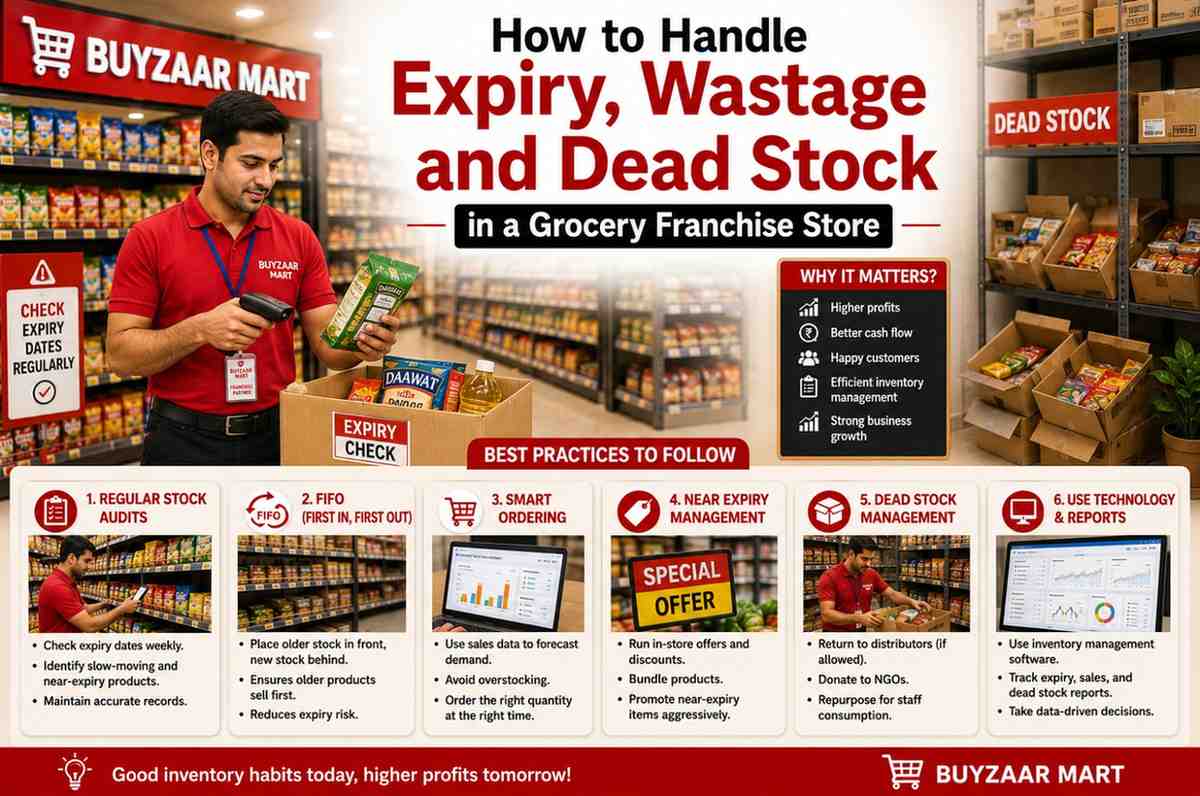
How to Handle Expiry, Wastage and Dead Stock in a Grocery Franchise Store
Expiry and dead stock are profit killers in grocery retail. Learn 6 proven best practices — from FIFO to smart ordering — to protect your margins in a grocery franchise store in India.
Ask any experienced grocery franchise owner about the biggest threat to their profit margins — and they will not say competition, or slow footfall, or high rent. They will say wastage. Expired products sitting on shelves that cannot be sold. Near-expiry items that were missed until it was too late. Dead stock that has been occupying valuable shelf and storage space for months, blocking working capital that should be circulating. These are not rare problems. They are daily operational realities in grocery retail — and if not managed actively, they quietly erode the profitability of even a well-run franchise store. In a grocery franchise, where gross margins typically range from 10 to 20 percent depending on product category, every rupee lost to wastage is a rupee that cannot be recovered. A store wasting ₹10,000 per month in expired or dead stock over 12 months loses ₹1.2 lakh annually — money that should have been profit in the owner's pocket. The good news is that expiry, wastage, and dead stock are manageable problems — with the right systems, habits, and best practices in place. This blog walks you through six proven best practices that professional grocery franchise operators use to eliminate these losses and protect their margins every single day.
Why Expiry and Dead Stock Happen: Understanding the Root Causes
Before solving the problem, it helps to understand why it occurs in the first place. Expiry and wastage in a grocery franchise store typically stem from four root causes. Over-ordering: buying more stock than the store's current demand can absorb, driven by supplier incentives, bulk purchase discounts, or poor demand forecasting. Poor stock rotation: products placed randomly on shelves without date-based organisation, allowing older stock to get buried behind new deliveries. Inadequate tracking: no system — or an inconsistently used system — for monitoring expiry dates across hundreds of SKUs simultaneously. Slow-moving product mix: stocking products that are not aligned to the local neighbourhood's actual buying preferences, resulting in items that sell slowly or not at all. Each of these causes has a specific solution — and the six best practices below address them directly.
Best Practice 1: Regular Stock Audits — Check Expiry Dates Weekly
The foundation of effective expiry management is visibility. You cannot manage what you cannot see — and in a grocery store with hundreds of SKUs across multiple product categories, expiry dates are easy to miss without a structured audit routine. A weekly stock audit is non-negotiable for a well-run franchise store. This does not mean counting every product every week — it means systematically checking expiry dates across all product categories on a rotating schedule, so that every SKU in the store is reviewed at least once every two weeks.
During a stock audit, the franchise owner or a designated staff member checks three things for every product: the expiry date printed on the packaging, the current shelf position (whether it is a near-expiry item hidden behind fresh stock), and whether the product is moving at a pace consistent with its remaining shelf life. A weekly stock audit should cover: checking expiry dates on all perishable and FMCG products systematically, identifying slow-moving and near-expiry products and flagging them for action, maintaining accurate digital records of flagged items in the POS inventory system, and updating expiry tracking records so future audits build on the previous week's data.
The Buyzaar Mart POS system supports this process by enabling franchise partners to log inventory batch numbers, track expiry data, and generate reports on near-expiry stock — eliminating the need to rely entirely on manual shelf-by-shelf checks. The discipline of the weekly audit is what separates stores that catch near-expiry products in time to clear them profitably from stores that discover expired stock when it is already a loss. Build the audit into your weekly store routine — and make it a non-negotiable Standard Operating Procedure for your team.
Best Practice 2: FIFO — First In, First Out
FIFO — First In, First Out — is the most fundamental principle of grocery inventory management. It is also the most commonly violated one in stores that rely on informal, habit-based shelf stocking. The principle is simple: when new stock arrives at your store, it goes to the back of the shelf. Older stock that was already on the shelf gets moved to the front. Every customer who picks a product from the front of the shelf is picking the oldest item in that category — which is exactly the behaviour you want to drive, because it ensures that your oldest stock sells before it reaches or nears its expiry date.
The failure mode is equally simple to understand: when new stock is placed in front of old stock — because it is quicker and easier to stack from the front — older products get pushed to the back and forgotten. By the time they are discovered again, they may already be expired or approaching expiry with insufficient time left to sell them at full price. FIFO in practice in a well-run Buyzaar Mart store: every delivery is unpacked and stacked from the back of the shelf forward without exception, staff are trained on the FIFO method during onboarding and reminded in daily briefings, new stock is clearly date-labelled or colour-coded where helpful, and shelf stocking is treated as a disciplined standard process — not an informal task.
FIFO reduces expiry risk because it continuously rotates your oldest stock to the front of every shelf. When executed consistently, it creates a self-managing system where the natural shopping behaviour of your customers works in your favour — they pick from the front, they clear your oldest stock, and your expiry problem shrinks over time. This is a practice that costs nothing to implement and saves thousands of rupees per month in avoided expiry losses.
Best Practice 3: Smart Ordering — Use Sales Data to Forecast Demand
One of the most powerful competitive advantages a Buyzaar Mart franchise partner has over an independent kirana store owner is access to real-time sales data. The Buyzaar Mart POS system tracks every product sold, every day — giving franchise owners a precise picture of which products are moving fast, which are moving slowly, and which have barely moved at all. Smart ordering means using this data to make purchasing decisions — not instinct, not supplier pressure, and not habit.
The core discipline of smart ordering is matching your order quantity to your store's actual sales velocity for each product. How smart ordering prevents wastage: use your POS weekly sales report to calculate average daily and weekly sell-through rates for every SKU, order only the quantity you can sell comfortably within half the product's remaining shelf life — creating a safety buffer, avoid over-ordering on slow-moving products even when suppliers offer bulk discounts, adjust order quantities seasonally (cold drinks and ORS sachets sell faster in summer; ghee and dry fruits sell faster in winter), and reduce order quantities for products that consistently carry over between delivery cycles.
The Buyzaar Mart system supports smart ordering with automated reorder suggestions based on sales data — helping franchise partners avoid both stockouts and overstocking. Smart ordering is not just about preventing wastage. It is about capital efficiency. Every rupee of inventory that sits unsold is a rupee that is not earning a return. A franchise store that turns its inventory every 30 to 45 days is more profitable than one sitting on 60 to 75 days of stock — even if the raw margin percentage looks similar on paper.
Best Practice 4: Near Expiry Management — Act Early, Act Aggressively
A near-expiry product is not a write-off — it is an opportunity that requires immediate, decisive action. The difference between recovering 80 percent of a product's value through a well-executed promotion and writing it off as a total loss is often just a matter of how early and how aggressively you act. Near-expiry management begins the moment a stock audit flags a product as approaching its expiry date. The standard trigger for action is when a product has 30 to 45 days of shelf life remaining — enough time to implement a promotion and sell through the stock before it expires.
Proven near-expiry clearance strategies for grocery franchise stores: Run in-store offers and discounts — a clearly labelled 'Special Offer' or 'Today's Deal' tag on near-expiry products draws customer attention and drives impulse purchase. Bundle products — pair near-expiry items with fast-moving products as a bundle deal to create perceived value and move both items. Promote near-expiry items through WhatsApp — leverage your customer loyalty database and WhatsApp broadcast lists to inform registered customers about special offers on near-expiry products. Front-shelf placement — move near-expiry products to the most visible, high-traffic positions in the store: eye-level shelves at the entrance, positions near the billing counter, end-cap displays.
The key principle is urgency. Near-expiry management requires action within days of identification — not weeks. A franchise owner who sees a flagged product and waits two weeks to act will find themselves with a much shorter sales window and a much harder clearance challenge.
Best Practice 5: Dead Stock Management — Handle It Before It Handles You
Dead stock is inventory that has stopped moving entirely — products that have not sold in 30 days or more, typically because they are not aligned with your neighbourhood's buying preferences, are priced uncompetitively, or were over-ordered relative to actual demand. Dead stock is a working capital problem as much as a product problem. Every unit of dead stock sitting on your shelf or in your backroom is blocking the capital that paid for it — capital that could be reinvested in faster-moving products that actually generate revenue.
Dead stock management requires a structured approach with three escalating resolution options. Return to distributors or the franchisor: this is always the first option to explore. The Buyzaar Mart inventory assurance policy provides franchise partners with the ability to return certain categories of unsold, near-expiry, or damaged stock — a significant protection that most independent store owners do not have. Donate to NGOs or community organisations: for dead stock that cannot be returned and still has usable shelf life, donation to registered NGOs or community organisations is a responsible and often tax-efficient resolution. Repurpose for staff consumption: products that are nearing expiry but still safe for consumption can be allocated for staff use — a small operational benefit that reduces waste while eliminating the inventory liability from your records.
Dead stock prevention is always preferable to dead stock management. The best defence against dead stock accumulation is the combination of smart ordering (Practice 3), weekly audits (Practice 1), and active near-expiry management (Practice 4) — all working together to catch slow-moving products early, before they become dead stock.
Best Practice 6: Use Technology and Reports — Data-Driven Decisions Every Day
All five practices above are significantly more effective when supported by the right technology. In 2026, a grocery franchise store that manages expiry, wastage, and dead stock manually — through paper records, mental tracking, and visual shelf checks — is operating with a fundamental disadvantage compared to a store using a proper inventory management system. The Buyzaar Mart POS system provides franchise partners with the technology backbone to operationalise every best practice in this blog.
Inventory management software tracks every product in the store — units in stock, units sold, days of supply remaining, and expiry dates — in real time. Expiry and dead stock reports give franchise owners a weekly snapshot of their risk exposure: which products are within 30 days of expiry, which SKUs have not moved in the past 30 days, and which categories are carrying excess inventory relative to sales velocity. Sales trend analytics reveal buying patterns across days, weeks, and seasons — enabling smarter ordering decisions, promotional planning, and product mix optimisation.
Take data-driven decisions every day — not just during the weekly audit. The best franchise operators review their POS dashboard daily, flagging any product that is showing unusual movement patterns — either abnormally fast (reorder alert) or abnormally slow (wastage risk). Technology does not replace the franchise owner's judgment. It informs it. The combination of a good system and an engaged, data-literate franchise owner is the most powerful inventory management tool available in Indian grocery retail today.
The Financial Impact of Getting This Right
Let us be concrete about what these six best practices are worth in rupee terms. A well-run Buyzaar Mart franchise store generating ₹5 lakh per month in revenue and operating with poor expiry and wastage management might lose 3 to 5 percent of gross revenue to expired products, dead stock write-offs, and clearance discounts — approximately ₹15,000 to ₹25,000 per month in avoidable losses. Implement all six best practices consistently, and that wastage rate can be reduced to under 1 percent of revenue — saving ₹10,000 to ₹20,000 per month. Over 12 months, that is ₹1.2 lakh to ₹2.4 lakh in recovered profit — money that goes directly to your bottom line without requiring a single additional customer or a single additional rupee of revenue.
In a business where net profit margins average between 15 and 20 percent, reducing wastage by even 2 percentage points has the same effect on your bottom line as increasing your revenue by 10 percent. It is, in the words of most experienced franchise operators, the easiest money you can make in your store — because it comes from protecting what you are already earning, not from chasing new revenue.
Buyzaar Mart's Inventory Assurance: A Built-In Safety Net
One of the most franchisee-friendly features of the Buyzaar Mart model is the Hassle-Free Inventory Assurance policy — which allows franchise partners to return expired and damaged goods under defined conditions. This policy reduces the financial exposure of a new franchise partner who is still learning their local demand patterns and optimising their product mix. For a first-time franchise owner, this assurance is genuinely valuable. The early months of operating a new grocery store involve a learning curve in inventory management — and the ability to return product that does not sell reduces the financial penalty for getting the ordering mix wrong while you build experience.
Combined with the Buyzaar Mart POS system's expiry tracking, smart ordering support, and real-time inventory reports, franchise partners have a complete ecosystem of tools and policies designed to make wastage management achievable — not just desirable.
Conclusion: Protect Your Margin, Every Day, One SKU at a Time
Expiry, wastage, and dead stock are not problems that get solved once. They are managed continuously — with disciplined weekly audits, FIFO shelf rotation, data-driven ordering, aggressive near-expiry clearance, structured dead stock resolution, and technology that keeps you informed in real time. The franchise owners who master these six best practices are not just better operators — they are more profitable ones. And in a business where every percentage point of margin matters, the difference between a store that manages its inventory professionally and one that manages it casually can be measured in lakhs of rupees per year. Build the habits. Use the systems. Protect your margin. Your franchise's profitability depends on it.
Ready to Own a Grocery Franchise Backed by Technology, Supply Chain Support, and Inventory Assurance?
🌐 Website: thebuyzaarmart.com/franchise
📞 Phone: 9217991727
📧 Email: info@thebuyzaarmart.com
Frequently Asked Questions
What are the most common causes of expiry and wastage in a grocery franchise store?
The four most common causes are over-ordering relative to actual demand, poor stock rotation (older products buried behind new stock), inadequate expiry tracking systems, and a slow-moving product mix that is not aligned to the local neighbourhood's buying preferences. Each cause has a specific solution — covered by the six best practices in this guide.
What is the FIFO method and why is it important in grocery retail?
FIFO stands for First In, First Out. It means that when new stock arrives, it is placed at the back of the shelf so that the older stock at the front sells first. This ensures your oldest products are always the ones customers pick up, preventing them from getting buried behind newer deliveries and expiring unsold. FIFO is the single most effective shelf-management habit for preventing expiry losses in grocery retail.
How often should a grocery franchise store conduct a stock audit?
A weekly stock audit is recommended as a minimum standard for a well-run grocery franchise. This does not require counting every product every week — it means systematically checking expiry dates across product categories on a rotating schedule, so every SKU in the store is reviewed at least once every two weeks. The Buyzaar Mart POS system supports this process with expiry tracking and near-expiry reports that make audits faster and more accurate.
When should I start promoting a near-expiry product in my store?
The standard trigger for action is when a product has 30 to 45 days of shelf life remaining. At this point, you have enough time to run a promotion, clear the stock, and recover most of the product's value. Waiting longer significantly reduces your clearance options. Effective near-expiry strategies include in-store discount labelling, product bundling, WhatsApp offers to your loyalty customer base, and moving the product to high-visibility front-shelf positions.
What should I do with dead stock that has stopped moving entirely?
Dead stock management follows a three-step escalating resolution approach. First, attempt to return the stock to distributors or through Buyzaar Mart's Hassle-Free Inventory Assurance policy — this recovers your full cost. Second, if return is not possible and the product still has usable shelf life, consider donating to registered NGOs or community organisations — a responsible and often tax-efficient option. Third, near-expiry stock that is still safe for consumption can be allocated for staff use, eliminating the inventory liability while reducing waste.
How does smart ordering help prevent wastage in a grocery franchise?
Smart ordering means using your POS sales data to match order quantities to your store's actual weekly sales velocity for each product — rather than ordering by instinct or under supplier pressure. A practical guideline is to order only enough stock to last within half the product's remaining shelf life, creating a safety buffer. The Buyzaar Mart system provides automated reorder suggestions based on sales data to help franchise partners avoid both stockouts and overstocking.
What technology does Buyzaar Mart provide to help manage expiry and dead stock?
The Buyzaar Mart POS system provides inventory management software that tracks units in stock, units sold, days of supply remaining, and expiry dates in real time. It generates weekly expiry and dead stock reports — showing which products are within 30 days of expiry and which SKUs have not moved in the past 30 days. Sales trend analytics reveal seasonal and weekly buying patterns to support smarter ordering decisions. These tools make data-driven inventory management accessible without requiring advanced technical skills.
How much money can a grocery franchise save by managing wastage properly?
A franchise store generating ₹5 lakh per month that currently loses 3 to 5 percent of gross revenue to wastage is losing ₹15,000 to ₹25,000 per month in avoidable losses. Implementing the six best practices consistently can reduce this wastage rate to under 1 percent — saving ₹10,000 to ₹20,000 per month, or ₹1.2 lakh to ₹2.4 lakh annually. In a business where net margins average 15 to 20 percent, a 2 percentage point reduction in wastage has the same bottom-line impact as a 10 percent increase in revenue.
What is Buyzaar Mart's Inventory Assurance policy?
Buyzaar Mart's Hassle-Free Inventory Assurance policy allows franchise partners to return expired and damaged goods under defined conditions. This reduces the financial risk for new franchise owners who are still learning their local demand patterns and optimising their product mix during the early months of operation. It is one of the most franchisee-friendly features of the Buyzaar Mart model and provides a meaningful financial safety net that independent kirana store owners do not have.
How can I apply for a Buyzaar Mart franchise to benefit from these inventory management tools?
You can apply by visiting www.thebuyzaarmart.com/franchise, calling 9217991727, or emailing info@thebuyzaarmart.com. The Buyzaar Mart team will walk you through store formats, investment requirements, the technology system, and the full support structure — including inventory assurance and operational guidance — so you can make a confident, informed franchise investment decision.