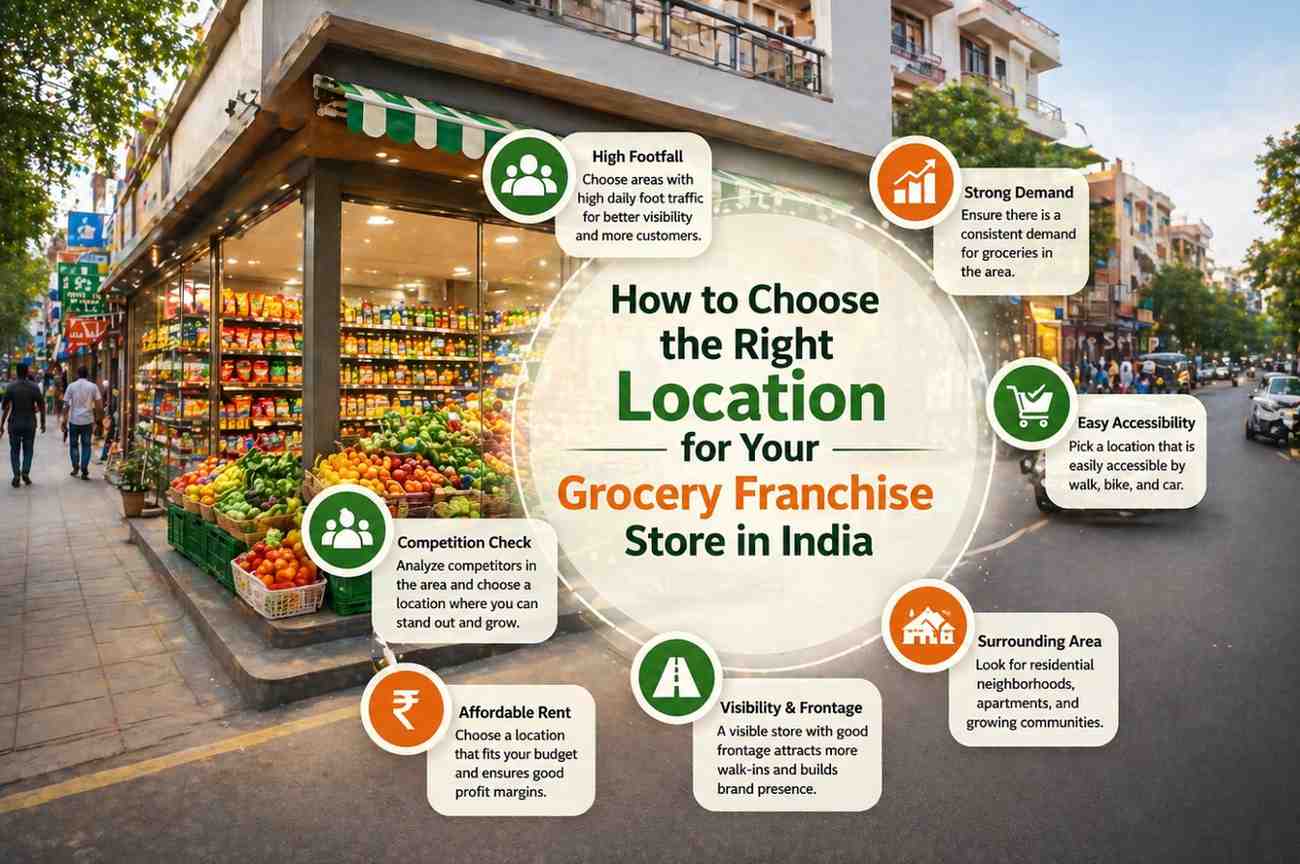
How to Choose the Right Location for Your Grocery Franchise Store in India (2026)
Footfall, Demographics, Competition, Rent & More — A Complete Site Selection Guide for Buyzaar Mart Franchise Store Owners in India (2026)
When aspiring entrepreneurs think about starting a grocery franchise in India, most of their attention goes toward investment, brand, and products. But there is one factor that quietly determines whether your store thrives or struggles — location. In retail, there is an old saying: 'The three most important things in business are location, location, and location.' And nowhere is this more true than in the grocery and FMCG franchise segment. A well-stocked, beautifully designed store in the wrong neighbourhood will consistently underperform a modest store in the right one. Whether you are planning to open a Buyzaar Mart Mini Mart, Super Mart, or Hyper Mart, this guide walks you through everything you need to evaluate before finalising your store location in India.
1. Understand the Catchment Area First
Before you look at any specific property, you need to understand the catchment area — the geographic zone from which your store will draw most of its customers. For a neighbourhood grocery franchise, this is typically a radius of 500 metres to 1.5 kilometres around your store.
Ask yourself: How many households exist within this radius? What is the average family size and household income? Is the population growing, stable, or declining? Are there new residential projects or colonies coming up nearby?
A dense residential neighbourhood with 500 to 1,000 households within walking distance is a strong foundation for a Mini Mart or Super Mart franchise. For a Hyper Mart format, you want a larger catchment with higher commercial activity. Buyzaar Mart's team provides site selection assistance to every franchise applicant, helping you evaluate your catchment area scientifically before you commit.
2. Evaluate Daily Footfall Potential
Footfall — the number of people who physically pass by or visit your store area every day — is the single most important indicator of a grocery store's revenue potential.
High footfall locations for grocery franchise stores in India typically include: near residential colonies and housing societies, close to schools, colleges, and offices, near bus stops, auto stands, and metro exits, main market roads and local bazaar streets, and near hospitals and religious places — all of which generate consistent daily visitor traffic.
Spend time physically observing a location at different times of day — morning, afternoon, and evening — and on both weekdays and weekends before deciding. Numbers on paper are no substitute for what you observe on the ground.
3. Study the Local Demographics
Not all footfall is equal. A thousand people walking past your store daily means nothing if they are not your target customers. Understanding who lives and shops in the area is essential.
For a grocery franchise like Buyzaar Mart, look for localities where middle-income and lower-middle-income families form the majority, working couples and nuclear families dominate, senior residents are present as regular and predictable shoppers, and the area has a mix of renters and homeowners — renters tend to shop more frequently in smaller quantities, which sustains daily footfall.
Avoid locations dominated entirely by very high-income households expecting premium and luxury products, or extremely low-income pockets where average basket sizes may be too small for healthy margins.
4. Analyse Existing Competition
Competition is not necessarily a bad sign — a market street with multiple grocery shops proves that demand exists. But you need to assess the type and quality of competition before entering.
Look for: unorganised kirana stores nearby — these are actually a positive signal, as an organised tech-enabled Buyzaar Mart store naturally attracts customers away from unorganised retail over time. Also check which organised franchise brands are operating and how crowded the space is, and note the distance to the nearest supermarket or hypermarket — if a large organised retailer is within 200 metres, it will directly compete for the same customers.
The sweet spot is a locality with several unorganised kirana stores (proving demand) but no established organised grocery franchise nearby. This is where a Buyzaar Mart store can create the strongest impact and grow fastest.
5. Assess Accessibility and Visibility
A store that is hard to find or hard to reach will always struggle, regardless of how good the products or pricing are. Evaluate road access, parking availability, store visibility (can your signage be seen clearly from at least 50 metres away in both directions?), ease of entry — a wide ground-floor entrance is always preferred over a basement or mezzanine — and last-mile delivery feasibility if you plan to offer home delivery in the future.
Corner plots and ground-floor properties on main roads score highest on all of these criteria. Even a small parking space in front of the store significantly increases basket size, as customers can buy more when they have a vehicle.
6. Check Property Size Against Your Chosen Format
Buyzaar Mart has three clearly defined store formats, each with specific space requirements. Choosing the wrong property size for your format creates operational inefficiency and a poor customer experience.
Mini Mart (600 to 1,000 sq ft) is best for dense residential colonies, small towns, and tier-3 markets, covering personal care, beverages, grocery and staples, homecare, stationery, and snacks. Super Mart (1,001 to 3,000 sq ft) is ideal for larger residential neighbourhoods and semi-urban markets, adding dairy and fruits and vegetables to the Mini Mart range. Hyper Mart (3,001 to 8,000 sq ft) suits high-footfall commercial zones and tier-1 or tier-2 city markets, adding gifts and toys, and frozen and ready-to-eat categories.
Do not try to fit a Super Mart format into a Mini Mart-sized space — it leads to cramped aisles, poor display, and a frustrating shopping experience. Equally, do not take on a very large property if the locality does not justify the higher rental cost.
7. Calculate the Rent-to-Revenue Ratio
Rent is your single largest fixed cost. A common mistake first-time franchise owners make is falling in love with a location without doing the math on whether the rental expense is sustainable.
A practical guideline for grocery retail in India: your monthly rental should not exceed 3 to 5 percent of your expected monthly revenue. For example, if your store is projected to generate ₹8 to ₹10 lakhs in monthly sales, your rental should ideally be capped at ₹30,000 to ₹50,000 per month. Paying ₹80,000 to ₹1 lakh per month in rent for the same revenue level will severely compress your margins.
High-visibility, high-footfall locations command premium rents — but if that footfall translates to proportionally higher sales, the math can still work. Always model your numbers before signing a lease. Buyzaar Mart offers an investment calculator on its website that helps you estimate total costs including stock, interior, software, franchise fee, and security deposit — helping you arrive at realistic revenue projections for your chosen format.
8. Verify Local Regulations and FSSAI Compliance
Before finalising any property, check that it meets the legal and regulatory requirements for operating a retail grocery store in that location. Confirm with the local municipal body that commercial retail activity is permitted at that address — some residential zones restrict commercial usage.
The address must qualify for an FSSAI licence, which is mandatory for any grocery retail operation. The store address will also be your GST place of business, and you must register under your state's Shops and Establishments Act, which requires valid commercial premises.
Buyzaar Mart is itself FSSAI licensed, GST registered, and MSME certified — and guides franchise partners through the compliance process for their individual stores.
9. Factor in Future Growth Potential
A great location today should also be a great location three to five years from now. Evaluate the development trajectory of the neighbourhood: Are new residential projects, apartment complexes, or townships being built nearby? Is there planned infrastructure development — metro lines, highways, or flyovers — that could increase or decrease footfall? Is the locality going through gentrification or demographic shift? Are commercial establishments, schools, or hospitals coming up in the vicinity?
A location in a developing colony with 500 households today but projected to grow to 2,000 households over the next three years is far more valuable than a saturated market that has peaked.
10. Get a Professional Site Evaluation Done
Even after doing your own research, it is strongly advisable to get a professional opinion before committing to a lease. Buyzaar Mart conducts a dedicated site visit and evaluation for every franchise applicant as part of the onboarding process.
The Buyzaar Mart team assesses locality demographics and household density, catchment area potential, competitive landscape in the micro-market, store layout feasibility within the property, and suitability for your chosen store format. This evaluation, supported by the team's experience across multiple operational stores in Noida, Gangoh, Saharanpur, and Haridwar, gives you data-backed confidence before you invest.
Quick Location Checklist Before You Sign
Before finalising your grocery franchise store location, run through this checklist: Minimum 500 households within 1 km radius. Good daily footfall — observed personally at different times. Ground floor with wide entrance and clear signage visibility. Near transit points, schools, or main market road. Unorganised competition nearby but no established franchise. Property size matches your chosen Buyzaar Mart format. Monthly rent within 3 to 5% of projected monthly revenue. Zoning permits commercial retail activity. FSSAI licence can be obtained at this address. Locality has positive future growth indicators. If you tick all or most of these boxes, you have found a strong candidate location for your Buyzaar Mart franchise store.
Final Thoughts
Choosing the right location for your grocery franchise store is not a decision to make on instinct alone. It requires a combination of ground-level observation, demographic analysis, competitive assessment, financial modelling, and regulatory verification. Getting this right dramatically increases your chances of building a store that is profitable, sustainable, and scalable.
With Buyzaar Mart's proven franchise model, end-to-end operational support, and dedicated site selection assistance, you do not have to navigate this process alone. From the moment you submit your inquiry to the day you open your doors, the Buyzaar Mart team is with you every step of the way. The right location, backed by the right brand, is where your entrepreneurial success story begins.
Ready to Find Your Location and Apply?
You now have a complete site selection framework to find the right location for your grocery franchise store in India. Don't let location uncertainty delay your launch — especially when prime spots in cities like Bareilly, Moradabad, and Lucknow are being taken up fast.
Apply for a Buyzaar Mart franchise today and get dedicated site evaluation support from Day 1.
Get a professional catchment area and footfall assessment for your shortlisted location.
Access Buyzaar Mart's investment calculator to model rent-to-revenue ratios before you commit.
Book a free 15-minute consultation with our franchise operations team.
📞 Phone: 9217991727
📧 Email: info@thebuyzaarmart.com
🌐 Website: thebuyzaarmart.com/franchise
Frequently Asked Questions
What is the ideal catchment area size for a Buyzaar Mart franchise store?
For a Mini Mart or Super Mart format, a catchment radius of 500 metres to 1 kilometre with at least 500 households is the recommended baseline. For a Hyper Mart, you need a larger radius with higher commercial activity and daily footfall.
Should I avoid locations where kirana stores already exist?
No. Unorganised kirana stores nearby are actually a positive indicator — they confirm that grocery demand exists in the area. An organised, tech-enabled Buyzaar Mart store with proper billing, branding, and a wide product range will naturally attract customers away from unorganised retail over time.
How much rent is too much for a grocery franchise store?
A practical guideline is that your monthly rental should not exceed 3 to 5 percent of your projected monthly revenue. For example, if you expect ₹8 to ₹10 lakhs in monthly sales, your rent should ideally stay between ₹30,000 and ₹50,000 per month.
What store formats does Buyzaar Mart offer and what space is required?
Buyzaar Mart has three formats: Mini Mart (600 to 1,000 sq ft), Super Mart (1,001 to 3,000 sq ft), and Hyper Mart (3,001 to 8,000 sq ft). Each format is designed for a specific market size and demographic. Choosing the right format for your available space is essential for operational efficiency.
Can I finalise a location without a site visit from the Buyzaar Mart team?
You can do your own initial research, but it is strongly recommended to get a professional site evaluation before signing a lease. Buyzaar Mart conducts a dedicated site visit and assessment for every franchise applicant as part of the onboarding process — covering demographics, footfall, competition, and format suitability.
Does a ground floor location really matter that much?
Yes, significantly. Ground floor properties with wide entrances and clear street-facing signage consistently outperform basement or upper-floor locations for grocery retail. Visibility, ease of entry, and the ability to park briefly all directly affect how many customers walk through your door.
What regulatory checks should I do before finalising a grocery store location?
Confirm that the local municipal body permits commercial retail activity at that address, that an FSSAI licence can be obtained at the premises, and that the property qualifies for GST registration as your place of business. You must also register under your state's Shops and Establishments Act.
Is it better to open in an established commercial area or a developing colony?
Both can work depending on the format and your investment horizon. Established markets offer immediate footfall but may have higher competition and rent. Developing colonies offer lower costs and early-mover advantage, but take longer to generate peak revenue. Buyzaar Mart's site evaluation helps you assess both scenarios before committing.
How long does it take to evaluate and finalise a store location?
With your own research plus a Buyzaar Mart site evaluation, the process typically takes 2 to 4 weeks from shortlisting to final decision. This includes on-ground observation, demographic study, competitive mapping, financial modelling, and regulatory verification.
If I join a Buyzaar Mart franchise, does the team help me find the location?
Yes. The Buyzaar Mart operations team provides site selection assistance to every franchise applicant. While the final decision is yours, the team evaluates your shortlisted property and gives data-backed guidance on catchment area potential, format suitability, and market opportunity — so you never make this decision alone.
Related Articles
What Makes Buyzaar Mart Different from Other Grocery Franchise Chains in North India? (2026)
Wondering what sets Buyzaar Mart apart from other grocery franchise chains in North India? Discover the key differentiators — from tech-enabled operations and FMCG brand partnerships to franchisee-first support and profit margins.
India's FMCG Sector in 2026: Which Categories Are Growing Fastest and Why It Matters
India's FMCG market is projected to hit ₹10.2 lakh crore by 2026. Discover which categories are growing fastest — from health foods to personal care — and what it means for grocery franchise owners across North India.
Staples vs Packaged Foods: Balancing Category Mix for Maximum Profit
Learn how to balance staples and packaged foods in your grocery store to maximise footfall, inventory turnover, and overall profitability.