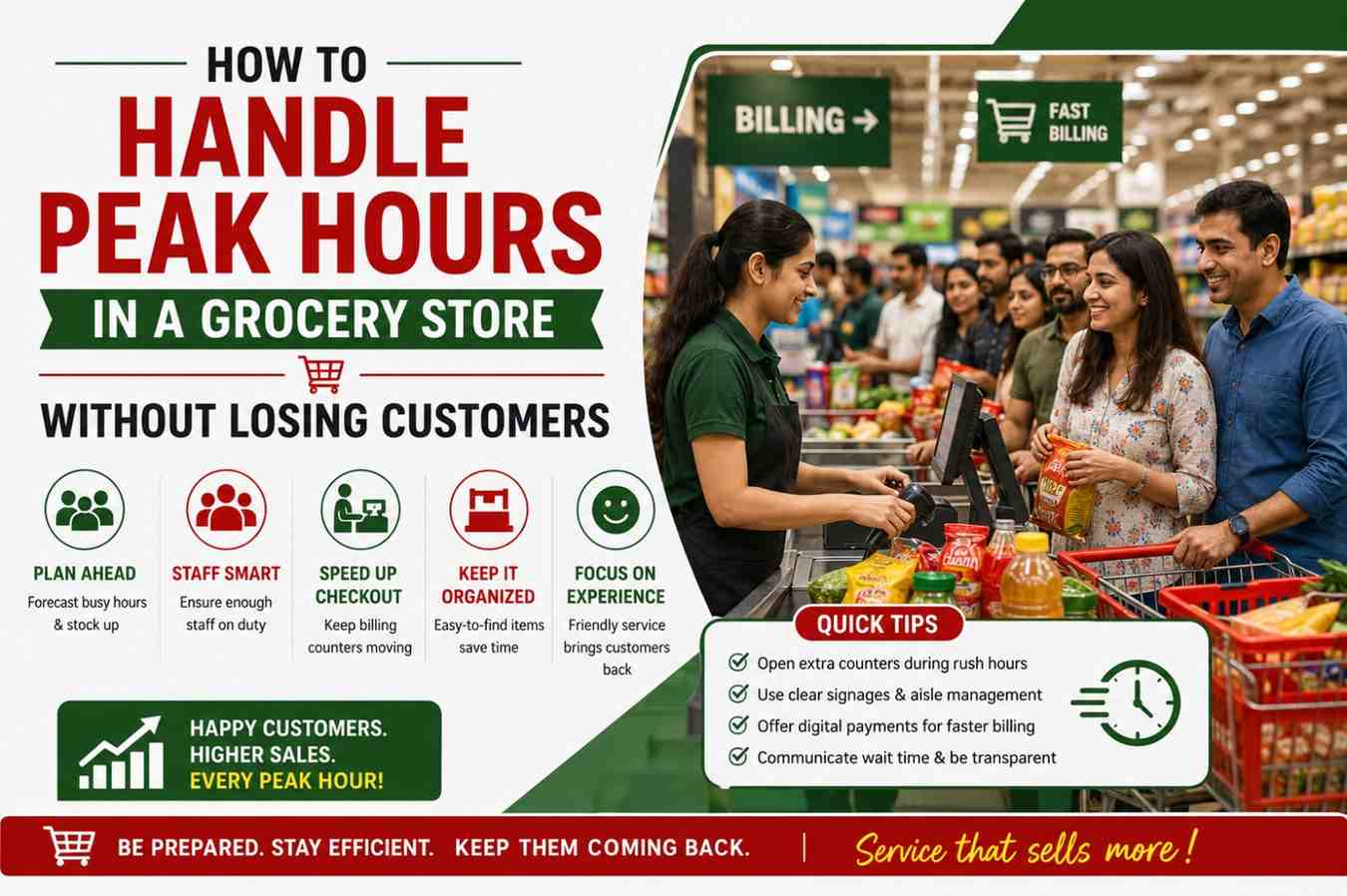
How to Handle Peak Hours in a Grocery Store Without Losing Customers (2026)
Long queues and stock-outs during peak hours silently kill customer loyalty. Learn practical strategies to manage rush hours in your grocery franchise store without losing a single customer.
Every grocery store has them. That chaotic 30-minute window in the morning when everyone stops in before work. The post-office lunch rush. The brutal evening window between 6 and 9 PM when half the neighbourhood descends on your store at once. Peak hours are not a problem. They are an opportunity. The stores that handle rush periods smoothly build a reputation for reliability that no marketing campaign can buy. The stores that handle them poorly — long queues, empty shelves, overwhelmed staff, impatient customers — quietly lose the very people they worked hardest to attract. In a Buyzaar Mart franchise store, where your entire business model depends on becoming the default grocery destination for your neighborhood, how you perform during peak hours is the single biggest factor in building long-term customer loyalty.
Step One — Know Exactly When Your Peak Hours Are
Before you can manage peak hours, you need to know precisely when they happen in your specific store. Do not assume — measure.
- •Use your POS system's transaction report to pull hourly sales data for the past four weeks — this gives you an exact picture of when customer volume spikes
- •Most neighborhood grocery stores in India follow a three-peak pattern — morning (7 to 10 AM), lunchtime (12 to 2 PM), and evening (6 to 9 PM) — but your specific locality may vary significantly
- •Weekend peaks behave differently from weekday peaks — Saturday and Sunday typically see higher average basket sizes but slightly different timing compared to weekday rushes
- •Festive periods — Diwali, Holi, Eid, Navratri, and month-end salary weeks — create extended peak windows that require planning three to four days in advance, not on the day itself
- •Once you have your hourly transaction data, map it into a simple weekly peak-hour calendar and plan your staffing, stocking, and billing operations around it — not the other way around
Part One — Billing and Queue Management
Nothing drives a customer out of your store faster than a long, slow-moving billing queue. This is the single most visible failure point during peak hours — and the most fixable one.
Keep All Billing Counters Operational During Peak Windows
- •Many franchise stores make the mistake of running a single billing counter during peak hours to save on staff costs — this is a false economy that costs far more in lost customers than it saves in wages
- •During identified peak windows, every available billing counter must be active and staffed — even if it means temporarily pulling a floor staff member to assist at billing
- •Buyzaar Mart's POS-enabled billing system allows fast, error-free checkout — but the technology only works as fast as the person operating it, which is why counter staffing during peak hours is non-negotiable
Train a Dedicated Peak-Hour Billing Staff
- •Identify your fastest and most accurate biller and ensure they are always scheduled during your peak windows — billing speed varies enormously between staff members and this matters during rush hour
- •Conduct brief speed drills during off-peak hours — practice scanning products quickly, processing UPI payments without delays, and handling returns efficiently
- •Ensure the billing counter has everything it needs before the peak begins — receipt paper loaded, change cash available, UPI QR code clearly visible, and billing software logged in and ready
Introduce a Fast-Track Lane for Small Baskets
- •A dedicated express lane for customers with five items or fewer dramatically reduces perceived queue length for the majority of shoppers during rush hour
- •Most peak-hour customers are buying a small number of daily essentials — milk, bread, biscuits, vegetables — and they will leave your store if asked to wait behind a full trolley of monthly shopping
- •A simple visual marker or signage at one counter designating it as a quick checkout lane costs nothing and immediately improves the peak-hour customer experience
Digital Payments Must Be Seamless
- •During peak hours, any friction in payment processing multiplies the queue — ensure your UPI QR code, card machine, and digital payment systems are tested and working before each peak window
- •Brief your staff to guide customers toward UPI payments during rush hours — they settle faster than cash, eliminate change-counting delays, and reduce billing counter time per transaction
- •Keep a small float of change cash readily available for customers who pay in cash — running out of change during a busy evening is an avoidable operational failure that frustrates everyone
Part Two — Floor and Shelf Management During Peak Hours
A billing queue is visible. Empty shelves are equally damaging — but less obvious. Customers who cannot find what they came for leave silently and often do not come back.
Pre-Stock High-Demand SKUs Before Every Peak Window
- •Identify your top 30 fastest-moving SKUs — the products that always run low during peak hours — and ensure they are fully stocked on the shelf at least 30 minutes before your peak window opens
- •Atta, refined oil, packaged milk, bread, biscuits, salt, sugar, tea, and daily personal care items are universally high-demand during peak hours in North Indian grocery stores
- •Never leave shelf restocking for during the peak window — moving cartons and stacking shelves while the store is crowded creates aisle blockages, frustrates customers, and slows down the entire shopping experience
Assign a Dedicated Floor Staff Member During Rush Hours
- •During peak windows, one staff member should be exclusively on floor duty — not stocking, not billing, not cleaning — just assisting customers, answering questions, and keeping the store organised
- •The most common customer frustration during peak hours in grocery stores is not being able to find a product quickly — a staff member who can immediately direct customers to the right shelf eliminates this friction entirely
- •This floor staff member should also watch for shelf gaps in real time and flag them to the stockroom staff for immediate replenishment
Keep Aisles Clear and Wide During Peak Hours
- •During rush periods, stockroom trolleys, empty cartons, and cleaning equipment must stay out of the aisles completely — any obstruction during peak hours creates a bottleneck that slows the entire store
- •Brief your team that peak-hour aisle clearing is a non-negotiable store rule, not a suggestion — a cluttered aisle during rush hour is the fastest way to make a crowded store feel chaotic and unprofessional
- •Ensure your store layout allows two customers with baskets to pass each other comfortably in every aisle — if your current layout does not allow this, rearrange during off-peak hours
Part Three — Staff Planning and Peak-Hour Rostering
The most common reason stores underperform during peak hours is not systems or layout — it is simply not having enough of the right people in the right place at the right time.
Build a Peak-Hour Roster Every Week
- •Review the upcoming week's peak-hour schedule every Monday and assign staff shifts explicitly around peak windows — do not assume staff will be present just because they are scheduled for a full day
- •Ensure your most experienced and customer-facing staff are rostered during peak hours — save training and orientation tasks for quieter mid-morning or afternoon windows
- •If your store regularly experiences severe peak-hour pressure, consider hiring a dedicated part-time staff member specifically for evening peak hours — the cost is easily recovered through the additional sales and customer retention that smooth peak-hour operations generate
Brief the Team Before Every Peak Window
- •A two-minute stand-up briefing before each peak window — covering which products need watching, which counters are active, and any specific tasks for floor staff — dramatically improves team coordination during rush hour
- •This does not need to be formal or lengthy — it simply ensures every person on the floor knows their role before the rush begins, rather than figuring it out in the middle of it
- •Use this briefing to flag any known issues going into the peak — a product that is nearly out of stock, a billing system that was slow earlier, a customer complaint from earlier in the day that needs following up
Cross-Train Every Staff Member on Billing
- •During unexpected peak surges, having a floor or stockroom staff member who cannot operate the POS system is a wasted resource
- •Invest one hour in cross-training every team member on basic billing operations — scanning products, processing UPI payments, and printing receipts — so anyone can step in at a second counter during a sudden rush
- •This cross-training also builds team confidence and flexibility — your store's ability to handle an unexpected volume spike depends entirely on how quickly your team can adapt
Part Four — Customer Experience During Peak Hours
Managing operations during peak hours is necessary. But the stores that truly stand out do something more — they make customers feel looked after even when the store is at its busiest.
Acknowledge Waiting Customers
- •A simple acknowledgement from billing or floor staff — 'We will be with you shortly' or 'Thank you for your patience' — reduces perceived waiting time significantly
- •Customers who feel seen and acknowledged during a wait are far more forgiving than customers who are ignored — this is one of the lowest-cost, highest-impact peak-hour customer retention tools available
- •Train your billing staff to make brief, friendly eye contact with the next customer in queue while completing the current transaction — it signals awareness and professionalism
Use the Wait Time to Drive Additional Sales
- •Peak-hour queues are actually a prime impulse purchase opportunity — position small, high-margin items near the billing counter that customers naturally pick up while waiting
- •Sachets, mouth fresheners, chewing gum, small snack packs, and mini personal care items placed at eye level near the counter consistently increase average basket size during peak hours with zero additional selling effort
- •This is a standard practice in organised retail globally — Buyzaar Mart franchise partners who implement counter-level impulse placement see measurable per-transaction value increases
Never Let a Customer Leave Empty-Handed if You Can Help It
- •If a customer asks for a product that is currently out of stock, offer an immediate alternative from the same category — do not simply say 'stock nahi hai' and move on
- •A brief 'Kal subah tak aa jayega, main note kar leta hoon' — noting the customer's requirement and committing to restock — retains the customer far more effectively than a flat unavailability response
- •Train your floor staff to treat every stock-out interaction as a service moment rather than a dead end — customers who feel their needs are being taken seriously return, even when their specific product is not available that day
Peak-Hour Management Checklist
| Timing | Action | Owner |
|---|---|---|
| 30 min before peak | Pre-stock top 30 fast-moving SKUs on shelves | Inventory staff |
| 30 min before peak | Verify all billing counters are active and logged in | Store manager |
| 30 min before peak | Check UPI QR, card machine, and change cash float | Billing staff |
| 30 min before peak | 2-minute team briefing — roles, stock alerts, tasks | Store manager |
| During peak | All counters staffed — no single-counter operation | Store manager |
| During peak | One staff exclusively on floor duty — no other tasks | Floor staff |
| During peak | Aisles completely clear — no trolleys or cartons | All staff |
| During peak | Acknowledge every waiting customer verbally | Billing & floor staff |
| During peak | Flag any shelf gap immediately to stockroom | Floor staff |
| After peak | Restock any depleted shelves before next peak window | Inventory staff |
| After peak | Note any products that ran out — adjust next order | Inventory manager |
| After peak | Review POS exception report for any billing anomalies | Store manager |
Peak-Hour Management Checklist — Before, During & After
Final Thoughts
- •Peak hours are not a stress test — they are a showcase of how well your store is run
- •Customers who experience smooth, fast, friendly service during the busiest time of day become the most loyal regulars your store will ever have — because they know you can be relied on when it matters most
- •The operational investments required to handle peak hours well — proper rostering, pre-stocking, counter staffing, aisle management, and staff training — are all low-cost, high-return decisions that compound in value with every passing week
- •Buyzaar Mart's POS system, CRM platform, and operational support framework give franchise partners the technology and guidance to manage peak-hour operations professionally from Day 1
- •The stores that build their reputation on never letting a customer down during rush hour are the stores that become neighborhood institutions — and that is exactly what a Buyzaar Mart franchise is built to be
Build a store your neighbourhood can rely on. Start at thebuyzaarmart.com/franchise or call 9217991727 (Monday to Saturday, 9 AM to 7 PM)
Frequently Asked Questions
What is the biggest mistake grocery stores make during peak hours?
Running a single billing counter. It creates visible queues that drive customers away. Always activate all counters during identified peak windows.
How much in advance should shelves be stocked before peak hours?
At least 30 minutes before your identified peak window begins. Never restock during the rush itself.
Should I hire extra staff specifically for peak hours?
If your evening peak consistently overwhelms your current team, a part-time evening staff member pays for themselves in retained customers and increased sales within the first month.
How do I identify my store's exact peak hours?
Pull hourly transaction reports from your POS system for the past four weeks. The pattern will be immediately clear.
Does Buyzaar Mart's POS system help during peak hours?
Yes significantly — fast barcode scanning, instant UPI payment processing, and real-time inventory tracking all directly reduce billing time and queue length during rush periods.