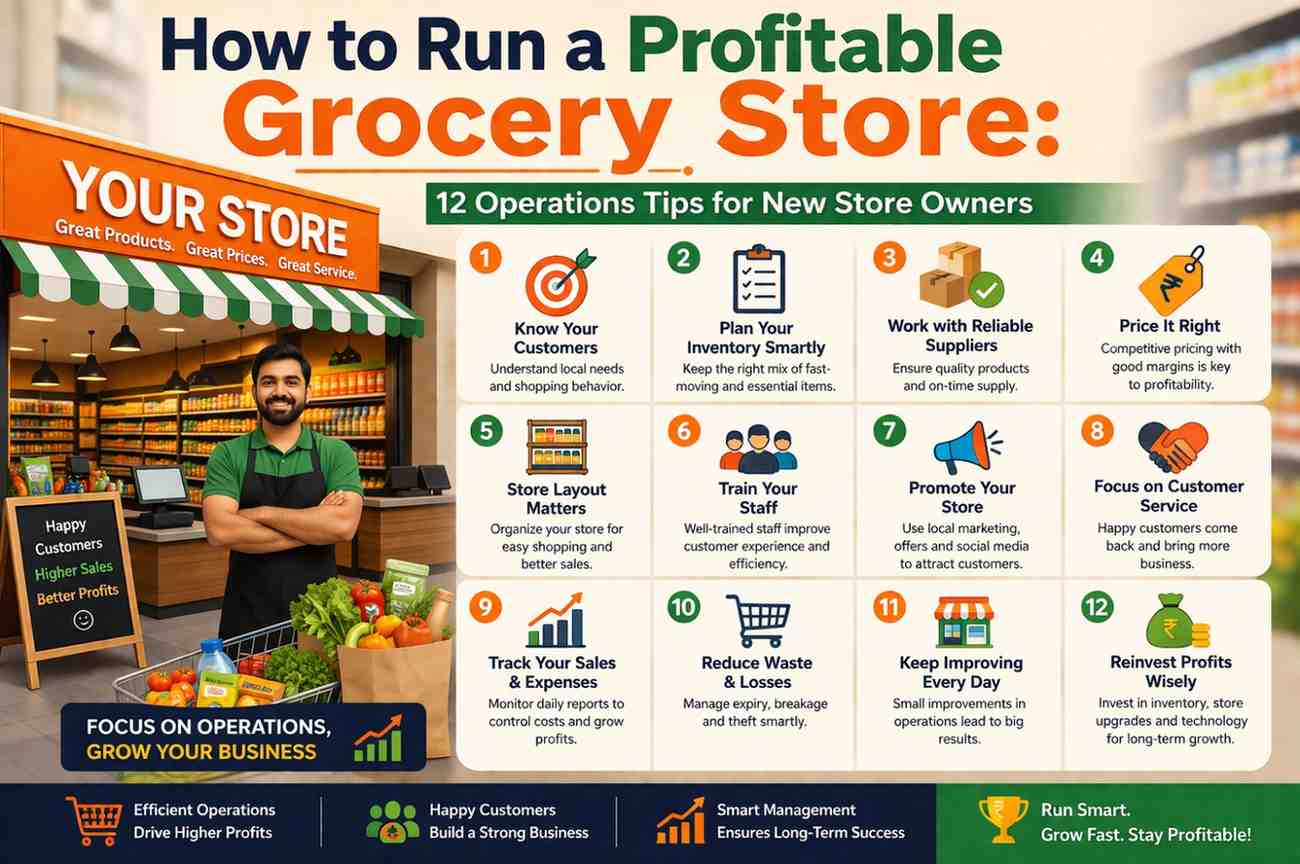
How to Run a Profitable Grocery Store: 12 Operations Tips for New Store Owners
From Knowing Your Customers and Inventory Planning to Staff Training, Marketing & Smart Reinvestment — A Complete Operations Guide
India has over 12 million retail grocery outlets. From small kirana shops in narrow bylanes to modern neighborhood supermarkets in residential colonies, grocery retail is everywhere. And yet, a large percentage of these stores fail to achieve consistent profitability — not because the demand is not there, but because the operations are not managed well. Grocery retail is a business of thin margins and high volume. Every decision you make — how you stock your shelves, how you price your products, how your staff treats customers, how you handle waste — either adds to your profit or quietly eats away at it. There is very little middle ground. This guide covers 12 practical, field-tested operations tips that every new grocery store owner in India needs to follow. Whether you are running an independent store or a franchise outlet under a brand like Buyzaar Mart, these tips will help you build a store that is not just busy — but genuinely and sustainably profitable.
The Real Reason Most Grocery Stores Struggle to Stay Profitable
Starting a grocery store seems straightforward — rent a space, stock products, open the doors. But the reality of running a profitable grocery store is far more demanding. The margins are thin, the competition is intense, and every operational gap costs you money you can barely afford to lose.
The stores that thrive are not the ones with the biggest budgets or the best locations. They are the ones run by owners who understand their customers deeply, manage inventory with discipline, train their teams consistently, and measure their performance every single day.
The following 12 tips are drawn from the realities of grocery retail in India — from Tier-2 towns to metro neighborhoods — and reflect the principles that separate stores that grow from stores that grind.
12 Proven Operations Tips to Run a Profitable Grocery Store
Tip 1: Know Your Customers
The single most important thing you can do before you stock a single shelf is understand exactly who your customers are and what they need. This sounds obvious, but the majority of new store owners skip this step entirely and stock their stores based on personal preference or generic wholesale lists rather than actual local demand.
Your neighborhood has a unique buying profile. A store located near a college campus will have very different top-selling products compared to a store in a family-oriented housing society or a working-class residential area. Study your neighborhood before you open and keep studying it after — customer needs evolve with seasons, incomes, and demographics.
Tip 2: Plan Your Inventory Smartly
Inventory planning is where most grocery store profits are won or lost. Stock too much and you face expiry losses, cash tied up in unsold goods, and cluttered shelves. Stock too little and you face empty shelves, disappointed customers, and lost sales that go straight to your competitor.
Plan your inventory around local seasons and festivals. Diwali, Holi, Eid, Navratri, and other regional festivals create sharp spikes in specific product categories. Anticipate these spikes at least two to three weeks in advance and stock up accordingly. Festival seasons are your highest-revenue opportunity of the year — do not let supply gaps cost you that opportunity.
Tip 3: Work With Reliable Suppliers
Your suppliers are your business partners whether you think of them that way or not. A supplier who delivers late, sends substandard products, or gives you incorrect quantities creates operational problems that cascade through your entire store — empty shelves, customer complaints, and wasted time chasing replacements.
If you are a Buyzaar Mart franchise partner, supplier coordination and procurement support are provided by the company as part of the FOCM model. This means you benefit from the brand's established supplier relationships, volume-based pricing, and logistical support — advantages that typically take independent store owners years to build on their own.
Tip 4: Price It Right
Pricing in grocery retail is a delicate balance. Price too high and customers will go to the nearest competitor. Price too low and you destroy your margin without necessarily building the loyalty you hoped for. The goal is competitive pricing with healthy margins — and achieving this requires understanding both your costs and your market.
Start with your cost price for every item and add a markup that reflects your overhead costs and target profit margin. Grocery retail in India typically operates on gross margins of 10 to 20% depending on the category — packaged goods tend to have lower margins while fresh produce and private label products can deliver significantly higher margins.
Tip 5: Store Layout Matters
How your store is organized has a direct and measurable impact on how much each customer spends per visit. A well-designed store layout guides customers naturally through more product sections, increases exposure to impulse-purchase items, and creates a shopping experience that feels easy and pleasant.
Place your high-frequency essentials — staples, dairy, cooking oil — toward the back or middle of the store. This ensures customers walk through other sections on their way to what they came for, increasing the chance of unplanned purchases. Position high-margin and promotional items at eye level and at the ends of aisles, which are the highest-visibility spots in any store.
Tip 6: Train Your Staff
Training should cover three core areas. First, product knowledge: your team should know where everything is, what it does, and what goes with it. Second, customer service standards: greeting customers warmly, responding to requests promptly, handling complaints calmly and constructively. Third, billing and operations: using the POS system accurately, processing returns correctly, and maintaining shelf neatness during busy periods.
Reduce staff turnover by creating a respectful, fair, and positive work environment. Every time a trained staff member leaves, you lose operational knowledge, customer relationships, and the investment you made in their training. Pay your team fairly, acknowledge good work, and involve them in simple store improvement decisions — they will repay that investment with loyalty and better performance.
Tip 7: Promote Your Store
A great grocery store that nobody knows about will not survive. Consistent, targeted promotion is essential — especially in the first six to twelve months when you are building your customer base and establishing your store's reputation in the neighborhood.
Set up and actively manage your Google Business Profile. When a resident in your area searches 'grocery store near me' or 'supermarket in [your area name],' your store should appear with accurate hours, address, phone number, photos, and positive reviews. Buyzaar Mart franchise partners receive professionally developed hyper-local marketing campaigns and digital marketing strategies as part of the franchise support system — including launch campaigns designed to generate rapid local visibility from day one.
Tip 8: Focus on Customer Service
Customer service is not a department in a grocery store. It is a culture. It is present in every interaction, every day, across every team member. And in the neighborhood retail context, where your customers live within walking distance and see your store as part of their daily routine, the quality of your customer service determines whether you build a loyal community around your store or constantly struggle to replace customers who leave.
Resolve complaints immediately and generously. If a customer brings back a product that was damaged or not as expected, replace it without argument. The cost of one replacement product is far less than the cost of losing a customer who spends with you every week. How you handle a complaint is remembered and shared — a customer whose problem was resolved brilliantly often becomes more loyal than a customer who never had a problem at all.
Tip 9: Track Your Sales and Expenses
You cannot manage what you do not measure. This is the foundational truth of profitable retail management, and yet a surprising number of new store owners operate entirely on gut feel — not knowing their actual daily revenue, their margin by category, or where their money is going.
Implement a POS billing system from your very first day of trading. Beyond generating bills, a good POS system tracks daily sales by product and category, records every transaction, and generates reports that tell you exactly what is selling, what is not, and where your revenue is coming from. For a well-run grocery store in India, aim for a gross margin of 12 to 18% and a net margin of 4 to 8%.
Tip 10: Reduce Waste and Losses
For theft prevention, install CCTV cameras covering all key areas including the billing counter, storeroom entrance, and high-value product sections. Conduct regular stock counts and reconcile them against POS sales data. Any consistent gap between physical inventory and recorded sales is a red flag that demands immediate investigation.
Buyzaar Mart franchise partners benefit from the company's Hassle-Free Inventory Assurance — a guarantee where the company takes back expired and damaged goods. This protection removes one of the most financially damaging risks in grocery retail and is a major advantage of operating under the Buyzaar Mart franchise system.
Tip 11: Keep Improving Every Day
The grocery stores that grow year over year are not the ones that got everything right at launch. They are the ones that built a culture of continuous improvement — making small, consistent upgrades to their operations, their customer experience, and their product range every single week.
Adopt the mindset that your store today should be slightly better than your store last week. Rearrange one product section for better visibility. Add a new product that three customers asked for. Fix the flickering light that made a section look uninviting. Update your WhatsApp offer message with better formatting. Individually, each of these improvements seems small. Cumulatively, over twelve months, they compound into a meaningfully better store.
Tip 12: Reinvest Profits Wisely
Many new store owners make a common and damaging mistake in their first year of profitability: they withdraw too much cash from the business too soon, leaving the store undercapitalized and unable to grow. Sustainable retail growth requires disciplined reinvestment of profits back into the business.
Define a clear reinvestment plan before you start drawing personal income from the store. In the first year, reinvest the majority of profits into three areas: inventory expansion to cover more categories and serve more customer needs; store upgrades to improve the shopping environment and operational efficiency; and technology — better POS systems, CCTV, weighing equipment, and refrigeration that reduce losses and improve customer experience.
Why the Right System Multiplies All 12 Tips
Each of the twelve tips in this guide is valuable on its own. But their real power comes from combining them within the right business system. When you know your customers and plan your inventory smartly, your stockouts drop and your cash flow improves. When you train your staff and focus on customer service, your repeat visit rate rises and your marketing costs fall. When you track your numbers and reinvest wisely, every improvement you make is visible, measurable, and compounding.
This is exactly the philosophy behind the Buyzaar Mart FOCM (Franchise Owned, Company Managed) model. Franchise partners get a system that incorporates all twelve of these principles from day one — professional store layout, inventory support, POS technology, staff training, marketing campaigns, performance audits, and the Hassle-Free Inventory Assurance that protects partners from expiry and damage losses.
Profitable Grocery Stores Are Built on Discipline and Systems
The twelve tips in this guide are not complicated. They do not require a business degree or years of retail experience. They require consistency, attention, and the discipline to apply the right principles day after day — even when the store is busy, even when things go wrong, and even when shortcuts seem tempting.
Follow these twelve principles and you will build more than a grocery store. You will build a business that your community depends on, that your family is proud of, and that grows stronger every year.
Quick summary:
Tip 1: Know your customers
Tip 2: Plan inventory smartly
Tip 3: Work with reliable suppliers
Tip 4: Price it right
Tip 5: Optimize store layout
Tip 6: Train your staff
Tip 7: Promote your store
Tip 8: Focus on customer service
Tip 9: Track sales and expenses
Tip 10: Reduce waste and losses
Tip 11: Keep improving every day
Tip 12: Reinvest profits wisely
Ready to Launch Your Profitable Grocery Store?
Buyzaar Mart actively seeks franchise partners in Tier-2 and Tier-3 cities across India. Visit thebuyzaarmart.com today, fill out the franchise inquiry form, and take the first step toward building a business you are proud to own.
📞 Phone: 9217991727
📧 Email: info@thebuyzaarmart.com
Frequently Asked Questions
How much capital do I need to start a profitable grocery store?
A typical small to mid-sized grocery store in India can require anywhere from ₹15–50 lakh+ depending on location, store size, and the format chosen. Franchise models like Buyzaar Mart offer structured investment tiers — Mini Mart, Super Mart, and Hyper Mart — to match different budgets.
Which operational tip has the biggest impact on profit?
For most new owners, inventory management combined with pricing strategy has the strongest impact on profitability. Keeping stock fresh, avoiding overstocking non-moving items, and maintaining competitive pricing on key categories can quickly improve margins and reduce wastage.
How can I reduce pilferage and stock loss in a small grocery store?
Key steps include using a POS billing and inventory system, enforcing clear opening and closing checks, rotating stock by expiry date, and limiting employee access to cash drawers and high-value items. Training staff to treat every small loss as a profit leak builds a culture of accountability.
How often should I reorder stock for a grocery store?
Most successful small grocery stores reorder fast-moving items 2–3 times per week and slow-moving items once a week. Use sales data from your billing software to set reorder thresholds. For perishables, plan daily or near-daily top-ups.
Should I offer home delivery from day one?
You don't need full-blown delivery on day one. Start with local same-day or next-day delivery within 1–2 km and standard self-pickup, then gradually scale as you see demand and can manage delivery costs without hurting margins.
How can I improve customer retention in a crowded market?
Focus on cleanliness, fast billing, friendly staff, and a simple loyalty system — even stamp cards or discount cards work well. Customers who feel recognized and valued come back consistently and refer others.
What is a realistic profitability timeline for a new grocery store?
Many small grocery stores in India become consistently profitable within 12–24 months, assuming good location, a basic stock range, and disciplined operations. Some break even earlier where footfall and repeat purchase rates are high.
Related Articles

What is FOCM Franchise Model? Complete Guide for Investors
The FOCM Franchise Model — Franchise Owned, Company Managed — is reshaping how investors enter organized retail in India. Learn how Buyzaar Mart's structured system works.

Buyzaar Mart vs Traditional Kirana Store – Which is More Profitable?
Is a traditional kirana store still the most profitable option, or does an organized retail format like Buyzaar Mart offer better long-term growth? A detailed comparison of both retail models.

How to Apply for a Buyzaar Mart Franchise: Step-by-Step Process (2026)
Want to open a Buyzaar Mart franchise in India? Read our complete 2026 step-by-step guide covering eligibility, investment, documentation, and store launch process.