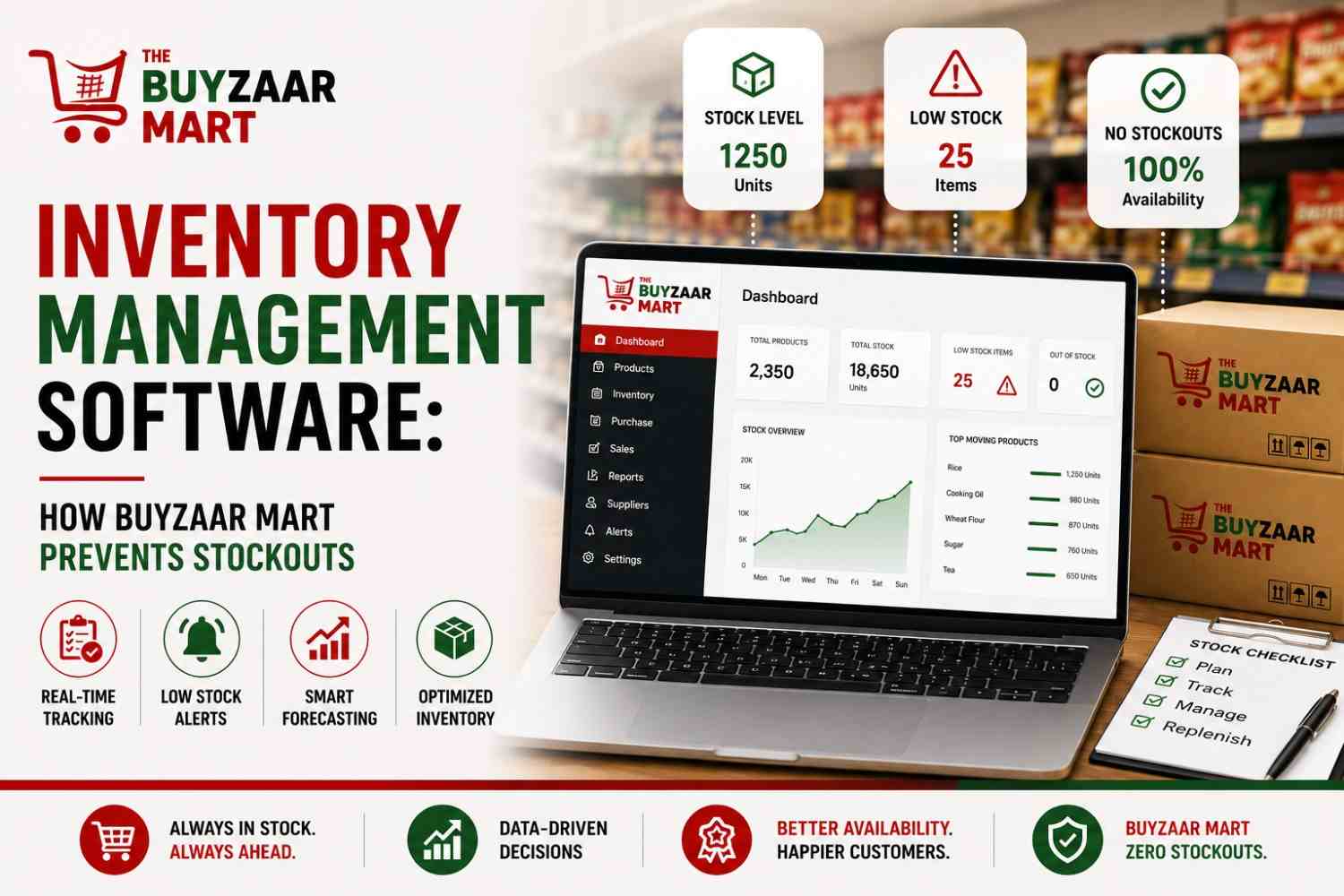
Inventory Management Software: How The Buyzaar Mart Prevents Stockouts
See how Buyzaar Mart's real-time inventory system, reorder alerts, and near-expiry tracking help franchise stores prevent stockouts and reduce losses.
A customer walks into your store looking for milk, biscuits, or cooking oil — and walks out empty-handed because the shelf is empty. That single moment doesn't just cost you one sale. It costs you a repeat customer, who now associates your store with unreliability and quietly starts shopping elsewhere. Stockouts are one of the most common and most preventable causes of revenue loss in Indian grocery retail — and the difference between a store that constantly runs out of fast-moving items and one that never does almost always comes down to one thing: the technology behind the shelf.
What Is a Stockout and Why Does It Hurt More Than It Looks
- •A stockout happens when a product a customer wants to buy is not available on the shelf at the moment of purchase
- •Unlike a slow sales day, a stockout is an invisible loss — the sale simply never happens, and it rarely shows up as a clear number in daily accounting
- •Repeated stockouts on high-demand items like milk, atta, or biscuits train customers to stop trusting your store for daily needs, pushing them toward a competitor permanently
- •Stockouts on fast-moving FMCG categories are especially damaging because these are exactly the products that drive repeat visit frequency
Why Traditional Grocery Stores Struggle with Stockouts
- •Most independent Kirana stores in India still rely on manual stock counting, memory-based reordering, or basic paper registers with no real-time visibility
- •Owners often discover an item is out of stock only when a customer asks for it — by which point the sale is already lost
- •Reordering decisions are frequently based on gut feeling rather than actual sales velocity, leading to either running out too early or over-ordering slow sellers
- •Without centralised data, a single-store owner has no early warning system for products approaching their reorder point
How Inventory Management Software Solves the Problem
- •Real-time stock tracking updates inventory levels automatically with every billing transaction, so the system always reflects what's actually left on the shelf
- •Reorder point alerts flag a product the moment its stock crosses a pre-set minimum threshold, well before the shelf actually runs empty
- •Sales velocity tracking identifies which SKUs are moving fastest, allowing reorder quantities to match actual local demand rather than a fixed guess
- •Centralised data across categories means the system — not the owner's memory — is responsible for knowing what needs to be reordered and when
Inside The Buyzaar Mart Inventory Management System
- •The Buyzaar Mart POS system, inventory management app, and sales analytics dashboard are fully configured and operational from Day 1 — included in every franchise setup, with no separate technology purchase or setup effort required from the franchise partner
- •Every franchise partner gets real-time access to daily sales data, inventory consumption reports, and stock-level visibility directly from their phone, from anywhere
- •System-generated reorder suggestions are based on actual sales patterns at that specific store, not a generic formula applied across the network
- •Centralised procurement means that once a reorder is triggered, the store receives network-negotiated pricing and scheduled delivery — removing the delay and price uncertainty an independent store owner would face negotiating with individual wholesalers
Near-Expiry Alerts — Preventing the Other Half of the Inventory Problem
- •Stockouts are only one side of poor inventory management — the other side is dead stock and expired goods sitting on shelves, quietly eating into working capital
- •Buyzaar Mart's system generates near-expiry alerts for perishable and short-shelf-life items, giving store owners time to run promotions or reposition stock before it expires
- •The Hassle-Free Inventory Assurance policy protects franchise partners from the working capital risk of expired or damaged stock — a protection independent store owners typically do not have access to
- •Managing both ends of the inventory curve — never running out of fast movers, never sitting on expired slow movers — is what separates a professionally run store from a reactive one
What This Means for Your The Buyzaar Mart Store
- •Check your inventory dashboard daily, not weekly — the value of real-time data is lost if it's only reviewed occasionally
- •Pay close attention to reorder alerts on your top 15-20 fastest-moving SKUs, since these products drive the majority of footfall and repeat visits
- •Use near-expiry alerts proactively — run a small in-store discount or bundle offer on flagged items instead of waiting for them to become total losses
- •Cross-check seasonal demand shifts (festivals, weather changes, school reopening) against your sales analytics so reorder quantities adjust ahead of demand spikes, not after
Common Inventory Mistakes That Still Cause Stockouts
- •Ignoring system-generated reorder suggestions and relying on personal judgment instead, which reintroduces the exact guesswork the technology is meant to eliminate
- •Failing to update store-specific factors — like a nearby school reopening or a local event — that can temporarily spike demand for specific categories
- •Treating the inventory app as a once-a-week task rather than a daily operational habit
- •Not communicating stockout patterns back to the supply chain team, missing an opportunity to adjust standing order quantities permanently
Why This Matters More in 2026 Than Ever Before
- •Indian consumers increasingly expect the reliability of organised retail even from their neighbourhood grocery store, and consistent product availability is the single biggest driver of that trust
- •As FMCG categories like health foods, functional beverages, and premium personal care grow rapidly, the cost of a stockout in a high-margin category is higher than ever
- •Stores that combine centralised supply chain support with real-time inventory technology are positioned to capture this growing demand without the operational chaos that limits independent stores to a single location
Final Thoughts
- •A stockout is rarely just a missing product — it's a missed sale, a dented customer relationship, and, if it happens often enough, a permanently lost customer
- •The gap between a struggling grocery store and a consistently profitable one is often not the product range or the location — it's whether the owner has real-time visibility into what's actually happening on the shelf
- •Buyzaar Mart's fully configured POS, inventory management app, and sales analytics dashboard remove the guesswork entirely, giving franchise partners the same operational control as a large retail chain — without having to build or fund that technology themselves
Frequently Asked Questions
What causes stockouts in a grocery store?
Stockouts typically happen due to manual stock tracking, delayed reordering, guesswork-based purchasing, and lack of real-time visibility into which products are running low.
How does Buyzaar Mart's inventory system prevent stockouts?
The system tracks stock levels in real time with every sale, sends automated alerts when products hit their reorder point, and generates data-driven reorder suggestions based on actual sales velocity at that specific store.
Does the inventory management software cost extra for Buyzaar Mart franchise partners?
No. The POS system, inventory management app, and sales analytics dashboard are fully configured and included in the franchise setup from Day 1, with no separate technology purchase required.
What is the Hassle-Free Inventory Assurance policy?
It's a Buyzaar Mart policy that protects franchise partners from the working capital risk of expired or damaged stock, working alongside near-expiry alerts to reduce inventory losses.
Can a franchise partner track inventory remotely?
Yes. Every franchise partner has real-time access to daily sales data, inventory consumption reports, and stock-level visibility directly from their phone, from anywhere.
How often should a store owner check inventory alerts?
Daily. Real-time inventory data loses much of its value if reviewed only weekly, especially for fast-moving categories that can go out of stock within a few days.