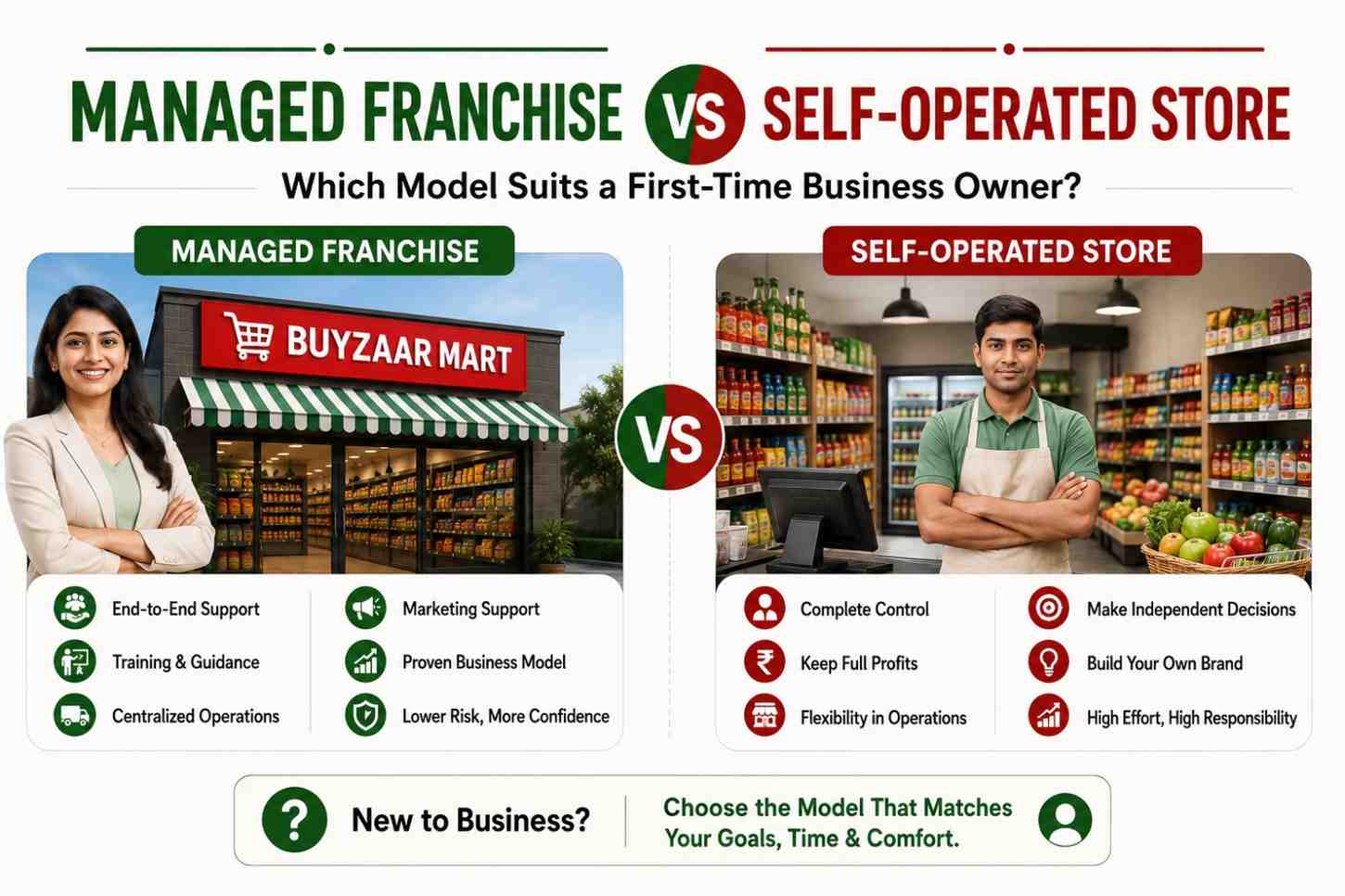
Managed Franchise vs Self-Operated Store: Which Suits a First-Time Business Owner?
Should you start an independent grocery store or choose a managed franchise? A data-backed, honest comparison of both models for first-time business owners in India in 2026.
You have decided to enter the retail business. You have the capital, the location idea, and the motivation. Now comes the question that will shape everything that follows: Do you build your own independent store from scratch — or do you join a managed franchise model? Both paths can lead to a profitable business. Both require capital, effort, and commitment. But they are fundamentally different in what they demand from you, what they protect you from, and how long they take to become profitable. For a first-time business owner, these differences are not minor — they are often the difference between building a sustainable store and shutting within two years. For a first-time investor with no prior experience, a well-researched franchise business is almost always the safer starting point. You get a proven system, operational support, and a much shorter learning curve.
Defining the Two Models Clearly
Self-Operated Independent Store: An independent grocery store is one where you — the owner — are responsible for every decision and every function. You choose the store name, design the interior, source products from your own supplier network, set your own pricing, build your own technology stack (or operate without one), hire and train staff without a structured system, and handle all marketing, operations, and customer management independently. Full control, no brand restrictions, and complete ownership of decisions — however, when you go deeper into operations, scalability, and long-term growth, the reality becomes more complex.
Managed Franchise Model: A managed franchise — like the Buyzaar Mart model — means you own the store and invest the capital, but operate under a proven brand's systems, supply chain, technology, and operational framework. The franchisor provides the playbook; you execute it locally. The brand handles procurement, logistics, technology, and marketing infrastructure. You bring presence, community relationships, and day-to-day management. Company-managed franchise models align with the 2026 retail transformation by combining ownership with professional management.
Dimension 1: Prior Experience Required
Independent Store: Building a successful independent grocery store from scratch requires working knowledge of product sourcing, supplier negotiation, inventory management, pricing strategy, store layout, staff management, and local marketing — all simultaneously, from Day 1. Most first-time entrepreneurs discover they have expertise in one or two of these areas and are learning the rest in real time — with their own money paying for every mistake. The learning curve is real, steep, and costly.
Managed Franchise: The managed franchise model is specifically designed for people without prior retail experience. With an established brand, proven business model, and training support, you do not need deep business experience to begin. The franchise system converts complex multi-domain expertise into a structured, teachable operating model — so you execute a proven system rather than inventing your own.
✅ Verdict: Managed franchise wins clearly for first-time owners with no retail background.
Dimension 2: Investment and Hidden Costs
Independent Store: The headline investment may appear lower — no franchise fee, no royalty structure. But hidden costs accumulate fast: supplier deposits, premium pricing from wholesalers, technology setup from scratch, marketing collateral design, store branding, and the cost of early inventory mistakes add up quickly and unpredictably. An independent store owner routinely spends 25 to 40% more than their initial estimate — because they did not know what they did not know. When you start your own business, you are paying for every mistake with your own money.
Managed Franchise: Total investment is transparent and disclosed upfront — covering franchise fee, interior fit-out, POS technology, initial inventory, security deposit, and working capital. Centralised procurement means you pay network-negotiated prices from Day 1 — not the premium that a single independent store pays to wholesalers. Monthly profit between ₹30,000 and ₹3,00,000 or more is achievable, with break-even within 6 to 24 months. The Buyzaar Mart model offers a live investment calculator on the franchise page — so total investment is calculable before you commit.
✅ Verdict: Managed franchise offers more predictable total cost and better product pricing through centralised procurement.
Dimension 3: Supply Chain and Product Sourcing
Independent Store: An independent store owner must build the entire supplier network from scratch — identifying distributors for every product category, negotiating credit terms, managing multiple delivery schedules, handling quality disputes, and replacing underperforming suppliers. This process takes months to optimise and years to master. Product availability inconsistencies directly damage customer trust during the critical early period when loyalty is being established.
Managed Franchise: The Buyzaar Mart centralised supply chain handles all procurement, pricing, logistics, and delivery scheduling. Franchise partners do not negotiate with suppliers — the network does it at scale, passing competitive pricing to all stores. Inventory delivery arrives on schedule; inventory alerts are system-generated and reorder suggestions are data-driven. The Hassle-Free Inventory Assurance policy protects franchise partners from the working capital risk of expired or damaged stock — a protection independent store owners simply do not have.
✅ Verdict: Managed franchise eliminates the most complex and failure-prone aspect of independent grocery retail entirely.
Dimension 4: Technology and Data
Independent Store: Most independent grocery store owners in India operate on basic billing software or paper records — without sales analytics, inventory forecasting, or customer data management. Building a proper POS system, inventory app, and analytics dashboard independently costs ₹50,000 to ₹2,00,000 in setup and annual licensing — before factoring in the time to learn and maintain it. Without data, inventory decisions are made on instinct — leading to overstocking, understocking, and preventable wastage.
Managed Franchise: In 2026, retail is becoming system-driven, technology-enabled, and supply-chain focused. The Buyzaar Mart POS system, inventory management app, and sales analytics dashboard are fully configured and operational from Day 1 — included in the franchise setup. Every franchise partner has real-time access to daily sales data, near-expiry alerts, inventory consumption reports, and customer loyalty programme analytics — from their phone, from anywhere. This technology capability gives Buyzaar Mart franchise partners the data visibility of a large retail chain at small-store investment levels.
✅ Verdict: Managed franchise delivers enterprise-level technology at accessible cost with zero setup effort from the owner.
Dimension 5: Brand Recognition and Customer Trust
Independent Store: A new independent store starts with zero brand recognition — the owner must build trust from scratch, customer by customer, over months and years. People tend to be loyal to brands they already know, which makes customer acquisition genuinely difficult during the start-up phase. Customer acquisition in the early months relies entirely on physical proximity and word-of-mouth — with no brand signal to accelerate the process.
Managed Franchise: A Buyzaar Mart franchise store opens with an established brand identity — consistent visual standards, recognised store format, and the credibility signal of an organised retail brand. Customers are more likely to purchase from a recognised brand — even in a neighbourhood store context, the familiarity of a branded format reduces the time it takes for new customers to try the store. Marketing support, promotional campaigns, and the loyalty programme are all built into the franchise system — giving the new store a structured customer acquisition and retention infrastructure from Day 1.
✅ Verdict: Managed franchise accelerates customer trust and brand recognition versus a zero-baseline independent launch.
Dimension 6: Risk Profile
Independent Store: Every risk in an independent store is borne entirely by the owner — supplier failure, technology breakdown, inventory misjudgement, staff hiring mistakes, and marketing ineffectiveness all land squarely on one person. There is no support team to call, no operational SOP to follow, and no safety net of any kind. More than 90% of independent businesses in India close within five years — a failure rate driven largely by the compounding of avoidable operational mistakes in the early phase. Startups typically take 2 to 5 years before showing returns.
Managed Franchise: The managed franchise model distributes risk between the franchise partner and the brand — supply chain risk, technology risk, and procurement risk are all absorbed by the franchise system. Inventory assurance, supply chain support, and ongoing operational guidance reduce the three most common causes of early-stage grocery retail failure. Franchise systems help businesses operate with less risk and show greater potential for sustained business expansion. Franchises typically give faster returns within 6 to 18 months compared to startups that take 2 to 5 years, and banks prefer lending to franchises due to their lower risk and proven business models.
✅ Verdict: Managed franchise significantly reduces the risk profile for first-time investors, particularly in the critical first 18 months.
Dimension 7: Control and Flexibility
Independent Store: An independent store gives you full control over every decision — product selection, pricing, store design, staff policies, and promotional strategy are entirely yours. This control is genuinely valuable for experienced retail operators who have a clear vision and the knowledge to execute it. For first-time owners, however, full control means full responsibility for every mistake — and the learning curve of discovering what you do not know through trial and error at your own cost.
Managed Franchise: Franchise partners operate within the brand's guidelines — product range, pricing policies, store standards, and technology systems are defined by the franchisor. Opening a franchise is like being guided through a set of instructions, whereas opening a business on your own would be like creating your own storyline. The trade-off of reduced control for reduced risk is a rational exchange for a first-time owner who does not yet have the knowledge base to justify full operational independence. Within the Buyzaar Mart framework, franchise partners retain significant local flexibility — in customer relationships, community engagement, staffing decisions, and marketing execution.
✅ Verdict: For experienced operators — independent store. For first-time owners — managed franchise's structured guidance far outweighs the loss of full control.
Dimension 8: Path to Growth
Independent Store: Growth from an independent store depends entirely on the owner's ability to build systems, train staff, and create replicable processes — capabilities that typically take 3 to 5 years to develop. Scaling to a second location means rebuilding the supplier network, technology stack, and operational framework from scratch again. Most independent grocery store owners plateau at a single store because the business is too dependent on their personal presence to scale.
Managed Franchise: A franchise partner who has successfully operated one Buyzaar Mart store can apply the same system to a second or third location with significantly lower incremental effort. The brand's support infrastructure, supply chain, and technology scale with the franchise partner — meaning growth does not require rebuilding the foundation. The growth trajectory — from a stable first store to a second location within 24 months — is achievable in a managed franchise but rare in an independent store.
✅ Verdict: Managed franchise creates a clearer, faster, and more replicable growth path.
The Scorecard: Managed Franchise vs Self-Operated Store
Prior Experience Required — Independent Store: High | Managed Franchise: Not required
Investment Predictability — Independent Store: Low (hidden costs common) | Managed Franchise: High (transparent upfront)
Supply Chain Support — Independent Store: None — build from scratch | Managed Franchise: Centralised, fully managed
Technology — Independent Store: Manual or costly to build | Managed Franchise: POS + analytics from Day 1
Brand Recognition — Independent Store: Zero at launch | Managed Franchise: Established brand identity
Risk Profile — Independent Store: Owner bears all risk | Managed Franchise: Shared with brand system
Control Level — Independent Store: Full — high risk for beginners | Managed Franchise: Guided — structured for safety
Growth Path — Independent Store: Slow — system-dependent | Managed Franchise: Faster — proven, replicable
When an Independent Store Makes Sense
In the interest of genuine balance, there are specific circumstances where an independent store is the right choice. If you have 5 or more years of direct retail experience — meaning you already know supplier networks, understand pricing dynamics, and have managed store teams before — you have the foundation to succeed independently. If you have a genuinely unique product proposition that a franchise model cannot accommodate — an exclusive local sourcing arrangement, a specialised product category, or a hyperlocal community need — building your own store preserves that advantage. If you are willing to absorb 2 to 4 years of lower income while building your own systems — financially, emotionally, and in terms of family support — the long runway becomes manageable. And if you have a strong mentor network in the retail sector who can provide guidance comparable to what a franchise system provides institutionally, you are not building alone. If these conditions describe you, an independent store gives you the freedom to build exactly what you envision, on your own terms. If they do not — and for most first-time business owners in India they do not — the managed franchise model is the rational, lower-risk, faster-return choice.
The Buyzaar Mart Model: Built Specifically for First-Time Owners
For many investors in 2026, structured franchise models — especially company-managed systems like the one followed by Buyzaar Mart — are becoming a more practical and scalable option. The Buyzaar Mart franchise model is designed from the ground up for entrepreneurs who are entering retail for the first time. Three store formats are available to match different investment levels and location types. The Mini Mart format covers 600 to 1,000 sq. ft. and starts from approximately ₹15 lakh, making it accessible for first-time investors in residential neighbourhoods. The Super Mart format spans 1,001 to 3,000 sq. ft. and is suited for larger residential catchments that can support a wider product range. The Hyper Mart format runs from 3,001 to 8,000 sq. ft. and is designed for high-footfall commercial zones where volume and variety drive footfall. The brand operates across Uttar Pradesh and the broader NCR corridor — in cities like Meerut, Ghaziabad, Noida, Saharanpur, and Bulandshahr — and is actively expanding its franchise network with partners who are ready to build a real business in their neighbourhood.
Conclusion: The Right Model Depends on Where You Are Starting From
The honest conclusion of this comparison is not that one model is universally better than the other. It is that the right model depends on your experience, your risk tolerance, and your honest assessment of what you know and do not know about running a retail business. For most first-time business owners in India — without prior retail experience, without established supplier relationships, and without an operational system already in their head — the managed franchise model removes the barriers that cause most independent stores to fail, and replaces them with a proven system designed to help you succeed. Opening a franchise is like being guided through a set of instructions, whereas opening a business on your own would be like creating your own storyline. Build your story — with the right foundation underneath it.
Ready to Explore the Buyzaar Mart Managed Franchise Model?
🌐 Website: thebuyzaarmart.com/franchise
📞 Phone: 9217991727
📧 Email: info@thebuyzaarmart.com
Frequently Asked Questions
What is the main difference between a managed franchise and a self-operated independent store?
In a self-operated independent store, the owner is responsible for every function — supplier sourcing, pricing, technology, marketing, staff training, and operations — entirely on their own, with no support system. In a managed franchise like Buyzaar Mart, the owner invests the capital and manages the store locally, but operates within a proven brand's systems, supply chain, technology, and operational framework. The franchisor provides the playbook; the franchise partner executes it. For a first-time owner, this distinction is the difference between a steep, costly learning curve and a supported, structured path to profitability.
Is a managed franchise better than an independent store for a first-time business owner in India?
For most first-time business owners — without prior retail experience, established supplier relationships, or an operational system already developed — a managed franchise is the significantly lower-risk, faster-return choice. Franchise businesses in India achieve break-even in 6 to 18 months, compared to 2 to 5 years for independent startups. More than 90 percent of independent businesses in India close within five years, while close to 70 percent of franchise businesses succeed within the same period. The managed franchise model removes the most common failure points — supply chain, technology, and procurement complexity — and replaces them with a proven system.
What hidden costs do independent grocery store owners typically face that franchise owners avoid?
Independent store owners commonly underestimate total investment by 25 to 40 percent due to hidden costs including: higher wholesale pricing (no volume negotiation leverage), technology setup costs of ₹50,000 to ₹2,00,000 for a basic POS and inventory system, store branding and marketing collateral design, FSSAI and GST compliance costs, initial inventory losses from inexperienced ordering, and supplier deposit requirements. Franchise partners in the Buyzaar Mart model benefit from centralised procurement pricing, pre-configured technology, and a transparent upfront investment estimate — significantly reducing the hidden cost risk.
How does the Buyzaar Mart franchise supply chain benefit first-time franchise owners versus independent store owners?
The Buyzaar Mart centralised supply chain handles all procurement, pricing, logistics, and delivery scheduling on behalf of franchise partners. Independent store owners must build their entire supplier network from scratch — a process that takes months to optimise and years to master — while managing quality disputes, unreliable delivery schedules, and premium wholesale pricing. Buyzaar Mart franchise partners receive network-negotiated product pricing from Day 1, scheduled inventory deliveries, system-generated reorder suggestions, and Hassle-Free Inventory Assurance for expired or damaged stock — protections that independent store owners simply do not have.
Does a managed franchise give the owner enough control over their business?
A managed franchise operates within the brand's guidelines — product range, pricing policies, store standards, and technology systems are defined by the franchisor. However, within this framework, Buyzaar Mart franchise partners retain significant local flexibility in customer relationships, community engagement, staffing decisions, and marketing execution. For first-time owners, the trade-off of reduced control for reduced risk is a rational exchange. Full control is genuinely valuable only when the owner has the knowledge and experience to exercise it correctly. For an experienced operator — an independent store. For a first-time owner — the structured guidance of a managed franchise far outweighs the loss of full control.
How long does it take a managed franchise to break even compared to an independent store?
Franchise businesses in India typically achieve break-even within 6 to 18 months, with most well-located grocery franchises hitting this milestone within 12 to 24 months. Independent startups typically take 2 to 5 years before showing consistent returns — and the majority do not survive long enough to reach sustained profitability. The faster break-even in a managed franchise is driven by the brand recognition that reduces customer acquisition time, centralised supply chain pricing that improves margins from Day 1, and the operational system that reduces costly early-phase mistakes.
What technology does a Buyzaar Mart franchise provide that an independent store owner would have to build themselves?
A Buyzaar Mart franchise includes a fully configured POS billing system, inventory management app, real-time sales analytics dashboard, near-expiry product alerts, customer loyalty programme, and daily financial reporting — all operational from Day 1. Building an equivalent technology stack independently would cost an independent store owner ₹50,000 to ₹2,00,000 in setup and annual licensing, plus significant time to learn, configure, and maintain. The franchise owner has enterprise-level data visibility from launch without any technology setup effort or cost beyond the franchise investment.
When does an independent store make more sense than a managed franchise?
An independent store is the right choice when: you have 5 or more years of direct retail experience with established supplier networks; you have a genuinely unique product proposition that a franchise model cannot accommodate; you are willing and financially able to absorb 2 to 4 years of lower income while building your own systems; and you have a strong mentor network in the retail sector. If these four conditions apply, an independent store gives you full freedom to build exactly what you envision. If they do not — which is true for most first-time business owners in India — the managed franchise model is the rational choice.
How does a managed franchise create a better path to growth than an independent store?
A managed franchise creates a replicable growth path because the systems, supply chain, technology, and operational framework are already built and proven. A franchise partner who successfully operates one Buyzaar Mart store has demonstrated the ability to execute the system — and can apply it to a second or third location with significantly lower incremental effort. Independent store growth requires rebuilding the supplier network, technology stack, and operational framework from scratch for each new location — a process that limits most independent store owners to a single store. The Buyzaar Mart growth trajectory — from stable first store to second location within 24 months — is achievable in a managed franchise but rare in an independent store.
How can I apply for a Buyzaar Mart franchise?
You can apply by visiting www.thebuyzaarmart.com/franchise, calling 9217991727, or emailing info@thebuyzaarmart.com. The Buyzaar Mart franchise team conducts an initial consultation to understand your location, available space, budget, and goals. They provide an investment calculator to model total costs transparently, conduct a professional site evaluation of your proposed location, and support you through the full onboarding process — from store setup and staff training to supply chain initialisation and launch.