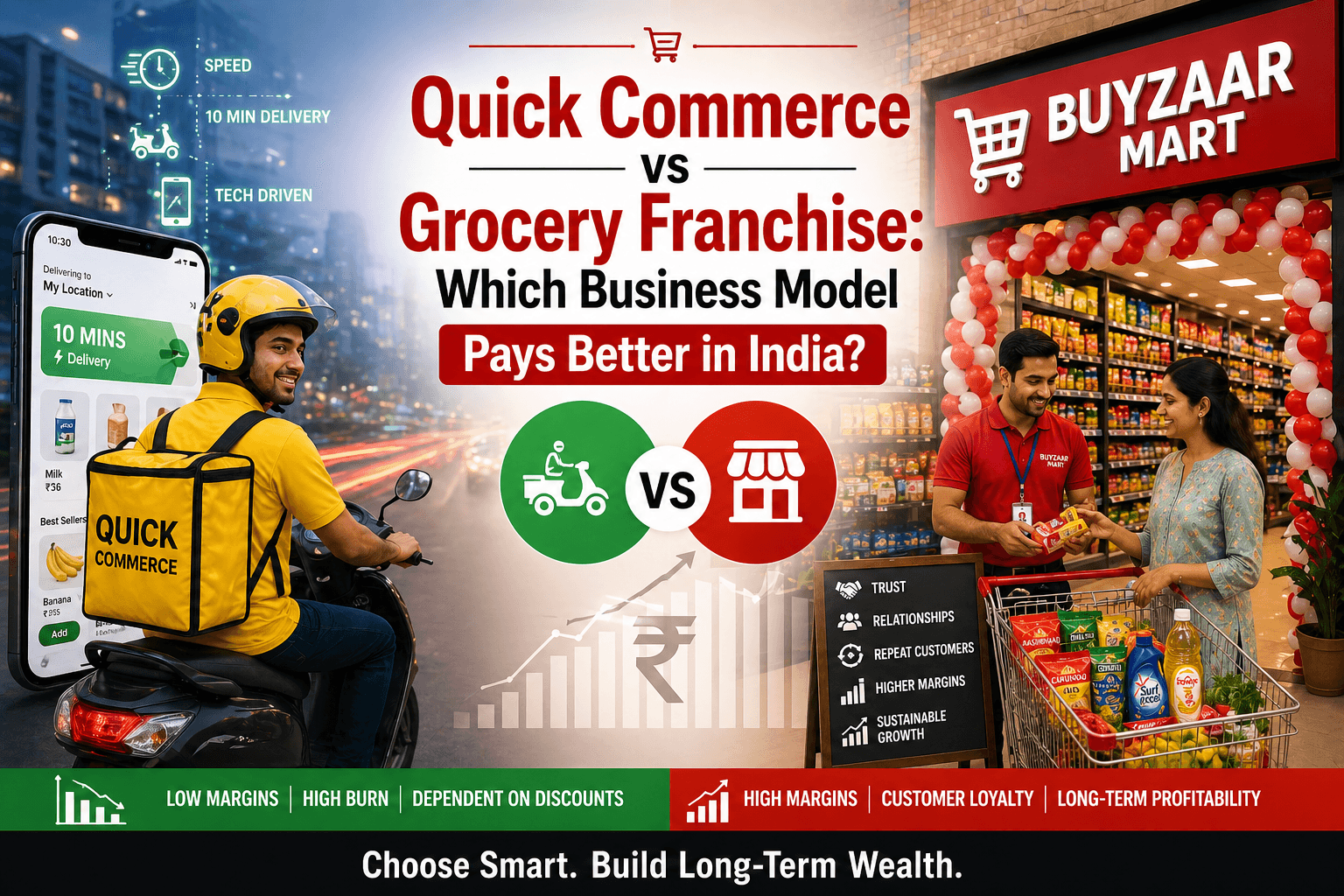
Quick Commerce vs Grocery Franchise: Which Business Model Pays Better in India?
Quick commerce is booming — but is it profitable for investors? Compare Q-commerce vs grocery franchise on margins, risk, investment & long-term returns. The honest 2026 breakdown.
Open Instagram, YouTube, or LinkedIn in 2026 and you will find no shortage of content about quick commerce. Blinkit. Zepto. Swiggy Instamart. Flipkart Minutes. Amazon Now. The 10-minute grocery delivery revolution has captured the imagination of Indian consumers, investors, and media alike — and for good reason. The sector surged to approximately ₹64,000 crore in gross order value in FY25 and continues its headline-generating expansion. But here is the question that rarely gets answered clearly: if you are an entrepreneur with ₹15 to ₹50 lakh to invest in a retail business, which model actually pays better — quick commerce or a grocery franchise? Not which model is more exciting. Not which one raises the most venture capital. Which one puts more rupees in your pocket, more reliably, over a five-year horizon? This blog answers that question honestly — comparing quick commerce and the grocery franchise model across six critical dimensions: capital requirement, revenue model, profit margins, risk profile, geographic reach, and long-term stability.
First, Let Us Understand What You Are Actually Comparing
Before we compare outcomes, it is important to be precise about what each model means for an individual entrepreneur — because the headlines about quick commerce and the reality for small investors are two very different things. Quick Commerce (Q-Commerce) involves ultra-fast delivery of groceries and daily essentials within 10 to 30 minutes, powered by hyperlocal dark stores positioned within 2 to 3 km of the customer. The major Q-commerce platforms in India — Blinkit, Zepto, Swiggy Instamart, Flipkart Minutes, and Amazon Now — are corporate-funded technology companies. Individual entrepreneurs do not own a Q-commerce business in the traditional sense. Your options as a small investor in the Q-commerce ecosystem are limited: you can operate a dark store partner location (essentially a warehousing and fulfilment contract), or you can list your existing store on a platform (which makes you a supplier, not a business owner).
Grocery Franchise — specifically the managed neighbourhood store model like Buyzaar Mart — involves owning and operating a physical retail store under a proven brand. The franchise partner invests in a store, uses the brand's supply chain, technology, and operational systems, serves customers directly, and earns revenue from product sales with gross margins that belong entirely to them. The comparison, therefore, is between being a small investor in someone else's platform versus being an owner of your own branded store with full margin ownership. That is a fundamentally different risk-reward equation — and it is the one that matters most to an entrepreneur evaluating where to put their capital.
Round 1: Capital Requirement — What Does It Cost to Get In?
Quick Commerce (Dark Store Partner): If you want to participate in Q-commerce as a dark store partner, your capital requirements include warehouse space rental, cold storage setup for perishables, initial inventory, staffing for pickers and packers, and technology integration costs. Estimates for a functional dark store setup in a Tier-2 city range from ₹20 lakh to ₹60 lakh depending on store size and category mix. But here is what the headlines rarely clarify: the margins you receive as a dark store operator are determined by the platform, not by you. You are a logistics partner, not a brand owner. The platform controls pricing, discount policies, delivery charges, and your per-order payout.
Grocery Franchise (Buyzaar Mart): A Buyzaar Mart Mini Mart franchise starts from approximately ₹15 lakh — making it one of the most accessible structured retail investment opportunities in India. The investment covers franchise fee, store interior and fit-out, POS technology setup, initial inventory, and security deposit. Super Mart and Hyper Mart formats scale up accordingly, offering higher revenue potential for larger investments. Critically, the margin structure in a grocery franchise is yours. You own the customer relationship, the store revenue, and the gross margin on every product sold. Verdict on Capital: Grocery franchise offers a more accessible entry point with direct margin ownership. Q-commerce dark store partnerships require comparable or higher investment but with platform-controlled, not owner-controlled, returns.
Round 2: Revenue Model — Where Does Your Money Come From?
Quick Commerce: The Q-commerce revenue model for a platform partner is fundamentally order-volume dependent. Your income comes from per-order fulfilment fees paid by the platform, based on how many orders the platform routes to your dark store. If the platform reduces order routing in your area — because of competitive dynamics, a promotional shift, or a technology change — your revenue falls accordingly. You have no direct relationship with the customer. You have no brand. You have no loyalty. You are a fulfilment node. The Q-commerce market in India in 2026 is entering what analysts describe as its most competitive phase — with Blinkit, Zepto, Swiggy Instamart, Flipkart Minutes, and Amazon Now all aggressively competing for the same urban customer base. Mergers, shutdowns, and acquisitions are expected in 2026.
Grocery Franchise: A grocery franchise store generates revenue directly from customer transactions — every person who walks into your store, fills a basket, and bills at the counter. This revenue is not mediated by a platform algorithm. It is not subject to routing decisions made in a distant headquarters. It comes from your neighbourhood, from customers who know your face, trust your store, and return multiple times a week. The Buyzaar Mart model adds a customer loyalty programme that drives repeat purchases and higher average basket values over time. The more your community trusts your store, the higher your daily revenue — and that relationship is built by you, owned by you, and cannot be taken away by a platform policy update. Verdict on Revenue: Grocery franchise revenue is direct, community-anchored, and owner-controlled. Q-commerce partner revenue is platform-dependent, algorithm-mediated, and externally controlled.
Round 3: Profit Margins — What Actually Reaches Your Pocket?
Quick Commerce: Q-commerce platforms operate on thin margins structurally. The high operating costs of the model — dark store rent, refrigeration, picker and packer salaries, last-mile delivery rider payouts, packaging, and technology — consume a significant portion of gross revenue. Mystery shopping in Bengaluru found average grocery discounts of around 17 percent — discounts that ultimately come out of someone's margin. The financial data confirms this. Blinkit — the market leader with over 50 percent market share — only reached adjusted EBITDA breakeven in Q3 FY26 (December 2025), posting a profit of ₹4 crore after a ₹156 crore loss just one quarter earlier. Zepto and Swiggy Instamart are still working toward consistent profitability. For a platform partner operating a dark store, the per-order economics are even thinner than the platform-level numbers suggest — because the partner absorbs fixed costs while per-order payouts are optimised for the platform's economics, not the partner's.
Grocery Franchise: In a well-run grocery franchise, FMCG products deliver gross margins of 10 to 12 percent on standard products, with speciality categories — personal care, home care, and certain staples — reaching 18 to 20 percent gross margins. These are margins that belong directly to the franchise owner, with no platform intermediary taking a cut. The Buyzaar Mart model's zero-royalty structure means franchise partners retain a significantly higher share of their gross margin than in traditional royalty-based franchise models. Most franchise businesses in India start turning a profit in approximately 18 to 24 months. For a neighbourhood grocery store with daily recurring FMCG demand — where every household buys multiple times per week, 365 days a year — that break-even timeline is among the most predictable in Indian entrepreneurship. Verdict on Margins: Grocery franchise margins are direct, owner-owned, and structurally superior for individual investors. Q-commerce partner margins are thin, platform-dependent, and still unproven at scale.
Round 4: Geographic Reach — Where Can You Actually Operate?
Quick Commerce: Q-commerce's dark store model is built for density. It works best — and only works profitably — in high-density urban areas where order frequency is high enough to justify the dark store's fixed costs. Industry analysts are explicit that only affluent areas might be profitable for dark stores, with serious questions about the model's reach beyond busy metro cities. In 2026, Q-commerce platforms are only beginning to test Tier-2 city expansion in cities like Jaipur, Lucknow, and Coimbatore. Whether unit economics hold outside the top 8 to 10 cities is still an open question. For entrepreneurs in cities like Meerut, Ghaziabad, Saharanpur, Bulandshahr, or any Tier-2 or Tier-3 market, the Q-commerce opportunity is either unavailable or deeply uncertain.
Grocery Franchise: A neighbourhood grocery franchise like Buyzaar Mart is designed precisely for the markets where Q-commerce does not — and may never — reach profitably. Tier-2 and Tier-3 cities, residential colonies, mid-sized towns, and growing urban peripheries are the natural home territory of the neighbourhood store model. These markets have dense populations with daily grocery needs, rising incomes, and a structural appetite for the organised retail experience — without the high-order-frequency and high-density requirements that Q-commerce needs to break even. India's retail growth story in 2026 is being written in its smaller cities — not just its metros. The grocery franchise model can participate in that growth everywhere. Q-commerce, structurally, cannot. Verdict on Geography: Grocery franchise operates profitably across Tier-1, Tier-2, and Tier-3 markets. Q-commerce is fundamentally a metro-centric model with unproven unit economics beyond high-density urban areas.
Round 5: Risk Profile — What Can Go Wrong?
Quick Commerce: The risk profile of a Q-commerce dark store investment is concentrated and platform-dependent. Your single biggest risk is not your own operational performance — it is your platform's business decisions. If Blinkit adjusts its dark store network, if Zepto consolidates operations, if Swiggy Instamart shifts its fulfilment model, or if a platform folds or is acquired — which analysts explicitly predict will happen to some players in 2026 — your investment is directly exposed. The competitive intensity of the Q-commerce sector in 2026, with Amazon, Flipkart, Reliance, Zomato, and Zepto all simultaneously expanding, creates a battlefield where individual platform partners face significant uncertainty.
Grocery Franchise: The risk profile of a grocery franchise is operational — meaning it is largely within your control. Your revenue depends on your neighbourhood, your customer relationships, your store quality, and your operational consistency. These are risks that an engaged, present franchise owner can directly manage and mitigate. The Buyzaar Mart supply chain, technology system, and operational support reduce the structural risks of running a grocery store independently. The grocery category itself is one of the most recession-resistant in retail — every household needs food, personal care products, and daily essentials regardless of economic conditions. Verdict on Risk: Grocery franchise risk is operational and within the owner's control. Q-commerce partner risk is platform-dependent and externally driven — a fundamentally more dangerous risk structure for small investors.
Round 6: Long-Term Stability — Which Model Builds Lasting Value?
Quick Commerce: Quick commerce is a technology and logistics play — and technology landscapes change. The Q-commerce sector in 2026 is entering a consolidation phase. Analysts explicitly forecast mergers, shutdowns, and acquisitions among current players. The platforms that survive will be the ones with the deepest capital reserves and the most efficient dark store networks — not necessarily the ones with the most dark store partners. For an individual investor who has committed ₹20 to ₹60 lakh to a Q-commerce dark store partnership, the long-term value of that investment depends entirely on the long-term survival and strategic priorities of a third-party platform. That is not an investment in your own business. It is a bet on someone else's.
Grocery Franchise: A grocery franchise store builds tangible, lasting value over time. Your customer relationships deepen. Your community loyalty grows. Your operational efficiency improves. Your brand recognition in your neighbourhood compounds year over year. After five years of running a well-managed Buyzaar Mart franchise, you have an asset — a customer base, a location, a reputation, and a cashflowing business — that has real value independent of any platform's decisions. This is the fundamental difference between owning a business and being a contractor for someone else's business. The grocery franchise model builds something you own. Q-commerce partnership builds something you operate on someone else's terms. Verdict on Long-Term Value: Grocery franchise builds durable, owner-controlled business value. Q-commerce partnership creates contractor-style dependence on platform survival.
The Scorecard: Quick Commerce vs Grocery Franchise
Entry Investment: Quick Commerce ₹20L–₹60L vs Grocery Franchise from ₹15L. Revenue Control: Platform-controlled vs Owner-controlled. Gross Margins: Thin and platform-dependent vs 10–20% directly owned. Geographic Flexibility: Metro-only, unproven in Tier-2 and Tier-3 vs Works across all city tiers. Profitability Timeline: Uncertain even at platform level vs 18–24 months on proven model. Risk Type: Platform-dependent and external vs Operational and owner-managed. Long-Term Value Built: Contractor relationship vs Owned business asset. Customer Relationship: None — platform owns it vs Direct, loyal, community-based.
The Honest Conclusion: Q-Commerce Is a Consumer Story. Franchise Is an Investor Story.
Quick commerce is a genuinely remarkable consumer convenience story. The ability to receive groceries in 10 minutes has changed how urban Indians shop, and the sector's growth is real and significant. But convenience for consumers does not automatically translate into returns for investors — and for small, individual entrepreneurs looking to build a profitable retail business in India in 2026, the numbers tell a clear story.
Q-commerce, as a platform business, is still working toward sustainable profitability at the macro level. As a dark store partnership model, it offers thin, platform-controlled margins in a high-competition, consolidation-phase market. The individual investor has limited control, limited upside, and platform-level exposure. The grocery franchise model — specifically a managed, neighbourhood store format like Buyzaar Mart — offers direct margin ownership, community-rooted revenue, geographic flexibility across India's highest-growth retail markets, and the satisfaction of building a business that is genuinely yours. For entrepreneurs who want to own their outcome, the answer is clear.
Explore the Buyzaar Mart Franchise Opportunity Today
🌐 Website: thebuyzaarmart.com/franchise
📞 Phone: 9217991727
📧 Email: info@thebuyzaarmart.com
Frequently Asked Questions
Is quick commerce or a grocery franchise a better investment in India in 2026?
For individual entrepreneurs looking to build a profitable, owner-controlled retail business, a grocery franchise model like Buyzaar Mart is the stronger investment. Grocery franchises offer direct margin ownership (10 to 20 percent gross margins), community-rooted revenue, geographic flexibility across all city tiers, and a proven break-even timeline of 18 to 24 months. Q-commerce dark store partnerships offer thin, platform-controlled margins in a consolidation-phase market where the individual investor has limited control over outcomes.
How much does it cost to start a Q-commerce dark store in India?
Setting up a functional Q-commerce dark store in a Tier-2 city typically requires ₹20 lakh to ₹60 lakh, covering warehouse rental, cold storage, initial inventory, picker and packer staffing, and technology integration. However, returns from this investment are controlled by the platform — the dark store operator earns per-order fulfilment fees determined by the platform's pricing, not their own margin structure.
Are Q-commerce platforms like Blinkit and Zepto profitable in 2026?
Q-commerce profitability at the platform level is still evolving. Blinkit — the market leader — only reached adjusted EBITDA breakeven in Q3 FY26 (December 2025) with a profit of ₹4 crore, after posting a ₹156 crore loss the previous quarter. Zepto and Swiggy Instamart are still working toward consistent profitability. At the individual dark store partner level, margins are even thinner than platform-level numbers suggest, as partners absorb fixed costs while per-order payouts are optimised for the platform's economics.
Can Q-commerce work in Tier-2 and Tier-3 cities in India?
Q-commerce's dark store model requires high order frequency and high population density to be profitable — conditions that currently exist primarily in metro cities. Industry analysts note that only affluent, high-density urban areas are reliably profitable for dark stores. Q-commerce platforms are only beginning to test Tier-2 expansion in 2026, and whether unit economics hold outside the top 8 to 10 cities remains an open question. For entrepreneurs in Tier-2 and Tier-3 markets, the Q-commerce opportunity is either unavailable or economically uncertain.
What are the gross margins in a grocery franchise like Buyzaar Mart?
A well-run Buyzaar Mart grocery franchise earns gross margins of 10 to 12 percent on standard FMCG products, with speciality categories such as personal care and home care reaching 18 to 20 percent. These margins belong directly to the franchise owner — there is no platform intermediary taking a cut. The Buyzaar Mart zero-royalty structure (available for certain formats) allows franchise partners to retain an even higher share of their gross margin compared to traditional royalty-based franchise models.
What is the biggest risk of investing in a Q-commerce dark store partnership?
The biggest risk for a dark store partner is platform dependency. Your revenue depends entirely on how many orders the platform routes to your location — a decision made by the platform's algorithm and business strategy, not your operational performance. If the platform rationalises its dark store network, shifts its fulfilment model, merges with a competitor, or shuts down, your investment is directly exposed. In a market where analysts explicitly forecast consolidation and shutdowns in 2026, this is a material risk for individual investors.
How long does it take for a grocery franchise to break even?
Most grocery franchise businesses in India achieve break-even within 18 to 24 months. For Buyzaar Mart franchise partners who are actively present, community-engaged, and data-driven in their daily management, this timeline can improve further. A well-run franchise can earn monthly profit between ₹30,000 and ₹3,00,000 or more depending on the store format, location, and operational performance.
Does a grocery franchise owner have a direct relationship with customers?
Yes — and this is one of the most important commercial advantages of the franchise model over Q-commerce. In a grocery franchise, the store owner builds direct, ongoing relationships with neighbourhood customers. Customers know the owner, trust the store, and return multiple times per week. This community loyalty drives revenue stability, higher basket values, and word-of-mouth growth. In Q-commerce, the platform owns the customer relationship entirely — the dark store partner has no direct connection to or visibility into the end customer.
What long-term value does a grocery franchise build compared to Q-commerce?
A grocery franchise builds tangible, lasting business value over time — a loyal customer base, a recognised local brand, an established location, and a cashflowing asset that the owner controls. After five years of running a well-managed store, the franchise has real commercial value independent of any third party's decisions. A Q-commerce dark store partnership, by contrast, builds a contractor-style operational relationship with a platform — one whose value depends entirely on that platform's continued investment in the partner's geography.
How can I apply for a Buyzaar Mart grocery franchise?
You can apply by visiting www.thebuyzaarmart.com/franchise, calling 9217991727, or emailing info@thebuyzaarmart.com. The Buyzaar Mart team will guide you through store format selection, site evaluation, investment modelling, and the full onboarding process — giving you a data-backed foundation for your franchise investment decision.