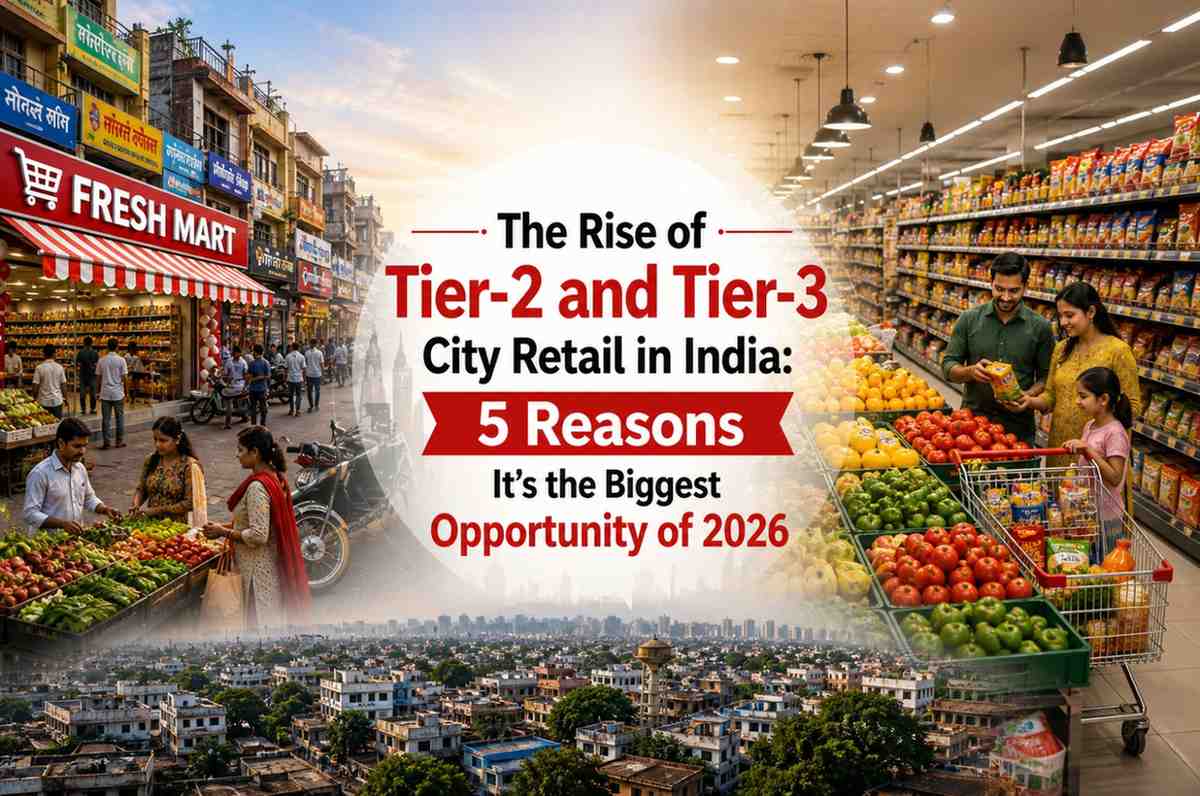
The Rise of Tier-2 and Tier-3 City Retail in India: 5 Reasons It's the Biggest Opportunity of 2026
Tier-2 and Tier-3 cities are India's new retail growth engine in 2026. Discover 5 data-backed reasons why smaller cities are the biggest franchise opportunity — and how Buyzaar Mart fits in.
For decades, the story of Indian retail was told through the lens of its metro cities. Mumbai's glittering malls. Delhi's sprawling market districts. Bengaluru's tech-driven consumer culture. These cities defined what modern retail looked like in India — and every brand, every investor, and every entrepreneur looked to them for direction. That story is changing — fast. In 2026, the most exciting chapter of India's retail revolution is being written not in the metros, but in the cities that most people once considered secondary. Cities like Meerut, Lucknow, Indore, Varanasi, Jodhpur, Nagpur, Coimbatore, and Bulandshahr. India's Tier-2 and Tier-3 cities are no longer waiting for the retail wave to reach them. They are creating it. The data is unambiguous. Industry experts, investment analysts, and retail consultants are in rare agreement: Tier-2 and Tier-3 city retail in India is the single biggest commercial opportunity of 2026 — and possibly the entire decade. This blog breaks down exactly why — with five clear, data-backed reasons — and explains why forward-thinking entrepreneurs are already moving to capitalise on it through models like the Buyzaar Mart franchise.
The Big Picture: What Is Happening in Smaller-City India Right Now?
Before we dive into the five reasons, it helps to understand the scale of what is happening. India's retail industry is currently valued at approximately $1.1 trillion, making it the world's third-largest retail market. For years, the bulk of organised retail spending was concentrated in eight to ten metro cities. But that concentration is now breaking apart.
According to Deloitte India, over 60 percent of e-commerce transactions now originate from Tier-2 and Tier-3 markets. Accenture's managing director called 2025 the year of the 'Bharat surge' — noting that Tier-2 and Tier-3 cities did not merely participate in retail growth, they led it. A KPMG report from April 2026 confirms that Tier-2 and Tier-3 cities drove 66 percent of all new D2C orders in FY 2026. The centre of gravity of Indian retail has shifted. The only question is: are you positioned to benefit from it?
Reason 1: Rising Disposable Incomes Are Creating a New Consumer Class
The most fundamental driver of Tier-2 and Tier-3 city retail growth is economic: people in smaller cities have more money to spend than ever before — and they are spending it. Rising household incomes in non-metro India, driven by improved agricultural earnings, growth in local manufacturing, government employment schemes, and the expansion of regional service industries, have created a new middle-class consumer base that did not exist at this scale a decade ago.
This is not a marginal shift. According to industry data, Tier-2 cities recorded 46 percent year-on-year growth in grocery spending in 2025 alone. Tier-3 cities saw grocery spending grow by 59 percent in the same period. These are not the numbers of a recovering market — they are the numbers of a market in full-scale expansion.
What makes this trend particularly powerful for retail entrepreneurs is the nature of the spending. Consumers in Tier-2 and Tier-3 cities are not just buying more — they are buying differently. They are shifting from loose, unbranded products to packaged, branded goods. They are upgrading from weekly market visits to organised store shopping. They are looking for the clean, reliable, well-stocked retail experience that metros take for granted — and they are willing to spend to get it.
For a grocery and FMCG franchise like Buyzaar Mart, operating in cities like Meerut, Saharanpur, Noida, and Bulandshahr, this consumer upgrade represents a direct and immediate business opportunity. Every household that makes the shift from the local kirana to an organised retail store is a potential loyal customer — and there are millions of them making that transition right now.
Reason 2: Digital Infrastructure Is Making Smaller Cities Shop-Ready
The second reason Tier-2 and Tier-3 city retail is exploding in 2026 is infrastructure — specifically, digital infrastructure. India's internet user base surpassed 950 million by late 2025, with rural and semi-urban areas now accounting for over 57 percent of all active users. Internet penetration in Tier-2 and Tier-3 cities is currently expanding at an annual rate of approximately 30 percent — nearly double the growth rate of already-saturated metro markets. With 5G now standard across most Tier-2 cities, the gap between urban and non-urban digital access has effectively closed.
The practical impact on retail is enormous. Consumers in smaller cities are now as digitally informed as their metro counterparts. They research products online before purchasing in-store. They compare prices across platforms. They read reviews, watch product videos, and follow brand content on social media. Their expectations around product quality, store experience, and service standards are almost identical to metro consumer expectations.
Digital payments have also undergone a transformation in non-metro India. UPI platforms — GPay, PhonePe, Paytm — are now standard even for the smallest merchants in Tier-3 towns. Customers in Tier-2 and Tier-3 cities are comfortable making repeat purchases digitally, which drives both transaction frequency and basket size.
For a tech-enabled retail franchise like Buyzaar Mart — which operates a digital POS system, app-based inventory management, and a customer loyalty programme — this digital-ready consumer base is the ideal operating environment. The technology investments built into the Buyzaar Mart system are not ahead of their time in these markets. They are exactly on time.
Reason 3: Metro Markets Are Saturated — The Real Competition Is in Smaller Cities
Here is the honest commercial reality that many entrepreneurs overlook: metro retail markets in India are, in large parts, saturated. Mumbai, Delhi NCR, Bengaluru, and Hyderabad are home to every major domestic and international retail chain. Commercial rents in these cities are among the highest in Asia. Customer acquisition costs are elevated. Competitive density is extreme. Breaking into metro retail as a new franchise in 2026 means competing for a shrinking share of a maturing market.
The situation in Tier-2 and Tier-3 cities is the exact opposite. Commercial rentals in Tier-2 cities are 30 to 50 percent lower than comparable metro locations, reducing both upfront investment and monthly operating costs. The density of organised retail competitors is a fraction of what it is in metros. Customer loyalty, once earned in a smaller city, tends to run deep — because the alternatives are fewer and the community relationships are stronger.
According to franchise industry analysts, approximately 50 percent of all new franchise enquiries in India in 2026 are now coming from Tier-2 and Tier-3 cities — a significant indicator that savvy entrepreneurs already understand where the opportunity lies.
For a franchise seeker evaluating locations, the calculus is straightforward. In a metro city, you are competing on price and convenience against dozens of established players with deeper pockets. In a Tier-2 or Tier-3 city, you are often among the first to bring a professional, branded retail experience to your neighbourhood — and in that context, you are not fighting for market share. You are creating it. This is precisely why Buyzaar Mart's expansion strategy is focused on cities across Uttar Pradesh and other non-metro growth markets.
Reason 4: Infrastructure Development Is Unlocking New Retail Catchment Areas
India's infrastructure story is not just about highways and airports — it is a retail story. In February 2026, the Cabinet approved an INR 1 lakh crore Urban Challenge Fund specifically designed to drive market-led urban transformation in India's smaller cities. Smart City projects are reshaping urban planning in hundreds of Tier-2 and Tier-3 locations. New regional airports are dramatically improving connectivity, making previously isolated commercial centres part of wider economic networks. Ring roads, metro rail extensions, and high-speed highway corridors are expanding the effective retail catchment areas of smaller cities.
The warehousing sector tells a parallel story. According to JLL, Tier-2 and Tier-3 cities are driving a 100-million-square-foot warehousing boom in India — a direct indicator that supply chain infrastructure in these markets is maturing rapidly. For retail franchise operators, better warehousing means better product availability, faster restocking, and more reliable supply chains.
This infrastructure build-out matters because it removes one of the traditional barriers to organised retail expansion in smaller cities: logistics. In the past, the cost and complexity of supplying stores in non-metro locations made organised retail economically challenging. Today, that barrier is eroding rapidly — and brands with established supply chains, like Buyzaar Mart, are benefiting directly.
The combination of physical infrastructure improvement and digital infrastructure advancement is creating what analysts describe as a structural shift — not a cyclical trend. This is not retail expansion that will reverse when the economy cools. It is the permanent formalisation of India's non-metro consumer economy.
Reason 5: Aspirational Consumers Are Demanding Organised Retail — Right Now
The fifth and perhaps most compelling reason Tier-2 and Tier-3 city retail is the biggest opportunity of 2026 is the nature of the consumer herself. India is expected to add nearly 100 million new consumers to branded and organised retail by 2030, and a disproportionate share of them will come from smaller cities. These are not passive, price-only consumers. They are aspirational shoppers who have watched metro consumer culture through social media, OTT platforms, and digital content — and they want it.
Social media has collapsed the time it takes for retail trends to travel from metros to smaller cities. What once took years to reach Tier-3 towns now spreads within days. Consumers in cities like Varanasi, Bareilly, and Aligarh are aware of branded product launches almost simultaneously with consumers in Gurugram or Pune. Their expectations of store quality, product range, and retail experience are rising in real time.
This aspirational demand is not limited to premium or lifestyle products. It applies equally to everyday grocery and FMCG shopping. Consumers in non-metro India are increasingly dissatisfied with the limited range, inconsistent stock, and informal experience of traditional kirana stores. They want clean, organised, well-lit stores with reliable product availability, branded goods, and digital payment options. They want, in short, what Buyzaar Mart offers.
The retail formats that will win in Tier-2 and Tier-3 India are not transplanted metro concepts — they are models specifically designed for the neighbourhood store format, combining organised retail standards with local community values. That is exactly the positioning that the Buyzaar Mart franchise has built its brand around: a smart neighbourhood store that serves daily needs with the quality and reliability of organised retail, at investment levels accessible to local entrepreneurs.
The Buyzaar Mart Advantage in This Landscape
Understanding why Tier-2 and Tier-3 city retail is growing is one thing. Knowing how to participate in that growth is another. Buyzaar Mart is a retail franchise network built specifically for this market. With store formats ranging from Mini Mart to Super Mart and Hyper Mart, the brand offers franchise partners a complete operating system — supply chain support, tech-enabled POS and inventory management, marketing tools, and operational guidance — at investment levels starting from approximately ₹15 lakh.
The brand currently operates across cities in Uttar Pradesh, one of India's most significant Tier-2 and Tier-3 retail growth markets, and is expanding rapidly. For entrepreneurs in Meerut, Noida, Saharanpur, Bulandshahr, Ghaziabad, and neighbouring cities, the opportunity to become a Buyzaar Mart franchise partner — and to capture a share of this structural retail growth story — is open right now. The brands that establish early presence in these markets will build customer loyalty, brand recognition, and revenue foundations that will compound for years. The window is open. The question is whether you are ready to walk through it.
Conclusion: The Bharat Surge Is Real — and It Is Happening Now
India's retail growth story has been rewritten. The metros had their chapter. Now it is Bharat's turn. Tier-2 and Tier-3 cities are not the future of Indian retail — they are the present. Rising incomes, digital infrastructure, lower competition, rapid physical development, and a generation of aspirational consumers are converging to create the most significant organised retail opportunity India has seen since liberalisation.
For entrepreneurs ready to build something real in their city — a business that serves their community, generates strong returns, and grows with India's consumption story — there has never been a better moment to act.
Explore the Buyzaar Mart Franchise Opportunity in Your City
🌐 Website: thebuyzaarmart.com/franchise
📞 Phone: 9217991727
📧 Email: info@thebuyzaarmart.com
Frequently Asked Questions
Why are Tier-2 and Tier-3 cities considered the biggest retail opportunity in India in 2026?
Tier-2 and Tier-3 cities are experiencing a convergence of factors that make them the most attractive retail growth markets in India — rising disposable incomes, rapid digital infrastructure expansion, lower commercial rents, minimal organised retail competition, and a large base of aspirational consumers actively upgrading from unorganised to organised retail. Industry data confirms that these cities drove 66 percent of all new D2C orders in FY 2026.
How much faster is retail growing in Tier-2 and Tier-3 cities compared to metros?
According to industry data, Tier-2 cities recorded 46 percent year-on-year growth in grocery spending in 2025, while Tier-3 cities saw 59 percent growth in the same period. These growth rates significantly outpace the more mature and saturated metro retail markets.
Is digital payment adoption strong enough in Tier-2 and Tier-3 cities to support a tech-enabled franchise?
Yes. UPI platforms — GPay, PhonePe, and Paytm — are now standard even in Tier-3 towns. With internet penetration in these cities growing at approximately 30 percent annually and 5G now standard across most Tier-2 cities, digital payment habits and consumer comfort with technology are well established in these markets.
Why is metro retail less attractive for new franchise investors compared to smaller cities?
Metro retail markets in India are largely saturated, with extremely high commercial rents, elevated customer acquisition costs, and intense competition from established domestic and international chains. By contrast, Tier-2 and Tier-3 cities offer commercial rentals that are 30 to 50 percent lower, far less organised retail competition, and an opportunity to build early brand presence in an under-served market.
What is driving income growth in Tier-2 and Tier-3 cities?
Multiple factors are contributing — improved agricultural earnings supported by higher Minimum Support Prices, growth in regional manufacturing, government employment and welfare schemes, and the expansion of local service industries. Together, these have created a new middle-class consumer base in non-metro India that has significantly increased household spending capacity over the past five years.
How is India's infrastructure development supporting retail growth in smaller cities?
The government's INR 1 lakh crore Urban Challenge Fund (approved February 2026), Smart City projects, new regional airports, ring roads, metro rail extensions, and highway corridors are all expanding the economic and retail catchment areas of smaller cities. Simultaneously, a 100-million-square-foot warehousing boom in Tier-2 and Tier-3 cities is maturing the supply chain infrastructure that organised retail depends on.
Who is the typical aspirational consumer driving organised retail demand in Tier-2 and Tier-3 cities?
These are middle-income and lower-middle-income consumers — working families, young professionals, and homemakers — who have been exposed to metro retail culture through social media and digital content. They are actively seeking clean, organised, well-stocked retail experiences with branded products and digital payment options, moving away from traditional kirana stores.
Is Buyzaar Mart specifically designed for Tier-2 and Tier-3 city markets?
Yes. Buyzaar Mart's neighbourhood store model — combining organised retail standards with local community values — is purpose-built for non-metro India. With store formats starting from 600 sq ft and investment starting from approximately ₹15 lakh, the brand offers an accessible entry point for local entrepreneurs in Tier-2 and Tier-3 cities across Uttar Pradesh and beyond.
Which cities is Buyzaar Mart currently operating in?
Buyzaar Mart currently operates across cities in Uttar Pradesh, including Noida, Meerut, Saharanpur, Bulandshahr, and Ghaziabad, with ongoing expansion across the state. The brand's geographic focus aligns directly with the Tier-2 and Tier-3 retail growth corridor.
How can I explore a Buyzaar Mart franchise opportunity in my city?
You can visit www.thebuyzaarmart.com/franchise, call 9217991727, or email info@thebuyzaarmart.com to enquire about franchise availability in your city, explore store formats and investment requirements, and book a free consultation with the Buyzaar Mart franchise team.
Related Articles
Why India's Grocery Retail Market Will Grow 35% by 2030 (And What It Means for Investors)
India's retail sector growing from US$952B in 2024 to US$1.6T by 2030. Grocery retail is the largest driver of organised retail capturing 35% market share. Discover why Buyzaar Mart franchise positions investors perfectly in Tier II/III growth markets.
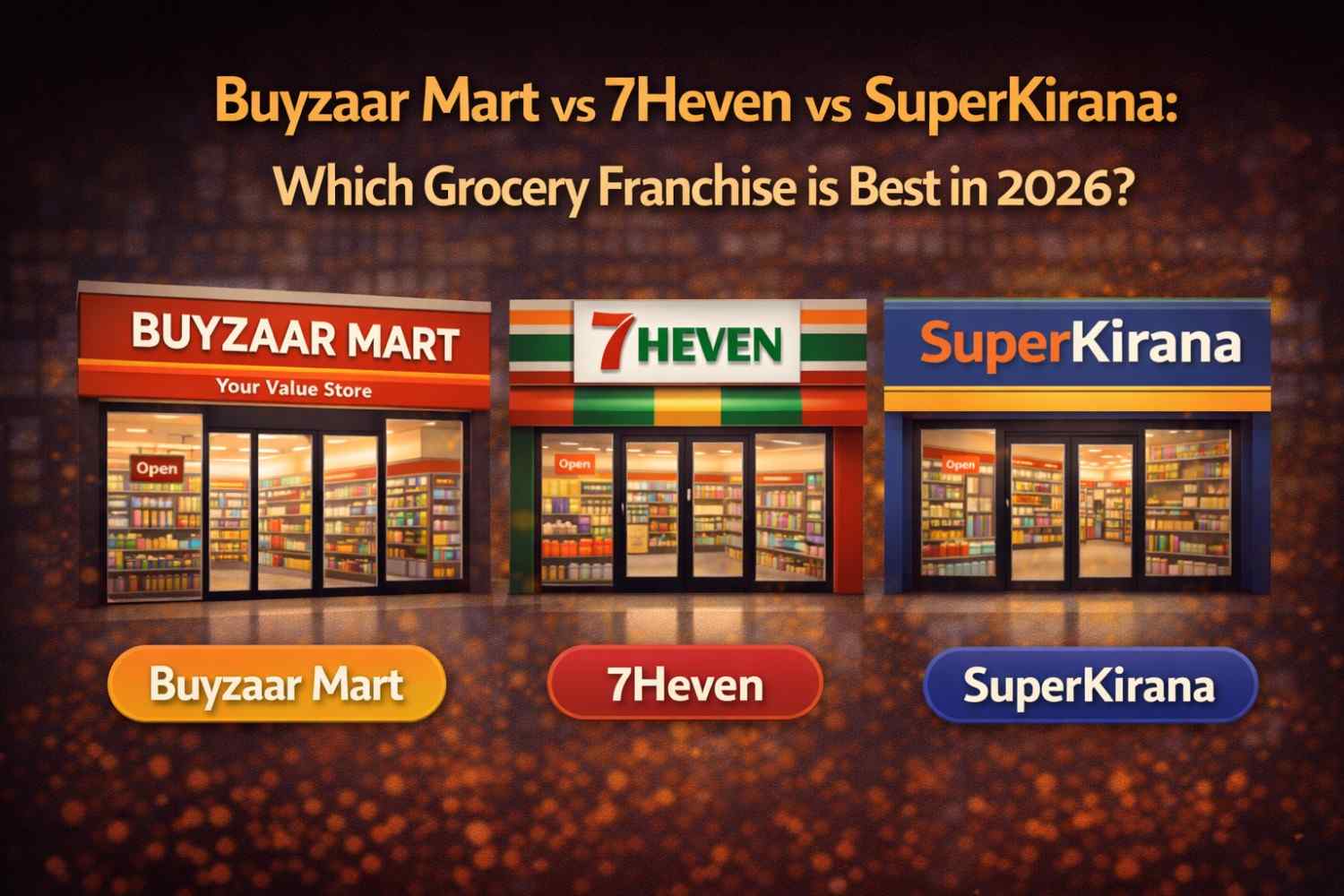
Buyzaar Mart vs 7Heven vs SuperKirana: Which Grocery Franchise is Best in 2026?
Buyzaar Mart, 7Heven, and SuperKirana — all three promise grocery franchise success. But which one actually delivers for investors in India's Tier 2 and Tier 3 cities in 2026?