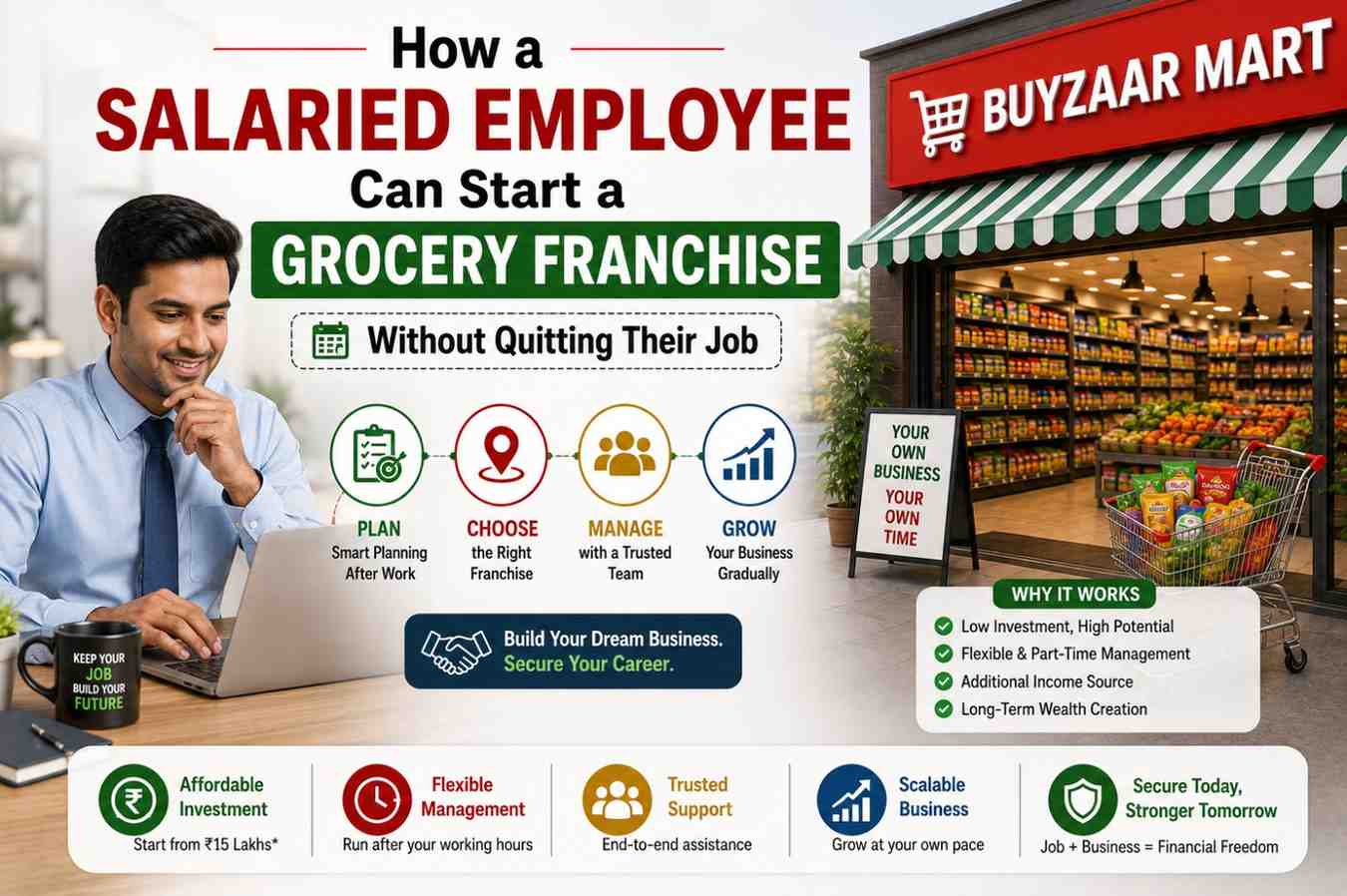
How a Salaried Employee Can Start a Grocery Franchise Without Quitting Their Job
Can you own a grocery franchise while keeping your job? Yes — with the right model, a good store manager, and smart systems. Here is the complete honest guide for salaried investors in India.
If you are a salaried professional in India in 2026, you are probably doing the math more often than you would like. Your salary covers the rent or EMI, the school fees, the grocery bills, the monthly SIP, maybe a small family holiday once a year. It is enough — but it is exactly enough. There is no meaningful buffer. There is no second engine. And there is a quiet, persistent awareness at the back of your mind that if something changes — a layoff, a health emergency, an economic slowdown — the single income holding everything together could stop being enough overnight. Active income is inherently limited by your time and energy. If your salary is not increasing by at least 7 to 8 percent annually, your purchasing power is actually shrinking. The answer that more and more salaried Indians are arriving at in 2026 is not to quit their job and take a leap of faith. It is to build a second income stream that runs alongside their career — without disrupting it. A grocery franchise, specifically, is one of the most practical ways to do exactly that. This blog explains precisely how — the right model, the right structure, the honest challenges, and the step-by-step plan for making it work without resigning, without panic, and without gambling your family's financial security.
The Core Question: Can You Really Run a Franchise While Holding a Full-Time Job?
The idea of owning a franchise while keeping your job is not a fantasy. Thousands of people across India's Tier-2 and Tier-3 cities are doing it — but they are doing it with a plan, not just a dream. The honest answer is: yes — but only with the right conditions in place. A grocery franchise is not a passive investment in the way that a fixed deposit or a mutual fund is passive. It is a real business with real customers, real staff, real inventory, and real daily operations. If you walk away from it entirely, it will not run itself.
But here is what makes the managed franchise model specifically workable for a salaried professional: the franchisor's systems handle the complexity. The supply chain, the technology, the inventory management, the marketing infrastructure, the product sourcing — all of this is managed by the franchise network. What remains for the franchise owner is oversight, relationships, and leadership — activities that can be structured around a working professional's schedule with the right team in place. The main aim of a passive franchise is that you can keep your job and still run it — with 1 to 3 hours of weekly oversight once the systems are properly established.
Why a Grocery Franchise Is Specifically Well-Suited for Salaried Investors
Not every franchise model is equally suitable for someone who cannot be physically present full-time. A restaurant franchise, for example, requires intense daily management, complex food safety compliance, and constant staff supervision. A grocery franchise — particularly a managed neighbourhood store model like Buyzaar Mart — has structural characteristics that make it more compatible with a salaried owner's schedule.
Predictable, routine operations: a grocery store does the same things every day — receive stock, stock shelves, bill customers, manage the register, close for the day. Routine operations are easier to delegate, easier to monitor, and easier to train a store manager to handle independently. Tech-enabled remote oversight: the Buyzaar Mart POS system gives franchise owners real-time access to daily sales data, inventory levels, and billing summaries from their phone, from anywhere. A salaried franchise owner can review the previous day's performance over morning chai before leaving for work. Centralised supply chain eliminates daily procurement: deliveries arrive on schedule, inventory is tracked digitally, and reorder suggestions are system-generated — the franchise owner's involvement in procurement is minimal.
Grocery retail is recession-proof demand: grocery stores usually generate regular monthly income due to daily customer demand. This predictability matters enormously for a salaried investor who needs their franchise income to be reliable — not speculative. Every household buys groceries multiple times per week, every week of the year, regardless of economic conditions. Most franchise companies provide complete training, including operations, billing, customer handling, and marketing — making it possible to train a competent store manager to handle day-to-day functions independently.
The Most Important Decision: Hiring the Right Store Manager
If there is one factor that determines whether a salaried professional's grocery franchise succeeds or struggles, it is this: the quality of the store manager. A good franchise manager is worth more than the best location. A competent, trustworthy store manager — someone who opens the store on time, manages staff effectively, handles customer interactions professionally, and is honest with the money — is the single most critical ingredient in a salaried owner's franchise model. Without a good store manager, a salaried owner cannot step away from daily operations. With one, the store runs reliably during work hours, the owner reviews numbers in the evening, and the model works.
What to look for in a grocery store manager: prior experience in retail or FMCG sales (kirana store, supermarket, or similar), honesty and reliability above all — verifiable through reference checks and a structured probation period, ability to manage 2 to 3 junior staff members independently, basic comfort with the POS billing system (Buyzaar Mart provides training), and a genuine interest in the role. What to pay: a well-qualified store manager in a Tier-2 or Tier-3 city typically commands ₹12,000 to ₹22,000 per month; in Delhi NCR or Noida the range is ₹18,000 to ₹30,000. Budget for this as a fixed operating cost from Day 1. How to find one: post on LinkedIn, Naukri, and local job portals; ask your Buyzaar Mart franchise support team. Take references seriously and allow a 30 to 60-day probation period before confirming employment.
The Salaried Investor's Week: What Running a Franchise Actually Looks Like
Every morning (15 to 20 minutes): review the previous day's POS sales summary on your phone, check if daily revenue is on track, note any low-stock alerts flagged by the inventory system, and confirm the day's delivery schedule with your store manager via a quick WhatsApp message. During the workday (5 to 10 minutes as needed): your store manager handles all in-store operations — you are available via WhatsApp for any decision that requires owner input. These interruptions should be rare in a well-run store. If they are frequent, your manager needs more training or replacement.
Every evening (20 to 30 minutes): review the day's full sales report on the POS app, check billing totals against cash and digital payment receipts, approve any inventory orders flagged by the system, send your daily WhatsApp deals message to your customer broadcast list, and note any operational issues to discuss with the store the next day. Weekly (60 to 90 minutes, ideally on a weekend): visit the store in person — walk the floor, check shelf presentation and cleanliness, review the week's sales data in detail, conduct a brief stock audit, and have a direct conversation with your manager about performance and upcoming challenges. Monthly (2 to 3 hours): review the full monthly revenue and expense summary, calculate gross margin by category, review staff performance, plan the following month's promotional calendar, and check in with the Buyzaar Mart franchise support team.
That is approximately 1 to 1.5 hours per day on weekdays, one meaningful weekly store visit, and a monthly review. This is the realistic time commitment for a salaried franchise owner whose store is well-staffed, well-systemised, and running on the Buyzaar Mart operational framework. The first year demands more — during the launch phase and first three to six months, expect to invest more time. The system becomes lighter as the store matures and your manager gains confidence.
The Financial Case: What Does a Salaried Investor Actually Earn?
Monthly Revenue (conservative estimate, well-located Mini Mart): ₹4,00,000 to ₹6,00,000. Monthly Costs: store rent ₹35,000 to ₹60,000, store manager salary ₹15,000 to ₹22,000, 2 junior staff salaries ₹18,000 to ₹28,000, electricity and utilities ₹8,000 to ₹15,000, miscellaneous operational ₹5,000 to ₹10,000 — total monthly fixed costs approximately ₹81,000 to ₹1,35,000. Gross margin on FMCG products: 10 to 20 percent depending on product mix. Monthly gross profit (on ₹5,00,000 revenue at 15 percent average margin): ₹75,000.
Monthly net profit after fixed costs: approximately ₹0 to ₹30,000 in early months, growing to ₹40,000 to ₹80,000 as revenue scales and costs stabilise. For a salaried professional earning ₹50,000 to ₹80,000 per month, a franchise generating ₹40,000 to ₹80,000 in net monthly profit represents a genuine 50 to 100 percent increase in household income — without resigning from the primary job. Most franchise businesses recover their investment within 6 to 24 months. The lower end of that range — 12 to 18 months — is achievable for a well-located, well-managed grocery store. Important caveat: anyone promising passive income from Month 3 is either misinformed or selling you something. Systems, staff, and brand loyalty all take time to build — the numbers above represent a mature store, not a Day 1 projection.
The Three Phases of a Salaried Investor's Franchise Journey
Phase 1 — Foundation (Months 1 to 6): This is the most time-intensive phase. You are setting up the store, training the manager, building the customer base, calibrating the inventory mix, and establishing the operational routines that will allow the store to run without your constant presence. During Phase 1, expect to spend two to three hours daily on franchise matters. Weekend presence is important. Buyzaar Mart's onboarding and launch support programme is specifically designed for this phase — providing setup guidance, staff training, supply chain initialisation, and marketing support to get the store to operational maturity as quickly as possible.
Phase 2 — Stabilisation (Months 7 to 18): Your manager knows the routines. Your customer base is growing through repeat visits and word-of-mouth. Your inventory mix is optimised to local demand. Revenue is tracking toward the store's potential. Your daily time commitment drops to 45 to 60 minutes. Weekly store visits become your primary direct involvement. The store is running — not because you are there, but because the systems and the team are functioning properly. This is when the second income starts to feel real.
Phase 3 — Growth (Month 18 onwards): Your store is profitable, your team is stable, and your systems are working. Options at this stage include expanding your customer base through WhatsApp and Instagram marketing, upgrading to a Super Mart format, opening a second Mini Mart franchise in a different neighbourhood, or — for those who are ready — making the transition from salaried employee to full-time franchise entrepreneur. Many Buyzaar Mart franchise partners who started while employed eventually transition to full-time store ownership once their franchise income consistently exceeds their salary. That transition is much easier to make when the franchise is already profitable and proven.
What You Need to Have in Place Before You Start
Sufficient capital without depleting your emergency fund: the total investment for a Buyzaar Mart Mini Mart starts from approximately ₹15 lakh. A salaried investor should have this capital available from savings, a planned loan, or family support — without touching their six-month emergency fund. Running a business with no financial cushion creates panic-driven decisions. Family alignment: starting a franchise while holding a job requires additional time and mental bandwidth during the setup phase. A spouse who can occasionally check in on the store, handle a supplier call, or review the day's numbers is an enormous asset for a salaried franchise owner.
A clear employment contract check: some employment contracts — particularly in financial services, government roles, or senior management — contain clauses restricting employees from owning or operating outside businesses. Review your employment agreement carefully before proceeding. Most standard private sector contracts do not prohibit business ownership, but confirming this protects you from future HR complications. A CA or accountant on call: salaried employees earning side income from a business need to file their ITR under the appropriate category and should consult a CA once monthly passive income from the business crosses ₹25,000 to ₹30,000 for proper tax compliance and optimisation.
The Honest Challenges — And How to Handle Them
Challenge 1 — Finding and keeping a reliable store manager: this is the biggest operational risk for a salaried franchise owner. The solution is to build a structured hiring and probation process, invest in their training, pay competitively, and create a performance incentive — a small monthly bonus tied to revenue targets — that aligns their interests with yours. Challenge 2 — The first three months: the early phase of any new store is demanding with a thin customer base, unestablished staff routines, and an inventory mix that needs calibration. Commit to the process for the full six months before drawing conclusions about performance.
Challenge 3 — Keeping your job performance intact: a franchise that starts affecting your professional performance is not a second income — it is a liability. Protect your primary job ruthlessly. Set clear boundaries on when you handle franchise matters (before work hours, evenings, weekends). Never handle store calls during important meetings or client interactions. Your salary is the financial backbone of this entire plan. Challenge 4 — Cash flow management in the early months: in the first six months, the store may not generate net profit consistently. Your salary is the buffer that allows you to sustain the business through this phase without making desperate decisions. This is the core advantage of starting a franchise while employed — you are not dependent on the store's income to cover household expenses, which means you can manage the business with patience rather than panic.
Why Buyzaar Mart Is Specifically Designed for This Model
The Buyzaar Mart managed franchise model removes the two biggest barriers that prevent salaried investors from owning a grocery store: the complexity of running daily operations without retail experience, and the time requirement of managing a business from scratch. The centralised supply chain eliminates daily procurement management. The POS technology provides real-time remote oversight. The inventory assurance policy reduces the financial risk of overstocking. The onboarding and training programme creates store manager capability quickly. The ongoing support team handles operational issues that would otherwise require the owner's direct intervention.
A good example of a business that generates passive income once set up is a franchise store. After the business starts running well, you do not need to work there every day. People use your product or service, and you keep earning money. That is the promise of the Buyzaar Mart franchise for a salaried investor — not passive income from Day 1, but a clear, supported path to a well-run business that generates meaningful monthly income without requiring you to sacrifice your career to build it.
Conclusion: The Salary Is the Foundation. The Franchise Is the Future.
The salaried professional who starts a grocery franchise in 2026 is making one of the most financially intelligent decisions available in India's current economic landscape. They are using the stability of their employment income to fund and buffer a business investment. They are using the franchise system's proven model to eliminate the most common risks of first-time entrepreneurship. And they are building an asset — a cashflowing, community-rooted business — that grows in value every month while their career continues in parallel. The salary pays the bills today. The franchise builds the future. You do not need to choose between them. You need the right plan, the right brand, the right manager, and the right mindset. The rest, the system provides.
Start Your Buyzaar Mart Franchise Journey Today — Without Leaving Your Desk
🌐 Website: thebuyzaarmart.com/franchise
📞 Phone: 9217991727
📧 Email: info@thebuyzaarmart.com
Frequently Asked Questions
Can a salaried employee in India own and operate a grocery franchise without quitting their job?
Yes — but only with the right conditions in place. A managed franchise model like Buyzaar Mart is specifically designed to make this possible. The franchisor's systems handle supply chain, technology, inventory management, and marketing infrastructure. What remains for the franchise owner is oversight, relationships, and leadership — activities that can be structured around a working professional's schedule once a competent store manager is hired and the operational routines are established.
How much time does a salaried franchise owner need to spend managing the store each day?
In a well-run, well-staffed Buyzaar Mart franchise, a salaried owner typically spends 15 to 20 minutes each morning reviewing POS sales data, 20 to 30 minutes each evening reviewing the day's report and approving inventory orders, and 5 to 10 minutes during the day for any WhatsApp queries from the store manager — totalling approximately 1 to 1.5 hours per day. A weekly in-person store visit of 60 to 90 minutes and a monthly financial review of 2 to 3 hours complete the commitment. The first six months require significantly more time while the team and systems are established.
Why is hiring the right store manager so critical for a salaried franchise owner?
For a salaried franchise owner who cannot be physically present during work hours, the store manager is the operational backbone of the entire model. A competent, trustworthy manager who opens the store on time, manages staff professionally, handles customer interactions, and is honest with money allows the owner to oversee remotely. Without a strong manager, the model breaks down — the owner is forced into daily presence that conflicts with their job. With one, the store runs reliably and the second income model functions as designed.
What salary should I expect to pay a grocery store manager in India?
A well-qualified store manager in a Tier-2 or Tier-3 city typically commands ₹12,000 to ₹22,000 per month depending on experience and city. In Delhi NCR and Noida, the range is ₹18,000 to ₹30,000. This should be budgeted as a non-negotiable fixed operating cost from Day 1. Adding a small performance incentive — a monthly bonus tied to revenue targets — helps align the manager's interests with the owner's and reduces turnover risk.
How much can a salaried investor earn from a Buyzaar Mart Mini Mart franchise?
A well-located Buyzaar Mart Mini Mart generating ₹4 to ₹6 lakh per month in revenue, operating at 15 percent average gross margin, and carrying total monthly fixed costs of approximately ₹81,000 to ₹1,35,000 can generate net monthly profit of ₹40,000 to ₹80,000 in a mature, stable phase (typically after 12 to 18 months). For a salaried professional earning ₹50,000 to ₹80,000 per month, this represents a genuine 50 to 100 percent increase in household income alongside their existing salary.
How long does it take to break even on a grocery franchise investment as a salaried owner?
Most grocery franchise businesses recover their investment within 6 to 24 months. For a well-located Buyzaar Mart franchise with a good store manager and strong local demand, the 12 to 18 month range is achievable. The early months (1 to 6) are the build-up phase where the store may not yet generate consistent net profit. The salaried owner's salary serves as the financial buffer during this phase — which is one of the key advantages of starting a franchise while still employed rather than after resigning.
Should I check my employment contract before starting a franchise alongside my job?
Yes — this is an important step that many salaried investors overlook. Some employment contracts, particularly in financial services, government roles, or senior management positions, contain clauses restricting employees from owning or operating outside businesses. Most standard private sector employment contracts do not prohibit business ownership, but reviewing your specific agreement before proceeding protects you from any future HR or legal complications. If in doubt, consult an employment lawyer for a quick review.
What are the three phases of owning a franchise alongside a salaried job?
Phase 1 — Foundation (Months 1 to 6): the most time-intensive phase, involving store setup, manager training, customer base building, and operational routine establishment. Phase 2 — Stabilisation (Months 7 to 18): the store runs on established systems with the manager handling daily operations. The owner's time commitment drops to 45 to 60 minutes per day plus weekly store visits. Net profit begins building consistently. Phase 3 — Growth (Month 18 onwards): the store is profitable and stable, opening options to expand the customer base, upgrade to a larger format, open a second store, or transition to full-time franchise ownership.
What are the biggest risks of running a franchise alongside a full-time job — and how do I manage them?
The four main risks are: finding and keeping a reliable store manager (managed through structured hiring, competitive pay, and performance incentives); the demanding early phase of the first three to six months (managed by committing fully to the process for the entire phase before evaluating performance); franchise matters affecting your job performance (managed by setting strict time boundaries — no store calls during work meetings); and cash flow pressure in the early months (managed by keeping your salary as the household financial backbone and not relying on franchise income to cover personal expenses during the build-up phase).
How can I apply for a Buyzaar Mart franchise as a salaried professional?
You can apply by visiting www.thebuyzaarmart.com/franchise, calling 9217991727, or emailing info@thebuyzaarmart.com. The Buyzaar Mart team conducts an initial consultation to understand your location, budget, employment situation, and goals before recommending the most suitable store format. The team also provides site evaluation, investment modelling, and full onboarding support — designed specifically to help first-time franchise owners, including salaried professionals, get to a running, profitable store as efficiently as possible.