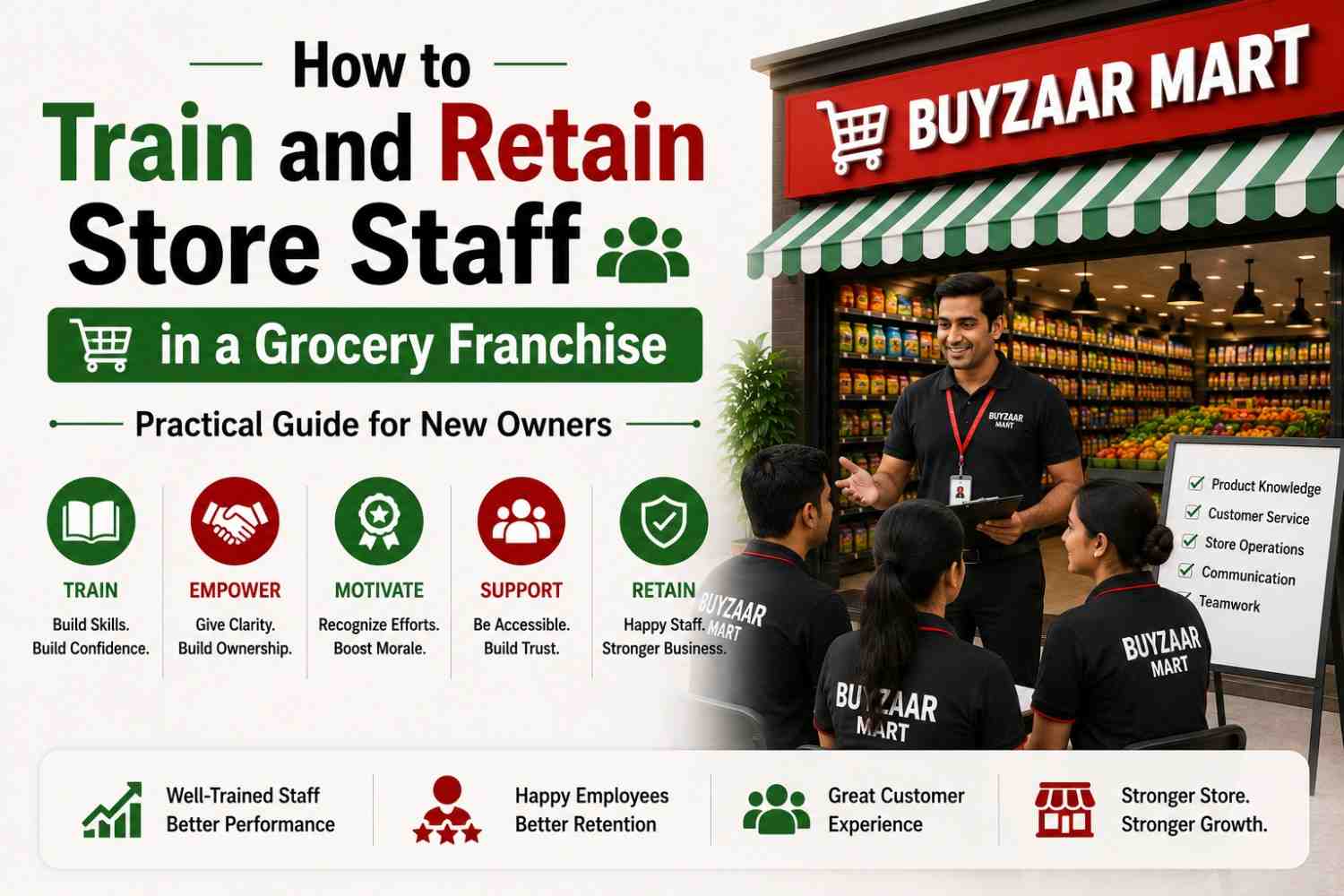
How to Train and Retain Store Staff in a Grocery Franchise: Guide for New Owners
High staff turnover kills grocery store profits. This practical guide covers exactly how to hire, train, and retain store staff in a grocery franchise — with day-by-day action steps.
Your store is only as good as the people running it every day. The best location in the city, the cleanest shelves, the most well-stocked inventory — all of it is undermined the moment a customer walks in and finds an untrained staff member who cannot find a product, fumbles at the billing counter, or handles a complaint rudely. Untrained or high-turnover staff affect billing speed, customer experience, and overall store productivity. Many grocery stores fail not because of poor products or bad locations, but because of weak human resource management. In India's retail sector, the turnover challenge is real — the healthy attrition rate for retail is 20 to 30 percent annually, significantly higher than other industries. What this means for a grocery franchise owner is simple: building and keeping a good team is not a one-time task. It is an ongoing operational discipline, as important as inventory management and customer service. This guide gives you the practical, step-by-step system for hiring the right people, training them properly, and retaining them long enough to build the reliable, motivated store team that drives consistent revenue and customer loyalty.
Part 1: Hiring Right — Because Training Cannot Fix the Wrong Person
The most expensive HR mistake a franchise owner makes is hiring quickly out of desperation and hoping training will fix attitude, reliability, or honesty. Training can build skills — it cannot build character. A dishonest staff member costs you inventory and cash. An unreliable staff member costs you customer trust and team morale. A disengaged staff member costs you customer experience — and customers never tell you when they decide not to come back.
For a Buyzaar Mart Mini Mart (600 to 1,000 sq. ft.), you typically need: one Store Manager or Senior Staff who is experienced, responsible, able to manage junior staff, comfortable with POS billing, and trustworthy with daily cash and digital payment reconciliation; and one to two Store Assistants or Sales Associates for shelf stocking, customer assistance, delivery receiving, and billing support during peak hours. Profile to look for in every candidate: prior experience in any retail, FMCG, or customer-facing role (even kirana store work is relevant), physical reliability for 8 to 10-hour shifts, basic numeracy and literacy for billing and stock counting, communication comfort for customer interactions, and local roots — staff who live near the store have lower absenteeism than those who commute long distances.
Where to find good candidates: post on Naukri.com, Apna.co, and WorkIndia — the most effective platforms for frontline retail hiring in India in 2026. Use neighbourhood notice boards and local WhatsApp groups for truly local candidates. Referrals from existing staff or your own network often produce the highest-quality hires. Keep a simple application form at your billing counter for interested walk-ins. Ask the Buyzaar Mart franchise support team for guidance on the right candidate profile. The hiring process: collect a brief written application with name, address, prior work experience, and two references. Conduct a 15 to 20-minute in-person interview focused on past work, reliability, and how they handle difficult customer scenarios. Always check references — call both and ask specifically about reliability, honesty, and work quality. Run a 3-day paid trial period before any contract. For store managers who handle cash and digital reconciliation, a basic police verification or ID-based background check is worth the small investment.
Part 2: Training — The First 30 Days Determine Everything
Research shows that spaced repetition through microlearning improves retention by 25 to 60 percent compared to one-time training events. Staff who are properly trained in their first 30 days make fewer billing errors, handle customers better, and stay in the role longer. Staff who are thrown into work without structured training feel overwhelmed, make avoidable mistakes, lose confidence, and leave early.
Week 1 — Store Orientation and Basic Operations. Day 1 (Welcome and Store Walkthrough): introduce the new staff member to the entire team and explain everyone's role. Walk through every section of the store — where each product category is located, how shelves are organised, where stock is stored. Explain store opening and closing procedures step by step. Show them the emergency contact list and basic safety procedures. Give them the store's daily routine in writing covering what happens at opening, mid-day, and closing. Day 2 (Product Knowledge Basics): spend 2 to 3 hours walking through the key product categories. Focus on the top 20 to 30 fastest-moving products. Teach them how to read product labels — brand name, MRP, expiry date, batch number. Explain the store's pricing policy — MRP is always the ceiling, no overcharging under any circumstance. Quiz them at the end of the day on product locations.
Day 3 (POS Billing System Training): sit with the new staff member at the billing counter and walk through the POS system step by step. Demonstrate a full billing transaction — scanning products, applying discounts, accepting cash, processing UPI and card payments, generating a receipt. Let them practice with dummy transactions before handling real customers. Explain how to handle common billing situations: price discrepancy, customer wants to remove an item after billing, damaged product return. The Buyzaar Mart POS system training is structured and staff-friendly — use the brand's training materials. Day 4 (Customer Service Standards): role-play three customer scenarios — a standard transaction, a product query, and a complaint. Explain the store's customer service standard: greet every customer within 10 seconds of entry, maintain eye contact, never say 'I don't know' without following up with 'let me find out for you.' Discuss body language — smiling, open posture, not leaning on the counter. Explain how to handle a customer complaint: listen fully, apologise sincerely, resolve if possible, escalate to manager if not — always with respect. Day 5 (Inventory and Stock Rotation): teach the FIFO (First In, First Out) principle — new stock goes behind old stock, always. Walk through the delivery receiving process. Show them how to identify near-expiry products during shelf stocking. Practice a shelf-stocking session together.
Week 2 — Supervised Practice: new staff member performs all tasks independently while you or the store manager observes. Correct errors in real time — calmly, specifically, and constructively. Let them handle customer interactions with you nearby but not intervening unless necessary. Check their end-of-day tasks: shelf tidiness, billing counter cleanliness, stock records. Week 3 — Independent Operations With Daily Check-In: staff member operates independently during their shift. Daily 10-minute check-in at the end of each shift covering what went well, what was difficult, and any questions. Introduce them to the weekly stock audit process. Give them one specific responsibility beyond basic duties — such as owning the stocking of one product category or managing the WhatsApp customer broadcast under your supervision. Week 4 — Full Responsibility With Weekly Review: staff member is now fully operational in their role. Weekly 20-minute review meeting covering sales performance for the week, any billing or inventory issues, customer feedback, and their personal questions or suggestions. Ask for their input on how the store runs. By the end of Week 4, a well-trained staff member should be independently managing their shift responsibilities with minimal daily intervention from the owner.
Ongoing Training — The Monthly Habit That Most Owners Skip: hold a monthly 30-minute team training session on rotating topics — near-expiry management, upselling techniques, handling a difficult customer, a product knowledge refresher on a new category. Short focused sessions of 3 to 5 minutes on specific skills fit into the natural breaks of a retail workday — these microlearning moments are more effective than long training events. Use the Buyzaar Mart brand's training materials, product knowledge sheets from FMCG brands, and simple WhatsApp voice notes from you to the team with operational reminders. Train on new product arrivals every time a new SKU hits the shelf — customers will ask, and 'I don't know' is an unacceptable answer in a well-run store.
Part 3: Retention — How to Keep Good Staff Once You Have Them
Why retail staff leave — the real reasons: Pay is the most immediate reason. If a competitor store offers ₹500 more per month for a similar role, a frontline worker will leave. Feeling unappreciated — recognition is one of the most effective retention strategies in retail, yet it is often inconsistent or informal. No growth path — the number one reason employees leave any organisation in India is lack of career advancement. Poor working conditions — uncomfortable physical environment, unreasonable hours, lack of a proper break room or meal arrangement, or exposure to difficult customers without management support. Bad relationship with the owner or manager — people leave managers, not companies.
10 Practical Retention Strategies: 1. Pay Competitively From Day One — research the local market rate before hiring, set salaries at or slightly above market, and review salaries at least once a year with an annual increment of ₹500 to ₹1,500 per month. 2. Create a Performance Incentive — a small monthly bonus of ₹500 to ₹2,000 tied to measurable performance (monthly revenue target achieved, zero billing discrepancies, no customer complaints) aligns staff interests with store performance. Make the incentive criteria transparent and simple. 3. Recognise Good Work — publicly and specifically. 'What gets recognised gets repeated.' A specific 10-second acknowledgement like 'Ram, you handled that difficult customer really well today — I noticed' has a retention impact that lasts weeks. Consider a simple 'Staff Member of the Month' recognition.
4. Give Reasonable, Predictable Working Hours — publish the weekly roster at least 4 to 5 days in advance, respect weekly off days consistently, and build a schedule that allows for at least one full day off per week with fair rotation of demanding shifts. 5. Provide a Clean, Comfortable Working Environment — a proper place to sit during breaks, access to clean drinking water, and a functioning toilet are baseline requirements. Small investments like a proper fan in the stockroom or a canteen allowance have outsized retention impact. 6. Handle Customer Conflicts on Behalf of Your Team — when a customer is rude to your staff, step in and manage the situation yourself. Staff who know their manager will back them up are dramatically more loyal and more confident with customers. 7. Create a Simple Growth Path — define a progression even in a two-person store: Sales Assistant → Senior Sales Assistant → Shift Supervisor → Store Manager. Make promotion criteria explicit so staff who see a future in your store stay.
8. Have Regular One-on-One Conversations — a 15-minute monthly conversation with each staff member about how they are finding the work, what is making their job harder, and what they would like to learn or do more of surfaces problems before they become resignations and signals that you see your team as people, not just resources. 9. Keep Communication Two-Way — involve staff in simple operational decisions: 'We're thinking of rearranging the snacks section — what do you think customers would prefer?' Staff who feel heard develop ownership over the store's success. 10. Respond Immediately to Early Warning Signs — key warning signs that a staff member is about to resign include decreased engagement in team meetings, unexplained absenteeism, reduced initiative, and visible frustration. Act immediately when you notice these signals — have a private, honest conversation before the resignation. Companies that implement strategic retention programmes can reduce attrition by up to 15 percent, and for a small grocery store team of 2 to 3 people, retaining even one key person for an additional year has direct, measurable impact on store performance and owner workload.
Part 4: Common Staff Management Mistakes New Franchise Owners Make
Hiring in a panic — recruiting quickly because you are short-staffed always results in the wrong person. A poorly staffed store for one week is better than a dishonest or incompetent staff member for six months. Skipping the trial period — the 3-day paid trial is the most efficient hiring filter available. Never bypass it. Training only once at the start — staff skills decay without reinforcement. Monthly training sessions are non-negotiable for maintaining standards. Ignoring performance problems — hoping a poor performer will improve on their own is a losing strategy. Address issues specifically, early, and directly.
Being inconsistent with rules — if you allow one staff member to come in late without consequence but reprimand another, you create resentment and confusion. Rules must apply equally and consistently. Never saying thank you — the absence of recognition is felt as rejection. In a small store where the owner is present daily, a staff member who works hard and receives no acknowledgement will stop working hard. Overloading one person — in stores where one capable staff member is given increasing responsibility without additional pay or recognition, burnout and resignation are inevitable.
What the Buyzaar Mart System Does to Support Your Staff Management
POS and inventory technology reduces the learning curve for new staff — the system is intuitive, designed for retail frontline workers, and comes with Buyzaar Mart's training support. The structured onboarding programme provides operational training for new franchise partners and their store managers as part of the launch support package. Supply chain reliability reduces staff stress — when inventory arrives on schedule and shelves can be stocked predictably, staff work with less pressure and fewer complaints. Standard Operating Procedures (SOPs) — the Buyzaar Mart operating framework gives store managers a clear, documented guide for daily operations, reducing dependence on the owner's constant presence and giving staff the clarity they need to perform confidently.
Conclusion: Your Team Is Your Competitive Advantage
In a neighbourhood grocery franchise, every customer interaction — every greeting, every product recommendation, every billing transaction, every complaint handled — is delivered by your staff, not by you. A well-trained, motivated, respected team is the single most durable competitive advantage a grocery store owner can build. It takes longer to build than a good shelf layout or a WhatsApp broadcast list. It requires consistent investment — in time, attention, and money. But the returns — in customer loyalty, store performance, and owner peace of mind — compound every month. Build the team that builds your store. The rest will follow.
Explore the Buyzaar Mart Franchise — With Full Staff Training and Operational Support Built In
🌐 Website: thebuyzaarmart.com/franchise
📞 Phone: 9217991727
📧 Email: info@thebuyzaarmart.com
Frequently Asked Questions
How many staff members does a Buyzaar Mart Mini Mart franchise typically need?
A Buyzaar Mart Mini Mart (600 to 1,000 sq. ft.) typically requires one Store Manager or Senior Staff member and one to two Store Assistants or Sales Associates. The store manager handles overall operations, POS billing, cash reconciliation, and junior staff management. Store assistants handle shelf stocking, customer assistance, delivery receiving, and billing support during peak hours. As revenue grows and store hours extend, the team can scale accordingly.
What is the best way to find good staff for a grocery franchise store in India?
The most effective platforms for frontline retail hiring in India in 2026 are Naukri.com, Apna.co, and WorkIndia. Neighbourhood notice boards and local WhatsApp groups are excellent for finding candidates with community ties who tend to have lower absenteeism. Staff referrals from your existing team or personal network often produce the highest-quality hires. Keeping a simple application form at your billing counter for walk-in candidates is also effective. The Buyzaar Mart franchise support team can also provide guidance on the right candidate profile for your store.
How should I structure the first week of training for a new grocery store staff member?
A structured first week should cover: Day 1 — store walkthrough, team introduction, opening and closing procedures, and the daily routine in writing; Day 2 — product knowledge for the top 20 to 30 fastest-moving items, label reading, and pricing policy; Day 3 — POS billing system training with dummy transactions before real customers; Day 4 — customer service standards, role-playing standard transactions, product queries, and complaints; Day 5 — FIFO stock rotation principle, the delivery receiving process, and a supervised shelf-stocking practice session.
What is the FIFO method and why is it important in staff training?
FIFO stands for First In, First Out. It means new stock arriving at the store is placed at the back of the shelf, so the older stock already on the shelf stays at the front and is picked by customers first. Teaching FIFO to every new staff member during their first week is essential because improper stock rotation — placing new stock in front of old — leads to older products getting buried, expiring unsold, and becoming a direct financial loss. FIFO is one of the most impactful habits a grocery store team can develop.
What are the most common reasons grocery store staff leave their jobs in India?
The five most common reasons are: pay — even a ₹500 per month difference from a nearby competitor is enough for frontline workers to leave; feeling unappreciated — the absence of recognition is felt as rejection; no visible growth path — the number one reason employees leave any organisation in India is lack of career advancement; poor working conditions — uncomfortable environment, unpredictable hours, and lack of basic facilities; and poor relationship with the owner or manager — people leave managers, not companies.
How can a grocery franchise owner reduce staff turnover?
The ten most effective retention strategies are: paying competitively from Day One and reviewing salaries annually; creating a transparent performance-linked monthly bonus of ₹500 to ₹2,000; recognising good work publicly and specifically; giving reasonable, predictable working hours with rosters published 4 to 5 days in advance; providing a clean and comfortable working environment; handling difficult customer situations on behalf of staff; creating a clear growth path with defined promotion criteria; holding regular 15-minute monthly one-on-one conversations; keeping communication two-way by involving staff in operational decisions; and responding immediately to early warning signs of disengagement or resignation intent.
How important is ongoing training after the first month for grocery store staff?
Ongoing training is critical and is one of the most commonly skipped operational disciplines in grocery retail. Staff skills decay without reinforcement — billing accuracy, product knowledge, and customer service standards all degrade over time without regular refreshers. A monthly 30-minute team training session on rotating topics, supplemented by short 3 to 5-minute microlearning moments during natural breaks in the workday, is the most effective format. Training on every new product arrival ensures staff can always answer customer questions confidently.
Should I do a trial period before hiring grocery store staff permanently?
Yes — a 3-day paid trial period is one of the most efficient hiring filters available to a grocery franchise owner. During the trial, you can observe how the candidate interacts with customers, how they handle boredom during slow hours, whether they show initiative, and whether their attitude and reliability match what they presented in the interview. Never skip the trial period — it saves months of difficulty with the wrong hire. Reference checks should also always be completed before confirming employment.
What technology does Buyzaar Mart provide to help train and manage store staff?
Buyzaar Mart provides an intuitive, retail-specific POS system that is designed to minimise the learning curve for new frontline staff. The system comes with structured training support as part of the franchise onboarding programme. Standard Operating Procedures (SOPs) provided by Buyzaar Mart give store managers a documented guide for daily operations, reducing dependence on the owner's constant presence and giving staff clear, consistent instructions for every routine task. The supply chain reliability also reduces operational stress on the team by ensuring inventory arrives predictably.
How can I apply for a Buyzaar Mart franchise with full training and operational support?
You can apply by visiting www.thebuyzaarmart.com/franchise, calling 9217991727, or emailing info@thebuyzaarmart.com. The Buyzaar Mart franchise includes a structured onboarding and launch support programme that covers staff training, POS system setup, supply chain initialisation, and operational SOPs — designed to help new franchise owners build a capable, reliable store team from Day 1.