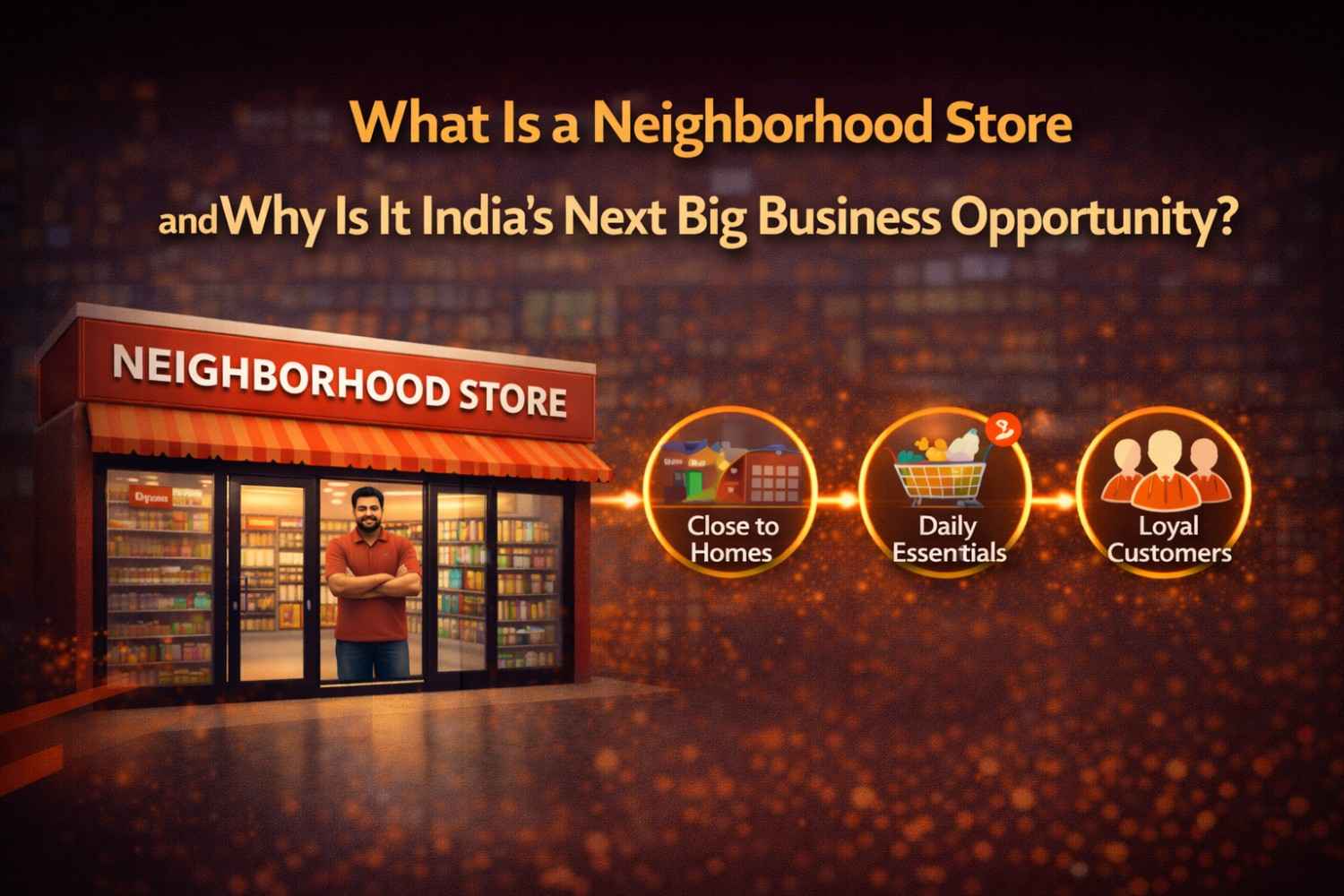
What Is a Neighborhood Store and Why Is It India's Next Big Business Opportunity?
The Case for Owning a Well-Branded, Well-Supported Neighborhood Store in 2026
Walk through any residential lane in India — in a bustling metro, a growing tier-2 city, or a thriving small town — and you will find one constant: the neighborhood store. It may be a compact shop tucked between two apartment buildings. It may be a slightly larger establishment anchoring the corner of a busy local market. It stocks the bread your family needs in the morning, the cooking oil that runs out mid-week, the cold drink your child asks for on the way back from school, and the biscuit packet that becomes an evening snack without much planning. The neighborhood store is not just a retail outlet. It is infrastructure. It is the quiet, unassuming backbone of daily life for hundreds of millions of Indian households. And in 2026, it is also one of the single most compelling business opportunities available to aspiring entrepreneurs across the country.
What Is a Neighborhood Store?
At its simplest, a neighborhood store is a retail outlet located within easy walking or commuting distance of the residential community it serves, stocking everyday household products that customers need to purchase on a regular — often daily — basis.
In India, the neighborhood store has traditionally been embodied by the iconic kirana store — a family-run shop that has served communities across the country for generations. The kirana store is remarkable in its own right: deeply trusted, hyper-local, and extraordinarily resilient. It survived the arrival of large-format supermarkets. It survived the entry of multinational retail chains. It survived the rise of e-commerce and, more recently, the explosive growth of quick commerce grocery delivery apps. The reason for this survival is not nostalgia. It is economics and human behavior.
A modern neighborhood store, however, is an evolved version of the traditional kirana concept. It combines the proximity, familiarity, and community trust of the local kirana with the organization, product range, technology, and brand consistency of the modern organised retail sector. It is clean, well-stocked, properly billed, and backed by a supply chain that ensures shelves are never empty and products are always fresh. This is precisely the format that Buyzaar Mart has built its franchise model around.
The Scale of India's Neighborhood Retail Sector
To understand why neighborhood stores represent such a compelling business opportunity, it helps to first appreciate the sheer scale of the market they serve. India is home to one of the largest retail markets in the world. The country's consumption story is driven by a massive and growing middle class, rapidly urbanizing tier-2 and tier-3 cities, a young demographic that is earning and spending at an unprecedented pace, and a deeply ingrained cultural habit of daily or near-daily household shopping rather than the weekly bulk-shopping patterns seen in Western markets.
Daily essentials — grocery, packaged food, beverages, personal care, and household products — account for the largest share of Indian household expenditure year after year. These are not discretionary purchases that get cut during economic slowdowns. They are non-negotiable daily necessities. This makes the neighborhood grocery retail segment one of the most recession-resistant business categories in the entire Indian economy.
The organized neighborhood retail segment is still vastly underpenetrated relative to total grocery retail spending in India. The majority of daily essential purchases in most Indian neighborhoods still happen at unorganized, unbranded local shops. This underpenetration is not a problem — it is an enormous, waiting opportunity for entrepreneurs who are ready to bring an organized, branded experience to their community.
Why Has the Neighborhood Store Outlasted Every Disruption?
The neighborhood store has faced serious competitive challenges over the past two decades — large-format hypermarkets, organized supermarket chains, e-commerce grocery platforms, and most recently, quick commerce delivery services promising ten-minute grocery delivery. Each of these formats was predicted at various points to eventually replace or dramatically diminish the local neighborhood store. None of them have succeeded in doing so.
Proximity Is Irreplaceable
No delivery platform, however fast, can beat the experience of walking sixty seconds to your corner store. For a single forgotten ingredient mid-cooking, for a cold drink on a hot afternoon, for a last-minute purchase before guests arrive — proximity wins every single time. The neighborhood store is always closer, always faster, and always open when it matters most.
Trust Built Over Time
Neighborhood stores build a depth of customer trust that national chains and digital platforms struggle to replicate. When a store owner knows your family's preferences, keeps your favorite brand in stock because you asked, and gives you accurate advice on product quality — that relationship has genuine, lasting commercial value. Repeat customers built on personal familiarity are far more loyal than customers acquired through a discount coupon on an app.
No Delivery Fees, No Minimum Orders
Every online grocery and quick commerce platform in India charges delivery fees, imposes minimum order values, or both. For a household that needs a single item — a packet of salt, a bar of soap, a bottle of cooking oil — the economics of app-based grocery delivery make no sense. The neighborhood store serves exactly this use case, every single day, millions of times across the country, without friction.
Cash and Credit Flexibility
Despite the growth of digital payments, a large portion of India's population — particularly in semi-urban and smaller markets — still transacts primarily in cash or operates on informal community credit with their local store. Neighborhood stores accommodate this naturally. Digital platforms largely do not.
The Sensory Shopping Experience
Many Indian consumers — especially for fresh produce and certain food categories — still strongly prefer to physically see, touch, and select the products they buy. The neighborhood store provides this experience in a way that a photograph on an app screen never fully can.
Why 2026 Is a Particularly Powerful Moment for Neighborhood Retail
The structural advantages of neighborhood stores have always existed. What makes 2026 a particularly compelling moment to enter this space is a confluence of factors that are creating fresh momentum.
Tier-2 and Tier-3 City Growth
India's economic growth story is no longer concentrated in its metros. Cities like Meerut, Bareilly, Haridwar, Saharanpur, Muzaffarnagar, Moradabad, and hundreds of similar urban centers across North India and beyond are experiencing rapid population growth, rising household incomes, and a fast-growing consumer middle class. The organized retail infrastructure in most of these cities has not kept pace with this demand growth — creating significant whitespace for well-branded neighborhood stores to establish themselves as the default shopping destination for entire residential zones.
The Post-Quick Commerce Reality
Quick commerce grocery delivery — the ten-minute delivery model that swept Indian metros between 2022 and 2025 — has gone through significant consolidation and scaling back. Many services have retreated from smaller cities entirely, reduced their product catalogs, or increased delivery fees to improve unit economics. This retreat has reinforced the practical relevance of the physical neighborhood store, particularly in markets outside major metros where quick commerce never meaningfully penetrated.
Rising Consumer Expectations in Small Towns
Consumers in smaller Indian cities and towns are increasingly exposed to organised retail experiences — through travel, social media, and the spread of branded chains. Their expectations for their local shopping environment are rising accordingly. They want clean stores, proper billing, good product variety, and a consistent experience. The traditional unorganized kirana store is increasingly struggling to meet these expectations. The organised neighborhood franchise store is perfectly positioned to fill this gap.
Digital Infrastructure Enabling Physical Retail
The availability of affordable POS billing systems, digital payment infrastructure, inventory management tools, and hyperlocal marketing platforms has made it easier and cheaper than ever to run a professionally operated neighborhood store. What previously required significant technical investment and expertise can now be deployed by a first-time entrepreneur with proper franchisor support.
A Generation Ready to Build
India has an enormous and growing population of young, educated, and ambitious individuals who are increasingly interested in entrepreneurship over traditional employment. Many of them are returning to their hometowns after education or early careers in larger cities, bringing energy, ideas, and resources — and looking for the right business model to deploy them. A neighborhood store franchise is one of the most accessible and community-meaningful opportunities available to this generation.
What Separates a Good Neighborhood Store from a Struggling One
Not every neighborhood store succeeds. Understanding what separates thriving stores from struggling ones is important for any entrepreneur evaluating this opportunity.
Location Quality
The single most important factor in any neighborhood store's success is its location. A store placed within walking distance of a dense residential population, in a visible and accessible spot, with minimal direct competition from other organized stores in the immediate radius, has an enormous inherent advantage. Location research and validation before committing to a space is non-negotiable.
Product Range Relevance
A neighborhood store must stock the products its specific community actually buys — not a generic catalog. Understanding local consumption patterns, popular brands in the area, and seasonal demand variations directly impacts how efficiently inventory is managed and how satisfied customers remain.
Consistency and Reliability
Customers return to neighborhood stores that are consistently open at expected hours, consistently stocked with the products they need, and consistently clean and organized. A store that regularly runs out of popular items or operates unpredictably loses its core customer base quickly to alternatives.
Brand Trust and Professionalism
An organized, branded store that offers digital billing, proper product display, and a clean shopping environment builds trust faster and more durably than an unorganized setup. This is a key reason why a franchise model with brand consistency standards — like Buyzaar Mart — gives franchisees a built-in advantage over independent operators.
Franchisor Support Quality
For a franchised neighborhood store, the quality of the franchisor's support — in inventory management, marketing, technology, and operational guidance — is a major determinant of success. A brand that actively invests in its franchisees' growth is a fundamentally different proposition from one that collects a fee and steps back.
Why Buyzaar Mart Is Built for This Opportunity
Buyzaar Mart has built its entire franchise model around a single conviction: that every Indian neighborhood deserves a properly run, well-stocked, friendly local store — and that every aspiring entrepreneur deserves a business system that gives them a genuine, fair chance to build one successfully.
Community-First Brand Identity
The Buyzaar Mart brand is positioned as "Your Friendly Neighborhood Store" — not a corporate chain, not an impersonal retail outlet, but a community institution that belongs to the neighborhood it serves. This positioning resonates deeply with the trust dynamics that drive neighborhood retail loyalty.
Multiple Store Formats for Every Market
Buyzaar Mart's three-tier format structure — Mini Mart, Super Mart, and Hyper Mart — means there is an appropriate store format for every type of neighborhood, every budget level, and every market size. A compact Mini Mart can serve a small residential colony just as effectively as a Super Mart serves a bustling urban market zone.
Inventory Assurance That Protects Your Investment
The hassle-free inventory assurance policy — through which Buyzaar Mart takes back expired and damaged goods — directly addresses one of the most significant financial risks in neighborhood grocery retail. This policy is not standard across the industry and represents a genuine, meaningful protection for franchisee investment.
Hyper-Local Marketing That Drives Real Footfall
Buyzaar Mart's marketing support is specifically designed for the neighborhood level — not broad national campaigns that have no relevance at the street level, but targeted, community-specific outreach that introduces your store to the exact households you are trying to serve.
Technology That Makes Professional Retail Accessible
Every Buyzaar Mart store is equipped with a POS-enabled billing and inventory management system that brings professional retail technology to neighborhood store operators regardless of prior technical experience. This technology backbone enables efficient operations, accurate stock management, and sales insights that help franchisees make smarter business decisions.
End-to-End Support From Inquiry to Launch and Beyond
The Buyzaar Mart franchise journey does not end at the store opening. Ongoing backend support, inventory replenishment guidance, and operational assistance ensure that franchisees have a responsive partner available as their business grows and evolves.
The Neighborhood Store Opportunity: A Quick Summary
India's neighborhood store sector is not a legacy retail format that technology will eventually replace. It is a living, evolving, and deeply embedded part of Indian daily life that is entering a new phase of organized, branded growth — creating a significant window of opportunity for entrepreneurs who move decisively.
The fundamentals are compelling: massive and growing demand, underserved markets in tier-2 and tier-3 cities, rising consumer expectations that favour organized branded stores, and a post-quick commerce environment that has reinforced the value of physical proximity. Add a franchise model that provides real operational support, genuine inventory protection, and community-focused brand identity — and the neighborhood store becomes one of the most intelligent business investments available in India today.
Ready to Own Your Neighborhood Store?
The opportunity is real, the demand is proven, and the model is available. Buyzaar Mart is actively expanding its franchise network across India — bringing organized, community-focused neighborhood retail to cities, towns, and localities that are ready for it. Whether you are a first-time entrepreneur, an experienced investor, or someone returning to their hometown with ambition and resources, there is a Buyzaar Mart format built for your situation.
Visit thebuyzaarmart.com today, submit your inquiry, and take the first step toward owning your neighborhood store. Your community is waiting.
📞 Phone: 9217991727
📧 Email: info@thebuyzaarmart.com
Frequently Asked Questions
What is the difference between a neighborhood store and a kirana store?
A kirana store is a traditional, typically unorganized family-run shop. A modern neighborhood store like Buyzaar Mart combines the proximity and community trust of the kirana model with organised retail standards — proper billing, curated product range, brand consistency, and operational support.
Is a neighborhood store business viable in small towns and tier-3 cities?
Absolutely. Tier-2 and tier-3 cities are among the most underserved markets for organized neighborhood retail in India. Lower real estate costs and rising consumer expectations make them particularly attractive locations for a well-branded neighborhood store franchise.
How does a neighborhood store compete with online grocery delivery?
Neighborhood stores offer proximity, no delivery fees, no minimum order requirements, cash flexibility, and a physical shopping experience — advantages that online platforms cannot replicate for daily top-up purchases and single-item needs.
Do I need prior retail experience to open a neighborhood store franchise?
No. Buyzaar Mart's franchise model is designed to support entrepreneurs regardless of prior retail experience. Comprehensive training, operational support, and technology tools ensure that first-time store owners can operate professionally from day one.
What investment is needed to open a Buyzaar Mart neighborhood store?
Investment varies based on store format and location. For detailed investment guidance tailored to your specific city and space, visit thebuyzaarmart.com and connect with the franchise team directly.
Why is now the right time to invest in a neighborhood store in India?
The combination of rapid tier-2 and tier-3 city growth, rising consumer expectations, quick commerce retreat from smaller markets, and the underpenetration of organized retail in most Indian neighborhoods makes 2026 one of the most favorable windows in years to establish a branded neighborhood store.
Related Articles
What is FOCM Franchise Model? Complete Guide for Investors
The FOCM Franchise Model — Franchise Owned, Company Managed — is reshaping how investors enter organized retail in India. Learn how Buyzaar Mart's structured system works.

Buyzaar Mart vs Traditional Kirana Store – Which is More Profitable?
Is a traditional kirana store still the most profitable option, or does an organized retail format like Buyzaar Mart offer better long-term growth? A detailed comparison of both retail models.

How to Apply for a Buyzaar Mart Franchise: Step-by-Step Process (2026)
Want to open a Buyzaar Mart franchise in India? Read our complete 2026 step-by-step guide covering eligibility, investment, documentation, and store launch process.