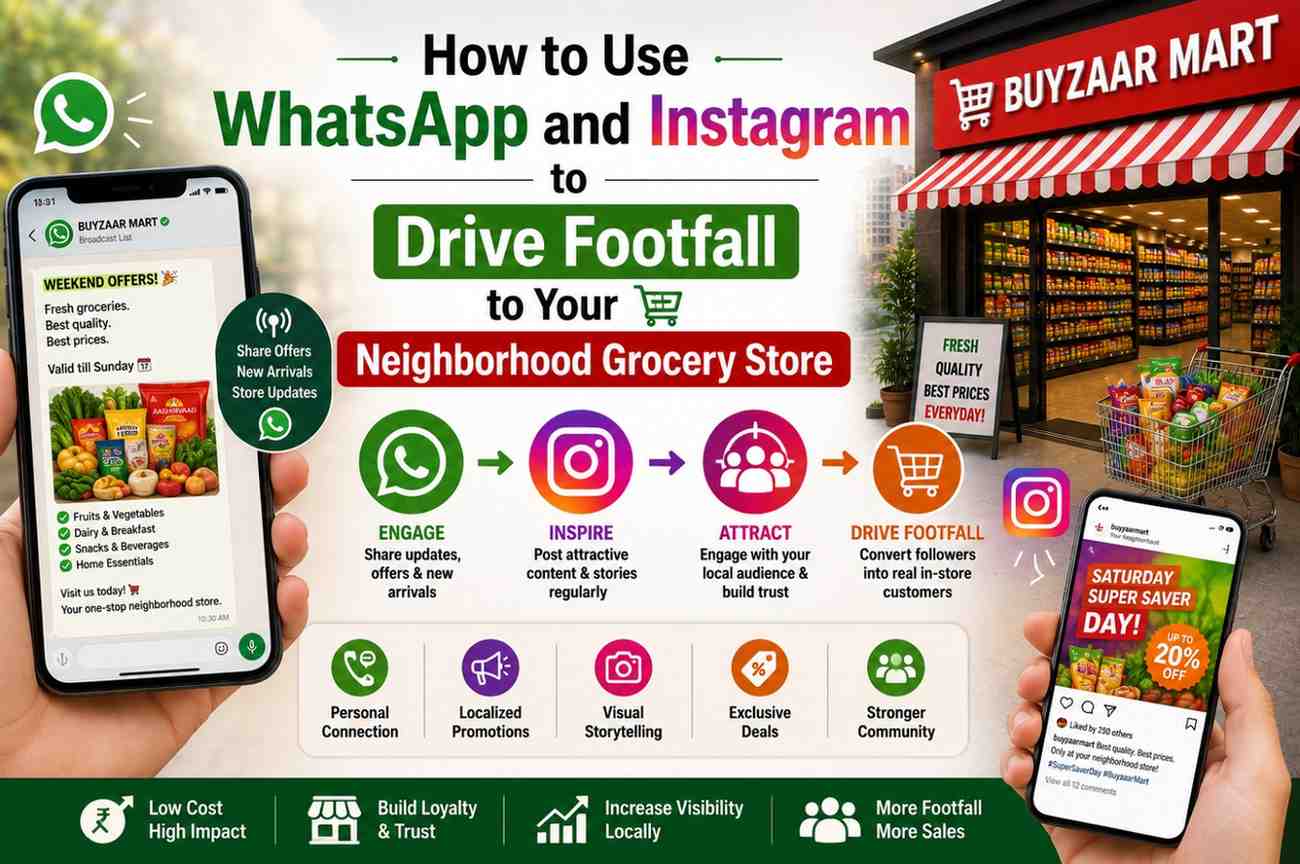
How to Use WhatsApp and Instagram to Drive Footfall to Your Grocery Store
72% of product discovery in India now happens on WhatsApp. Learn exactly how to use WhatsApp & Instagram to bring more customers into your neighbourhood grocery franchise store in 2026.
Here is a number that should change the way every grocery franchise owner thinks about marketing: 72 percent of product discovery in India now happens on WhatsApp. Not Instagram. Not Google. Not television. WhatsApp — the same app your customers use to talk to family, share memes, and coordinate weekend plans — is now the single most powerful product discovery channel in India, according to a landmark Meta and Retailers Association of India (RAI) report published in 2026. And yet, most neighbourhood grocery store owners in India are not using WhatsApp to market their store at all. They are relying entirely on physical proximity — hoping customers will walk past and walk in. In 2026, that is leaving significant revenue on the table. The Indian consumer is no longer choosing between the store and the screen. Omnichannel shoppers — people who discover products digitally and buy in-store — spend 2.5 times more than single-channel shoppers. This blog is the complete, practical playbook for using WhatsApp and Instagram to drive real, measurable footfall to your neighbourhood grocery store — written specifically for Buyzaar Mart franchise partners and independent grocery store operators in India in 2026.
Part 1: WhatsApp Marketing for Your Grocery Store
Why WhatsApp Is the Most Powerful Tool a Grocery Store Owner Has: Grocery shopping is a high-frequency, habitual behaviour. Your customers buy from you not once, but multiple times per week. WhatsApp is a relationship platform — it is personal, direct, and high-attention. A message in a WhatsApp chat gets read at a rate that no email newsletter or social media post can match. In 2026, WhatsApp has evolved into what digital marketers are calling a super app for Indian commerce. A small business can now run its entire customer communication — from daily offers to loyalty updates to new product alerts — inside a single WhatsApp channel. Discovery, engagement, and retention, all in one place that your customers already check dozens of times per day. A grocery franchise owner who uses WhatsApp well has a direct line to their most loyal customers' attention — every single day, for free.
Step 1: Set Up WhatsApp Business Properly
The first and non-negotiable step is to move your store communication to WhatsApp Business — not your personal WhatsApp number. Running business marketing from a personal account limits your tools, damages your professional image, and makes it impossible to scale your customer list. WhatsApp Business is free and gives you access to: a business profile with your store name, address, hours, and description; a product catalogue displaying your key products with images and prices; Quick Replies for common customer questions; automated greeting messages for new customers; Labels to organise your customer contacts (loyal customers, new customers, bulk buyers); and Broadcast lists to send messages to multiple customers without creating a group.
Your WhatsApp Business profile should include: store name matching your Buyzaar Mart signage, full address with landmark, store hours including any weekly off day, a clear welcoming store photo as your display picture, and a brief friendly business description — for example: 'Your trusted neighbourhood store in [Colony Name] — fresh stock daily, great prices, quick billing.' Setting up your profile correctly takes less than 30 minutes and transforms your store's communication from a personal chat into a professional retail channel.
Step 2: Build Your Customer Contact List — The Right Way
Your WhatsApp marketing is only as good as the list of customers who receive it. Building this list is a gradual, relationship-based process — and it must be done ethically. WhatsApp's algorithms are strict about spam in 2026. Adding numbers without consent and blasting unsolicited messages will get your account restricted or permanently banned. The right way to build your list is to collect opt-ins — customers who actively choose to receive messages from your store.
Practical ways to build your opted-in customer WhatsApp list: At the billing counter, train your staff to ask every customer if they can save their number to send daily offers and new stock alerts. Display a WhatsApp QR code in-store near the entrance and billing counter captioned 'Scan to get daily deals and new arrivals on WhatsApp.' Offer a small incentive for joining — 'Add us on WhatsApp and get ₹20 off your next purchase' accelerates list building in early months. Leverage your loyalty programme — make WhatsApp registration part of the sign-up process so every loyalty member becomes a WhatsApp marketing contact. A list of 200 to 500 genuinely opted-in regular customers in your neighbourhood is more valuable than a list of 5,000 unverified numbers.
Step 3: What to Send — The WhatsApp Content Calendar for a Grocery Store
The most common mistake grocery store owners make with WhatsApp marketing is sending too many promotional messages with too little variety — training customers to ignore or mute them. Aim for a maximum of one message per day and mix content across four categories. Category 1 — Daily or Weekly Deals (3 to 4 times per week): specific offers on specific products with a clear discount and time-specific call to action. Example: '🛒 Today's Special at [Store Name] — Parle-G 800g ₹45 (MRP ₹52), Fortune Sunflower Oil 1L ₹128 (MRP ₹145). Offer valid today only. Come in before 8 PM! 📍 [Store Address].'
Category 2 — New Stock Alerts (1 to 2 times per week): customers love knowing when new products arrive — especially seasonal items, festival specials, or locally popular brands. Example: '🆕 Just Arrived at [Store Name]! Real Juice Mango 1L, Kurkure Lime Achaar New Flavour, Borges Olive Oil 500ml. Come check it out today! Open till 9 PM.' Category 3 — Community and Seasonal Messages (1 to 2 times per month): festival greetings, season-specific highlights, and genuine community messages build the human relationship between your store and customers without selling directly. Category 4 — VIP Customer Exclusives (monthly): reward your most loyal customers with a WhatsApp-exclusive offer not available to walk-in customers, creating a sense of belonging and a strong reason to stay on your list.
Step 4: WhatsApp Status — The Free Billboard You Are Not Using
WhatsApp Status is one of the most underused marketing tools available to grocery store owners in India — and it is completely free. Every contact who has your number saved can see your Status updates — meaning your opted-in customer list sees your content automatically, without you sending a single broadcast. Post WhatsApp Status updates once or twice daily showing: today's best offers or fresh stock arrivals (a quick photo of the product on the shelf), a short video tour of a newly stocked section, a 'Today's Deal' graphic created on Canva (free tool, mobile-friendly), festive decoration in your store during celebration seasons, and a friendly 'Good Morning — we are open!' message with the day's top deal. Status updates create a daily visual touchpoint with your customers that feels organic rather than promotional — because it is placed in the same feed as their friends' and family's updates.
Part 2: Instagram Marketing for Your Grocery Store
Why Instagram Matters for a Neighbourhood Store in 2026: Social media is no longer just a place to build awareness in India — it is a primary commerce channel where buyers now expect to go from discovery to checkout without ever leaving their favourite app. Indian consumers respond strongly to visual content, and Instagram's Reels algorithm gives small local businesses the ability to reach thousands of potential customers in their neighbourhood — for free — if the content is right. For a grocery franchise store, Instagram serves a different but complementary role to WhatsApp. WhatsApp nurtures your existing customers. Instagram attracts new ones — people in your neighbourhood who do not yet know your store exists but are scrolling through local content every day.
Step 1: Set Up an Instagram Business Account for Your Store
Switch to an Instagram Professional (Business) account — it is free, takes under two minutes, and gives you access to Instagram Insights showing who is viewing your content, when they are most active, and which posts are performing best. Your Instagram profile setup: Username — @[YourStoreName][ColonyName] or @BuyzaarMart[AreaName], clear, local, and searchable. Profile picture — your Buyzaar Mart store front or logo for brand consistency. Bio — keep it sharp and local, for example: 'Your neighbourhood grocery store in [Colony Name], [City] 🛒 Fresh stock daily | Great prices | Open 8AM–9PM | 📞 [Your number].' Link in bio — your WhatsApp Business link so every Instagram visitor can contact you directly.
Step 2: The 5 Types of Instagram Content That Drive Grocery Store Footfall
Format 1 — Reels Showing Daily Deals (3 to 4 per week): Short 15 to 30-second Reels showing the day's best offers are the highest-performing content type for neighbourhood grocery stores. Film a quick walkthrough of your store, point the camera at the special offer items with prices visible, and add text overlays showing the deal. End with your store name, address, and hours. These Reels are simple to make on a smartphone, require no professional editing, and consistently outperform polished branded content in reach because they feel authentic and local.
Format 2 — New Arrivals Posts (weekly): Photograph or film newly arrived products — especially seasonal items, limited-stock specials, or new brand launches — and post as a carousel or Reel with product name, price, and a call to action: 'Available now at [Store Name] in [Colony]. Come pick yours up before it runs out!' Format 3 — Behind-the-Scenes Store Content (twice a month): Short authentic videos showing your store team restocking shelves, your morning setup routine, or a time-lapse of your busiest hour build the human story behind your store and create community loyalty. Format 4 — Festival and Seasonal Content (around key dates): India's festival calendar is a marketing gift — Diwali, Holi, Eid, Navratri, and dozens of regional festivals offer opportunities for relevant content that gets significantly higher engagement than regular posts. Format 5 — Customer Testimonials and UGC (monthly): a 20-second video of a regular customer saying why they shop at your store will outperform any promotional graphic you create.
Step 4: Collaborate With a Local Nano-Influencer
One of the highest-ROI marketing tactics available to a neighbourhood grocery store in 2026 is a collaboration with a local nano-influencer — a person with 1,000 to 15,000 followers in your specific neighbourhood or city who creates content about local food, lifestyle, or community. The biggest mistake in influencer marketing is chasing follower counts. A food page with 5 lakh followers but 0.8 percent engagement moves fewer real visitors than a neighbourhood creator with 15,000 followers and 6 percent engagement — because the smaller creator's audience is local, trusting, and genuinely interested in their recommendations.
To find the right nano-influencer for your store: search city-specific hashtags on Instagram (#[YourCity]Food, #[YourArea]Life, #[YourCity]Shopping), look for creators who consistently post about local places with active commenting audiences, check engagement rate (divide average likes plus comments by follower count — anything above 3 percent is strong), and look for comments asking 'where is this?' or 'what is the address?' which indicate the creator drives real local intent. Offer your chosen creator a store tour, a basket of products to review, and a modest collaboration fee of ₹1,000 to ₹5,000 for a nano-influencer. Their honest post or Reel about your store, published to their local following, can drive new footfall that no paid advertisement could match for the same budget.
Step 5: Run a Simple Instagram Giveaway to Build Local Followers
A monthly Instagram giveaway is one of the fastest ways to grow your local follower base and create buzz in your neighbourhood. Post a Reel or photo saying: ' [Store Name] Giveaway! Win a ₹500 grocery hamper from our store. To enter: 1) Follow our page, 2) Like this post, 3) Tag a neighbour in the comments. Winner announced [date]!' This format drives three powerful outcomes simultaneously: new followers (people who follow to enter), engagement (likes and comments that boost the post in Instagram's algorithm), and organic reach (every tag brings a new potential follower to your profile). The cost is a ₹500 grocery basket. Run one giveaway per month — over six months, a well-executed monthly giveaway can grow your local Instagram following from zero to several hundred genuine neighbourhood followers.
Combining WhatsApp and Instagram: The Flywheel Effect
WhatsApp and Instagram work best not in isolation but as a connected system — a marketing flywheel that continuously moves people from awareness to loyalty. Instagram attracts new customers — people in your neighbourhood see your Reels, your local hashtag content, or a nano-influencer's post about your store and visit for the first time. In-store experience converts them — your clean, well-stocked, friendly Buyzaar Mart store delivers on the promise of the Instagram content and the customer has a good experience. WhatsApp retains them — at billing, you collect their number and add them to your WhatsApp list with consent, so they now receive your daily deals, new stock alerts, and exclusive offers directly.
Regular WhatsApp communication drives repeat visits — the customer returns not just out of habit but because your messages consistently give them a reason to visit today. Their basket size grows over time. Loyalty drives Instagram advocacy — your happiest customers become the ones who tag your store in their own posts, recommend you to neighbours, and participate in your giveaways. Their advocacy generates new Instagram visibility and the flywheel begins again. This compounding effect is why franchise owners who invest in both channels consistently outperform those who rely on walk-in traffic alone. The investment is primarily time — not money.
Common Mistakes to Avoid
On WhatsApp: never add numbers without consent — WhatsApp's 2026 spam detection is strict and will restrict your account. Never send more than one message per day — fatigue causes customers to mute or block you. Never use your personal WhatsApp for store marketing — always use WhatsApp Business. Never send poor-quality images or long blocks of text — keep it visual, short, and specific. On Instagram: never post without a location tag — you are invisible to local search without it. Never ignore comments — reply to every comment within 24 hours. Never post inconsistently — an account that goes silent for two weeks loses algorithmic momentum, so post at minimum 4 to 5 times per week. Never post only promotional content — mix deals with behind-the-scenes, community, and seasonal content for a healthy engaging feed.
The 30-Day Quick Start Plan for Grocery Store Owners
Week 1 — Setup: set up WhatsApp Business with full profile, set up Instagram Business account, begin collecting customer WhatsApp numbers at billing with consent, and start posting one Instagram Reel per day using your existing smartphone. Week 2 — Content Rhythm: send your first WhatsApp broadcast to your initial contact list, post consistently on Instagram with location tags and local hashtags, start posting WhatsApp Status updates once daily, and identify one local nano-influencer to approach for collaboration.
Week 3 — Community Building: launch your first Instagram giveaway, reach out to your identified nano-influencer, post your first behind-the-scenes Instagram content, and send your first WhatsApp New Arrivals message to your list. Week 4 — Review and Optimise: check Instagram Insights to see which posts got the most reach and profile visits, then double down on that content format. Review your WhatsApp broadcast read receipts and adjust messaging frequency and content mix based on what is working. Set your content plan for Month 2. By the end of 30 days, you will have a functioning local marketing operation that is growing your customer base, driving repeat visits, and building neighbourhood brand loyalty.
Conclusion: The Store That Stays in Your Customer's Phone Stays in Their Loyalty
The neighbourhood grocery store that wins in 2026 is not necessarily the one with the best location, the lowest prices, or the largest product range — though all of those matter. It is the one that stays present in its customers' lives between visits. WhatsApp and Instagram are the tools that make that presence possible — for free, for any store owner willing to invest 30 to 45 minutes per day in consistent, authentic, community-first content. The 72 percent of product discovery happening on WhatsApp right now is an opportunity. Start today. Build the list. Post the Reel. Send the broadcast. And watch your neighbourhood grocery franchise become the store that everyone in your colony talks about — not just shops at.
Want the Full Marketing Toolkit for Your Buyzaar Mart Franchise Store?
🌐 Website: thebuyzaarmart.com/franchise
📞 Phone: 9217991727
📧 Email: info@thebuyzaarmart.com
Frequently Asked Questions
Why should a grocery franchise owner use WhatsApp for marketing in 2026?
According to a Meta and Retailers Association of India (RAI) report published in 2026, 72 percent of product discovery in India now happens on WhatsApp. It is India's most powerful product discovery channel — personal, direct, and high-attention. A grocery store that uses WhatsApp marketing effectively has a daily direct line to its most loyal customers' attention, at no cost. Omnichannel shoppers who discover products digitally and buy in-store also spend 2.5 times more than single-channel shoppers.
What is the difference between WhatsApp and WhatsApp Business for a grocery store?
WhatsApp Business is a dedicated app designed for small businesses that offers tools not available on personal WhatsApp — including a business profile with store hours and address, a product catalogue with images and prices, Quick Replies for common customer questions, automated greeting messages, customer contact labels, and Broadcast lists for sending offers to multiple customers at once. Using WhatsApp Business instead of a personal account makes your store communication professional, scalable, and compliant with WhatsApp's 2026 usage policies.
How do I build a WhatsApp marketing list for my grocery store without getting banned?
Building your list ethically through opt-ins is essential. Ask customers at the billing counter for permission to save their number for daily offers and stock alerts. Display a WhatsApp QR code in-store so customers can scan and connect voluntarily. Offer a small joining incentive such as ₹20 off the next purchase. Make WhatsApp registration part of your loyalty programme sign-up. Never add numbers without consent — WhatsApp's spam detection in 2026 will restrict or permanently ban accounts that send unsolicited messages.
How often should I send WhatsApp messages to my grocery store customers?
A maximum of one broadcast message per day is the recommended frequency. Sending more than one message daily leads to customer fatigue — resulting in mutes or blocks that reduce your effective list size. Mix your content across four categories: daily or weekly deals (3 to 4 times per week), new stock alerts (1 to 2 times per week), community and seasonal messages (1 to 2 times per month), and VIP customer exclusives (monthly). Variety and restraint are the keys to maintaining an engaged, receptive customer list.
What type of Instagram content works best for a neighbourhood grocery store?
The five most effective Instagram content formats for a neighbourhood grocery store are: short Reels showing daily deals filmed on a smartphone (3 to 4 per week), New Arrivals posts or carousels highlighting new products (weekly), behind-the-scenes store content showing team and daily operations (twice a month), festival and seasonal content around key Indian calendar dates, and customer testimonials or user-generated content (monthly). Reels consistently outperform static posts in reach because Instagram's algorithm prioritises video content.
How do local hashtags help my grocery store's Instagram reach?
Instagram's algorithm uses location tags and local hashtags to show your content to people who are in or interested in your specific area. Every post or Reel that includes a location tag (your store or nearest landmark) and local area hashtags — such as #RohiniDelhi, #NoidaDeals, or #IndirapuramShopping — becomes visible to people browsing that locality's content, including potential customers who do not yet follow your account. Consistently using these tags means your store gradually appears in local searches, building neighbourhood discovery organically and for free.
What is a nano-influencer and why are they better than larger influencers for a grocery store?
A nano-influencer is a creator with 1,000 to 15,000 followers in a specific neighbourhood or city who creates content about local food, lifestyle, or community. They are more effective for a neighbourhood grocery store than larger influencers because their audience is local, trusting, and genuinely interested in their recommendations — resulting in higher engagement rates (typically above 3 percent) and stronger local intent. A collaboration with a relevant nano-influencer for ₹1,000 to ₹5,000 can drive more real in-store footfall than a paid advertisement targeting the same geography.
How does an Instagram giveaway help grow a grocery store's local follower base?
A monthly Instagram giveaway drives three simultaneous outcomes: new followers (people who follow to enter), engagement in the form of likes and comments that boost the post in Instagram's algorithm, and organic reach through every tag that brings a new potential follower to your profile. A ₹500 grocery hamper is sufficient prize value to generate meaningful participation in a neighbourhood context. Over six months of consistent monthly giveaways, a grocery store can grow its local Instagram following from zero to several hundred genuine neighbourhood followers — each of whom is a potential in-store customer.
How do WhatsApp and Instagram work together to grow a grocery franchise's revenue?
WhatsApp and Instagram function as a connected marketing flywheel. Instagram attracts new customers through Reels, local hashtags, and influencer collaborations. The in-store experience converts first-time visitors into regulars. WhatsApp retains those customers by providing daily deals, new stock alerts, and exclusive offers directly to their phones. Regular WhatsApp communication drives repeat visits and increases basket size over time. Loyal customers then advocate on Instagram — tagging the store, participating in giveaways, and generating new visibility that attracts the next wave of customers.
Can I get marketing support for my Buyzaar Mart franchise store?
Yes. Buyzaar Mart provides franchise partners with marketing tools, campaign materials, promotional planning support, and a customer loyalty programme as part of the franchise system. To learn more about the full marketing toolkit available to Buyzaar Mart franchise partners, visit www.thebuyzaarmart.com/franchise, call 9217991727, or email info@thebuyzaarmart.com.