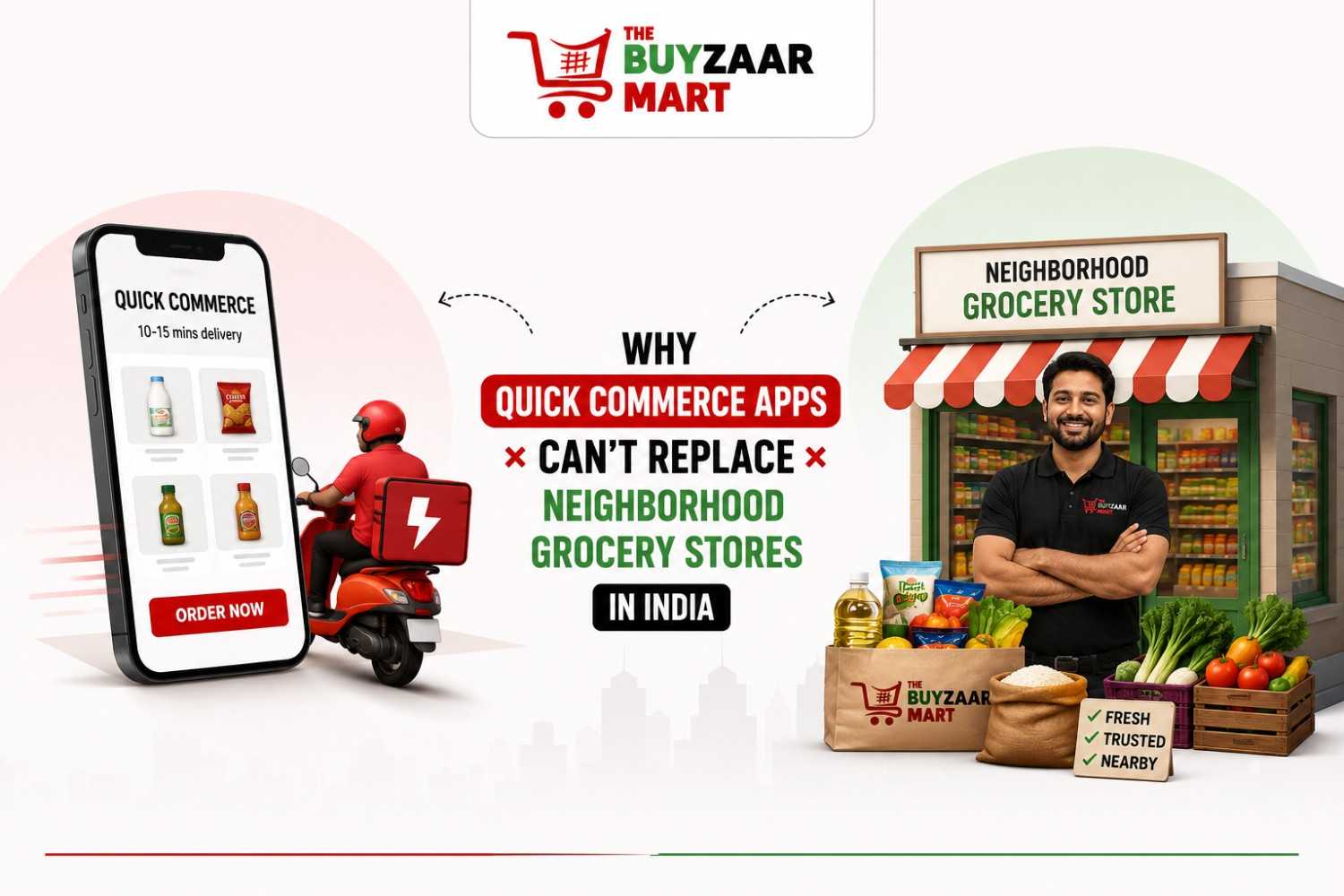
Why Quick Commerce Apps Can't Replace Neighborhood Grocery Stores in India
Explore why quick commerce apps in India cannot fully replace neighborhood grocery stores, from trust and affordability to local employment and reliability.
India's retail landscape has changed dramatically over the past few years. Ten-minute delivery apps have captured headlines, investor attention, and a growing share of urban wallets. Yet, despite the noise around quick commerce, neighborhood grocery stores continue to thrive in almost every city, town, and residential colony across the country. This is not nostalgia or resistance to technology — it reflects a deeper structural reality about how Indian households actually shop, trust, and live. Below is a detailed look at why quick commerce apps, for all their convenience, cannot fully replace the neighborhood grocery store — and why local retail formats remain relevant, resilient, and in many ways irreplaceable.
Quick Commerce Has Changed Habits, Not Replaced Them
Quick commerce platforms have introduced speed and convenience that did not exist a decade ago.
- •They work well for last-minute needs — a missing ingredient, a sudden guest, a forgotten essential
- •However, most Indian households still rely on a mix of shopping formats rather than a single channel
- •Monthly groceries, bulk staples, and trusted brands are still largely purchased from physical stores
- •Quick commerce has added a layer of convenience on top of existing shopping behavior, not replaced it entirely
- •Many users treat these apps as a backup option rather than a primary grocery destination, reaching for them only when the local store is closed or a specific item is urgently needed
- •Shopping behavior research consistently shows that habitual, planned purchases — the kind that make up the bulk of a household's monthly grocery bill — remain concentrated in physical retail rather than app-based ordering
The Trust Factor: Why Relationships Still Matter in Grocery Shopping
Neighborhood stores are built on years, sometimes decades, of personal relationships with customers.
- •Store owners often know customer preferences, family sizes, festival needs, and even credit history
- •This personal trust translates into informal credit facilities, especially for regular customers — something apps cannot offer
- •Customers trust a familiar shopkeeper's judgment on freshness, quality, and substitutes far more than an anonymous algorithm
- •In smaller cities and semi-urban areas, this relationship-driven trust is even stronger and forms the backbone of daily shopping decisions
- •This trust extends beyond transactions — a local shopkeeper often acts as an informal advisor, recommending brands, warning against overpriced items, or flagging quality issues before a customer even asks
Product Quality and the Problem of Substitution
Quick commerce apps often substitute unavailable items with similar products without prior confirmation.
- •This is a common frustration point, especially for perishables like vegetables, fruits, and dairy
- •Local stores allow customers to physically check freshness, ripeness, and quality before buying
- •Many households — particularly those with elderly members or specific dietary needs — prefer selecting produce themselves
- •The tactile, sensory nature of grocery shopping (touching, smelling, comparing) simply cannot be replicated through a screen
- •Packaging dates, batch freshness, and visible quality cues are far easier to verify in person, especially for categories like dairy, spices, and staples where quality can vary significantly between batches
Affordability and the Realities of Delivery-Based Pricing
Quick commerce platforms rely on delivery fees, surge pricing, and platform charges that add to the final bill.
- •Many apps set minimum order values, pushing customers to buy more than they actually need just to avoid extra charges
- •Neighborhood stores allow small-ticket purchases — a single onion, half a kilo of sugar, one packet of milk — without penalty
- •For price-sensitive households, especially in tier-2 and tier-3 cities, this flexibility is not a luxury; it is essential
- •Local stores also frequently offer better deals on bulk purchases through direct negotiation, something apps rarely allow
- •Seasonal price fluctuations, festival discounts, and loose-item purchasing (buying exactly the quantity needed rather than pre-packaged sizes) are far more manageable at a physical store
The Infrastructure Reality: Quick Commerce Is an Urban-Centric Model
Quick commerce depends heavily on dense population clusters, dark stores, and efficient last-mile logistics.
- •This model works well in metro cities and select urban pockets but struggles to scale profitably in smaller towns
- •Vast parts of India — including tier-2 cities, semi-urban colonies, and rural belts — remain outside the practical reach of ten-minute delivery
- •Neighborhood grocery stores, by contrast, are hyperlocal by design and already embedded within these very communities
- •This makes local retail formats structurally better suited to serve India's diverse geography, not just its metro pockets
- •Setting up a dark store network requires significant capital investment, dense delivery fleets, and consistent order volumes to remain viable — conditions that simply do not exist in most Indian towns and residential colonies outside major metros
Employment and the Local Economic Ecosystem
Neighborhood stores are often family-run businesses that support local employment and livelihoods.
- •They contribute to local economies by sourcing from nearby suppliers, wholesalers, and distributors
- •Every rupee spent at a local store circulates within the community, unlike platform-based spending, which is largely centralized
- •Quick commerce, being capital-intensive and tech-driven, creates far fewer direct local employment opportunities per store compared to a physical retail outlet
- •For many Indian families, a grocery store is not just a shop — it is a source of livelihood passed down across generations
- •A single neighborhood store often supports multiple livelihoods directly — the owner's family, store staff, delivery helpers — and indirectly through relationships with local vendors and suppliers
Emotional and Social Value of Physical Shopping
Grocery shopping in India is often a social activity, not just a transaction.
- •A visit to the local store may include a quick conversation, festival greetings, or neighborhood updates
- •For elderly customers, this human interaction plays an important role in daily routine and social connection
- •Apps, by design, remove this human element entirely, replacing it with efficiency but losing the community touchpoint
- •This social value is difficult to quantify but plays a real role in why local stores remain culturally significant
- •The neighborhood store often functions as an informal community hub — a place where people exchange local news, festival plans, and everyday updates while shopping
Reliability During Disruptions
Quick commerce services can be affected by weather conditions, traffic disruptions, rider shortages, or technical glitches.
- •Neighborhood stores, being physically present and community-rooted, tend to remain operational and accessible even during such disruptions
- •During emergencies or urgent situations, walking to a nearby store is often faster and more dependable than waiting on an app
- •This reliability factor becomes especially important in cities with infrastructure challenges or unpredictable weather patterns
- •During heavy monsoon periods, festival rushes, or local disruptions, delivery timelines on quick commerce apps often extend well beyond their promised windows, while a nearby store remains a consistent, walkable option
Why the Future Is Hybrid, Not Either-Or
The Indian grocery retail story is not about quick commerce versus neighborhood stores — it is about coexistence.
- •Smart local retailers are increasingly adopting technology like point-of-sale systems, digital payments, and inventory management to stay competitive
- •Organized neighborhood retail formats are combining the trust and accessibility of traditional stores with modern operational efficiency
- •This hybrid approach allows local stores to retain their community strengths while improving speed, consistency, and product range
- •The most successful grocery retail models in India will likely be those that blend hyperlocal trust with organized, technology-backed operations
The Bigger Picture: What This Means for India's Retail Future
India's grocery retail market is enormous and highly fragmented, with unorganized retail still commanding a dominant share.
- •Quick commerce has carved out a meaningful niche, particularly for urgent and impulse purchases in dense urban markets
- •Neighborhood stores continue to serve the bulk of planned, routine, and value-driven grocery shopping across the country
- •Rather than one format eliminating the other, the two are increasingly complementary, addressing different customer needs and occasions
- •Organized neighborhood retail formats, in particular, are well positioned to bridge the gap — combining the trust of traditional stores with structured, modern operations
- •As India's retail sector continues to evolve, the winners will likely be those formats that understand local customer behavior deeply while layering in just enough technology to improve convenience without losing the personal connection that defines Indian grocery shopping
Frequently Asked Questions
Are quick commerce apps a threat to neighborhood grocery stores in India?
Quick commerce has changed shopping habits for urgent needs, but it has not replaced routine, value-driven grocery shopping, which remains strongly rooted in local stores.
Why do Indian households still prefer local grocery stores over apps?
Trust, credit flexibility, product quality checks, and community relationships are key reasons households continue to rely on neighborhood stores.
Can quick commerce and local grocery stores coexist?
Yes, the two formats largely serve different shopping occasions and are increasingly complementary rather than competitive.
Why does quick commerce struggle in smaller Indian cities?
Quick commerce depends on dense population clusters and efficient logistics, which are harder to sustain profitably in tier-2 and tier-3 cities compared to metros.
How can organized local grocery formats stay competitive against quick commerce?
By adopting modern retail practices such as point-of-sale technology, better inventory management, and consistent product availability while retaining the trust and accessibility of a local store.