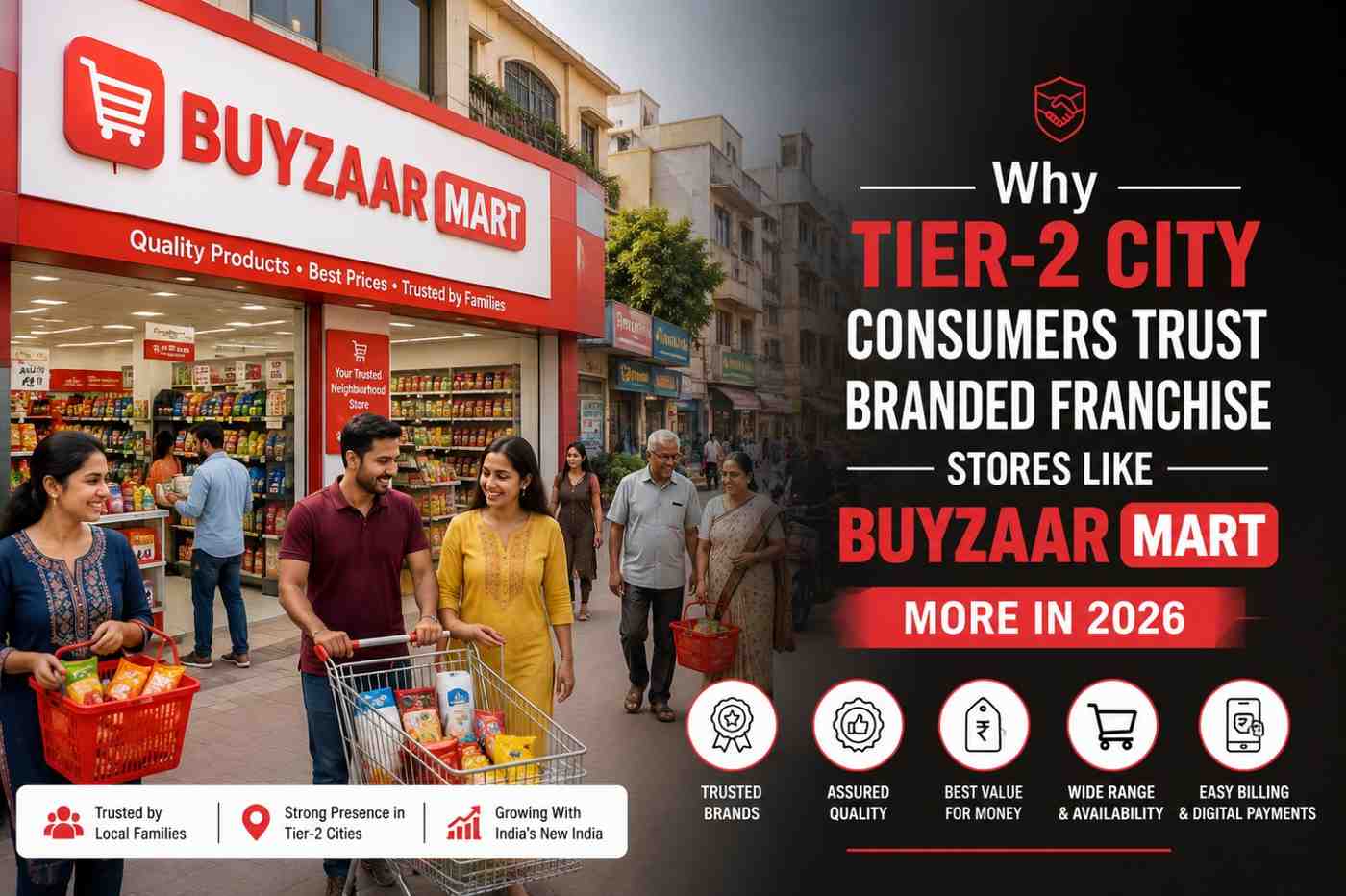
Why Tier-2 City Consumers Trust Branded Franchise Stores Like Buyzaar Mart More in 2026
Consumer trust in tier-2 Indian cities is shifting fast — from familiar local kiranas to branded, organised franchise stores. Here's why 2026 marks the tipping point and what it means for grocery franchise owners.
Something is quietly changing in how families in Kanpur, Lucknow, Meerut, Dehradun, and dozens of other tier-2 Indian cities make one of their most routine decisions — where to buy their groceries. For generations, this was not a decision at all. The answer was the kirana at the corner of the street — a familiar face, a familiar shelf, a running khata. That relationship was built on familiarity and convenience, and for decades it was unquestioned. In 2026, it is being questioned. And the answer is increasingly a branded, organised franchise store. This is not a metro trend arriving late to smaller cities. It is a tier-2 specific consumer shift driven by forces that are uniquely strong in these markets right now — and understanding why it is happening is essential for anyone building or running a grocery franchise in North India.
The Trust Gap That Nobody Talked About
The honest truth about the traditional kirana relationship is this: it was built on social trust, not product trust. You trusted the shopkeeper. You did not necessarily trust every product on his shelf.
- •Adulteration in loose staples — atta, dal, spices, oil — has been a persistent and widely acknowledged problem across unorganised grocery retail in India. Consumers in tier-2 cities are not unaware of this — they simply had no reliable organised alternative until recently
- •Inconsistent pricing, the absence of visible MRPs on loose products, and the practice of informal discounting created a pricing environment where most customers never knew if they were paying a fair price
- •Product expiry management in unorganised stores is almost entirely absent — products are rarely date-checked, near-expiry items stay on the shelf, and the customer bears the full risk of a bad purchase
- •Stock unreliability — the particular brand or variant a customer wants is frequently unavailable, forcing compromise purchases that accumulate into quiet dissatisfaction over time
These were tolerated problems. Not because consumers did not mind them, but because there was nothing better available. In 2026, there is.
What Has Changed in Tier-2 Consumer Behaviour
Three forces have converged in 2026 to make tier-2 consumers not just open to organised franchise stores but actively seeking them out.
Digital Exposure Has Raised the Standard
A consumer in Lucknow who shops on Blinkit, browses Amazon for household products, and watches YouTube videos about nutrition and food safety has a fundamentally different set of expectations than the same consumer five years ago. She knows what a proper MRP label looks like. She knows what FSSAI certification means. She knows the difference between a genuine Aashirvaad packet and a loose atta substitute. Digital literacy has created product literacy — and product-literate consumers choose organised retail.
Post-Pandemic Hygiene Consciousness Is Permanent
The COVID years created a permanent shift in how tier-2 city consumers think about the physical handling of their food. Packaged products, sealed containers, clean store environments, and visible hygiene standards are no longer metropolitan preferences — they are baseline expectations across income levels in every significant North Indian city. An organised Buyzaar Mart store with uniform shelving, proper packaging standards, and daily expiry checks satisfies these expectations in ways that an unorganised kirana structurally cannot.
Rising Incomes Have Created Brand Consciousness
As household incomes grow in tier-2 cities — driven by government salary revisions, private sector expansion, and the UP Defence Industrial Corridor and Smart City investments that are reshaping cities like Lucknow and Kanpur — families are choosing brands over generics, packaged over loose, and organised over unorganised. Brand loyalty is the consumer expression of rising income — and it flows naturally toward organised franchise stores.
Why Buyzaar Mart Specifically Earns Trust Faster in These Markets
Not every organised grocery brand earns trust equally in tier-2 North Indian cities. Buyzaar Mart's model is specifically architected to build trust rapidly in these markets — and several features make it distinctly effective.
- •Recognisable brand partnerships build immediate credibility. When a consumer walks into a Buyzaar Mart store and sees HUL, ITC, Nestlé, Tata Consumer, Dabur, Patanjali, and Britannia products on well-maintained branded shelves, the store immediately inherits the trust equity of those brands. She does not need six months of shopping experience to decide whether to trust the store — the brands she already trusts are already there
- •Transparent, visible pricing removes a long-standing consumer grievance. Every product on a Buyzaar Mart shelf is MRP-labelled and shelf-priced. There is no negotiation, no ambiguity, and no post-purchase doubt about whether she paid a fair price. For tier-2 consumers who have spent years navigating the informal pricing of unorganised retail, this transparency is genuinely disarming
- •The FSSAI licence and regulatory compliance are visible signals of legitimacy. In markets where food safety concerns are real and widely discussed, operating under a government-recognised licence is a meaningful trust signal — particularly for first-time customers making their initial decision about whether to switch from their existing kirana
- •The physical store environment creates an immediate quality signal. Uniform store design, clean floors, properly faced shelves, and branded signage communicate organisation and professionalism before a single product is picked up. In tier-2 cities where organised retail is still sparse, the store environment itself is a differentiation that earns trust on first visit
The Network Effect of Trust — How It Compounds in Tier-2 Communities
In a tier-2 city, word of mouth travels faster and carries more weight than in a metro. When a Buyzaar Mart store opens in a colony in Kanpur or a mohalla market in Lucknow, the community dynamic accelerates trust-building in a way that no marketing campaign can replicate.
- •A customer who has a good experience tells three to five people in her immediate social circle within the same week — through WhatsApp groups, during school drop-off conversations, or in the evening colony gathering
- •One family who finds a trusted, reliable grocery store actively recommends it to every new family that moves into the colony — neighbourhood referral is the most powerful customer acquisition channel in tier-2 Indian retail
- •The store's physical presence in the community — consistent hours, reliable stock, familiar friendly staff — builds the kind of institutional trust that takes organised retail chains years to build in metros but can be established within months in a tight-knit tier-2 neighbourhood
- •Over time, the Buyzaar Mart store becomes what the corner kirana used to be — but with the product trust, pricing transparency, and quality assurance that the kirana could never offer. It becomes the neighbourhood's trusted institution, not just its convenient option
What This Means for Franchise Owners
- •The shift in tier-2 consumer trust toward branded organised stores is not something franchise owners need to create — it is already happening, and a well-run Buyzaar Mart store positions itself perfectly to capture it
- •The franchise owner's job is to not break the trust that the brand and the model have already built — consistent stock availability, honest pricing, clean store conditions, and professional customer service are the operational behaviours that sustain and compound the consumer trust advantage
- •Every customer who switches from her neighbourhood kirana to a Buyzaar Mart store and has a positive first experience represents not just one converted customer — it represents access to her entire social network in that community
- •The franchise owners who grow fastest in tier-2 cities in 2026 are those who understand that they are not just running a grocery store — they are becoming their neighbourhood's trusted institution. That is a position worth earning carefully and protecting consistently
Final Thoughts
- •Consumer trust in tier-2 Indian cities is shifting structurally and permanently toward organised, branded grocery retail — driven by digital exposure, post-pandemic hygiene consciousness, and rising brand awareness
- •Buyzaar Mart's brand partnerships, transparent pricing, regulatory compliance, and uniform store standards make it one of the most trust-credible organised grocery franchise options in the North Indian tier-2 market
- •Trust, once built in a tight-knit tier-2 community, compounds faster and lasts longer than in any metro market — making a well-run Buyzaar Mart franchise in these cities one of the most defensible and loyalty-rich businesses an entrepreneur can build in 2026
- •In tier-2 India, the consumer is ready. The trust is being earned. The question is whether your store is the one earning it.
Build the most trusted store in your neighbourhood. Apply at thebuyzaarmart.com/franchise or call 9217991727 (Monday to Saturday, 9 AM to 7 PM)
Frequently Asked Questions
Why are tier-2 city consumers in India shifting from kirana stores to organised grocery franchises?
Three forces are driving this shift in 2026: digital exposure has raised consumer expectations around product quality, MRP transparency, and FSSAI compliance; post-pandemic hygiene consciousness has made packaged, properly stored products a baseline expectation; and rising incomes have created brand consciousness that naturally flows toward organised, branded stores like Buyzaar Mart.
What makes Buyzaar Mart more trustworthy than other grocery options in tier-2 cities?
Buyzaar Mart builds trust through four pillars: recognisable brand partnerships (HUL, ITC, Nestlé, Tata Consumer, Dabur, Patanjali, Britannia) that transfer trust equity immediately; transparent MRP-based shelf pricing that eliminates pricing ambiguity; FSSAI licensing and regulatory compliance that signal legitimacy; and a uniform, clean store environment that communicates professionalism before a single product is picked up.
Is consumer trust in organised retail growing in tier-2 cities or only in metros?
The trust shift toward organised retail is actually happening faster in tier-2 cities than in metros right now. In metros, organised retail already has significant penetration. In tier-2 cities like Lucknow, Kanpur, Meerut, and Dehradun, the shift from unorganised to organised is at its most active inflection point — making the first-mover advantage for franchise owners exceptionally strong in 2026.
How does word of mouth drive customer acquisition for a Buyzaar Mart franchise in tier-2 cities?
In tight-knit tier-2 communities, a satisfied customer tells three to five people in her immediate social circle within days — through WhatsApp groups, school drop-off conversations, and neighbourhood gatherings. Neighbourhood referral is the most powerful and lowest-cost customer acquisition channel in tier-2 Indian retail, and a well-run Buyzaar Mart store with consistent quality and honest pricing activates this channel naturally and rapidly.
What should a Buyzaar Mart franchise owner do to maintain and grow consumer trust?
The most important trust behaviours are: never running out of core staples (stock reliability is the foundation of trust), maintaining consistent and transparent pricing at MRP, keeping the store clean and organised at all times, removing expired products immediately as a daily non-negotiable, and treating every customer complaint as a trust recovery opportunity rather than an inconvenience. Trust is built transaction by transaction — and lost in a single bad experience.