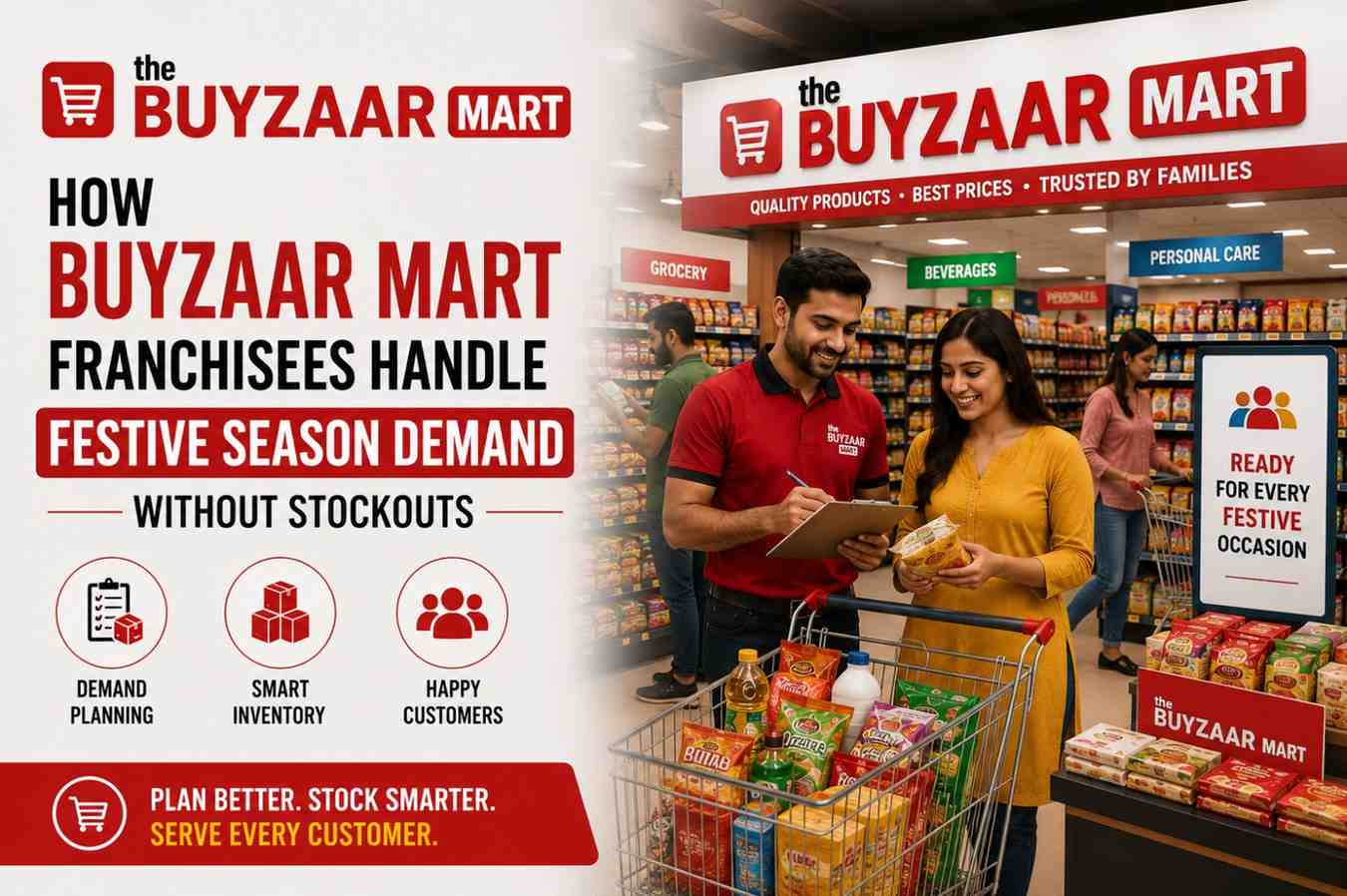
How Buyzaar Mart Franchisees Handle Festive Season Demand Without Stockouts (2026)
Festive season is the biggest revenue opportunity and the biggest operational test for any grocery franchise store. Here is exactly how Buyzaar Mart franchise partners prepare for it — and never run out of stock.
Every grocery franchise store owner in North India knows the feeling. It is Day 3 of Navratri. The store opened at 8 AM to a queue that had already formed outside. By 10 AM, the sendha namak shelf is empty. By noon, the kuttu atta is gone. By 3 PM, customers are asking for products you never thought to order and leaving with half their planned purchase because the other half is simply not there. That feeling — of watching your highest-footfall week of the year turn into a series of apologetic conversations about empty shelves — is one of the most avoidable and most expensive operational failures in grocery retail. The festive calendar in North India is not unpredictable. Navratri, Diwali, Dussehra, Chhath Puja, Holi, Eid, and Christmas follow the same rough dates every year. The demand spikes are entirely foreseeable. The products that will sell out first are largely knowable in advance. The only variable is whether the franchise owner has prepared — or has not. Here is exactly how Buyzaar Mart franchise partners are advised to prepare for festive season demand — so that their highest-footfall days become their highest-revenue days, not their highest-stockout days.
Why Festive Season Stockouts Are More Damaging Than Regular Stockouts
Before getting into the operational playbook, it is worth understanding why festive stockouts carry a disproportionately high cost compared to regular inventory gaps.
- •A customer who cannot find her regular dal on a Tuesday is mildly inconvenienced — she will likely return tomorrow or check another store without significant loyalty damage
- •A customer who cannot find sendha namak on Day 4 of Navratri, or ghee for Diwali sweets, or dry fruits for gifting on Dhanteras, does not have the option to wait. Her festive preparation has a deadline and an emotional significance that a regular purchase does not
- •She will find the product somewhere else — and the store that serves her in that moment of genuine need earns the kind of grateful, occasion-anchored loyalty that is far stronger than the loyalty built through routine shopping
- •The inverse is equally true: the store that lets her down during a festive need earns a negative emotional association that is also stronger and longer-lasting than regular service failures
- •Festive periods represent a large share of some categories' entire annual sales volume — a single well-managed Diwali week can represent more gross profit than several average weeks combined. A stockout during this window is not just a missed sale, it is a missed multiplied opportunity
The Festive Season Calendar — Plan for Every Peak, Not Just the Biggest One
North Indian grocery demand has a festive rhythm that every Buyzaar Mart franchise owner should have mapped and planned for before the year begins.
January to February
- •Makar Sankranti — til, gur, groundnut, and sesame products spike sharply
- •Republic Day — packaged snacks and beverages for family gatherings increase
March to April
- •Holi — mithai ingredients, thandai mix, dry fruits, beverages, and packaged sweets drive significant volume spikes
- •Ram Navami — puja items, fruits, and satvik grocery items
March to June
- •Wedding season — bulk buying of dry fruits, ghee, rice, dal, and packaged sweets from families hosting or attending weddings in the neighbourhood
September to October
- •Navratri — the single largest demand spike for satvik grocery items across North India. Sendha namak, kuttu atta, sabudana, singhara atta, sama ke chawal, dry fruits, rock sugar, and fresh fruits all see sharp, multi-fold demand increases over the nine-day period
- •Dussehra — marks the end of Navratri and the beginning of the pre-Diwali gifting and stocking season
October to November
- •Dhanteras and Diwali — the biggest overall grocery demand event of the year. Dry fruits, premium ghee, mithai ingredients, packaged gift packs, edible oil, rice, flour, sugar, and cleaning products all spike simultaneously. Premium FMCG gift packs from HUL, ITC, Nestlé, and Dabur see their peak annual movement during this two-week window
- •Chhath Puja — thekua ingredients, lotus seeds, sugarcane, dry fruits, and fruits are high demand items, particularly strong in eastern UP catchments
November to December
- •Month-end and year-end corporate gifting — packaged dry fruit boxes, premium FMCG hampers, and sweet boxes
Each of these demand events requires a separate preparation plan — not a single generic festive season strategy that tries to handle all of them with the same approach.
The Eight-Step Festive Preparation Framework
Step 1 — Pull Last Year's Sales Data Four Weeks Before Each Festive Period
The most accurate predictor of this year's festive demand is last year's festive performance — and your POS system holds that data.
- •Four weeks before any major festive period, pull your daily and weekly sales reports from the same period last year — which SKUs sold at what velocity, which categories spiked most sharply, which products ran out and on which day
- •If your store is in its first year of operation and does not have prior year data, use your most recent four-week average as a baseline and apply a 30 to 50 percent uplift for festive periods — conservative enough to avoid gross overstock but sufficient to cover the demand increase for most categories
- •Pay particular attention to the exact day within each festive period when stockouts occurred last year — Navratri Day 3, Diwali Eve, Chhath Puja morning — and plan your re-supply schedule around those specific high-risk windows
- •Share this analysis with Buyzaar Mart's supply team when placing your festive orders — the team can advise on supply availability, likely allocation constraints for high-demand SKUs, and alternative product options if primary SKUs face supply challenges
Step 2 — Build Your Festive SKU List Category by Category
Generic festive preparation — order more of everything — is as likely to create wastage as it is to prevent stockouts. Effective festive preparation is category-specific and SKU-specific.
Navratri Specific SKU List
- •Sendha namak — stock three to four times your normal weekly quantity. This is the single most common Navratri stockout item across all North Indian grocery stores
- •Kuttu atta — stock in both 1 kg and 500 g pack sizes, since families observe fasts at different intensity levels and buy different quantities
- •Sabudana — in 200 g, 500 g, and 1 kg packs. A family doing a nine-day fast will buy multiple packs
- •Singhara atta, sama ke chawal, and rajgira atta — smaller volume than kuttu but significant demand from observing households
- •Dry fruits — almonds, cashews, and raisins across multiple pack sizes, for both fasting snacking and puja offerings
- •Rock sugar and mishri — regular demand but significantly elevated during Navratri
- •Fresh fruits — banana, apple, and pear for puja thalis. Coordinate with your fresh produce supplier specifically for Navratri
Diwali and Dhanteras Specific SKU List
- •Premium dry fruit packs — branded gift boxes at ₹150 to ₹500 price points are peak festive demand items
- •FMCG gift hampers — major brands produce Diwali gift packs specifically. Stock these prominently and early, since they sell out fastest
- •Premium ghee — in 500 g and 1 kg packs, since Diwali mithai making drives the sharpest ghee demand of the year
- •Refined sugar — 1 kg and 5 kg packs, with demand spiking sharply in the week before Diwali as families make sweets at home
- •Besan — bulk demand for ladoo and halwa making in the two weeks before Diwali
- •Cleaning products — floor cleaners, phenyl, glass cleaners, and surface disinfectants all spike as families deep-clean for Diwali. Stock at twice your normal level
- •Diyas, matchboxes, and candles — small but consistent demand that can be stocked at the entry display for impulse purchase
Holi Specific SKU List
- •Thandai mix — packaged thandai powder from established brands
- •Dry fruits and nuts — for thandai preparation and gifting
- •Packaged sweets and gujiya mixes — ready-to-make gujiya dough or moyan mixes
- •Beverages — carbonated drinks, packaged juices, and flavoured milk see sharp demand increases during Holi gatherings
Step 3 — Place Festive Orders in Two Tranches, Not One
One of the most common festive stocking mistakes is placing a single large order three weeks before the festive period and hoping it covers the entire demand window. This approach has two consistent failure modes: if the estimate is too high, you are left with overstock after the festival ends; if it is too low, you run out mid-festival with no time to resupply.
- •Tranche 1 — three weeks before: place 60 to 65 percent of your estimated total festive demand. This covers your base demand and gives you stock from the first day of the festive period
- •Tranche 2 — one week before: based on how Tranche 1 is moving through the store, top up the specific SKUs showing the fastest depletion. This allows real-time demand adjustment rather than betting everything on a single pre-festival estimate
- •For Navratri specifically, given its nine-day compressed timeframe, consider a third mid-festival top-up order on Day 4 or 5 for the fastest-moving satvik items. Coordinate this with Buyzaar Mart's supply team in advance so the delivery turnaround time is pre-planned rather than reactive
Step 4 — Reconfigure Your Store Layout for Festive Periods
A Buyzaar Mart store that looks the same during Diwali week as it does on a regular Tuesday is leaving significant impulse revenue uncaptured.
- •Create a dedicated festive display zone at the store entrance — the highest-visibility location in the store, showcasing dry fruit gift packs, FMCG festive hampers, premium ghee, and key festive SKUs at a glance
- •Move festive-specific products to eye-level shelving for the duration of the festive period — sendha namak at eye level during Navratri, ghee and dry fruits front and centre during the Diwali window
- •Create clear in-store signage for festive category groupings — Navratri Corner, Diwali Gifting Section, Chhath Puja Essentials — so customers navigate faster and discover more products
- •Position complementary festive products together — kuttu atta next to sendha namak next to sabudana next to dry fruits — so a customer coming in for one item sees the full range and completes her list in one visit
Step 5 — Increase Staff Coverage During Peak Festive Days
The operational failure mode during festive peaks is not always inventory — it is often insufficient staff to handle the volume of customers, billing speed, and shelf replenishment simultaneously.
- •Identify the three to five highest-traffic days within each festive period — Navratri Days 1, 8, and 9, Dhanteras Eve and Day, Diwali Eve — and schedule maximum staff coverage for those specific windows
- •Bring in a temporary part-time staff member for the festive peak period if your regular team cannot handle the volume — even two weeks of additional staffing during Navratri and Diwali pays for itself through the additional sales and stockout prevention it enables
- •Assign one staff member exclusively to shelf replenishment during peak hours — keeping festive shelves full during the busiest days requires someone whose sole responsibility is moving stock from the stockroom to the shelf in real time
Step 6 — Activate Your WhatsApp Customer Network Before and During the Festive Period
Your WhatsApp customer broadcast list is your most cost-effective and fastest festive demand activation tool.
- •Seven days before the festive period, send a broadcast announcing your festive stock arrival — driving planned visits from customers who would otherwise shop elsewhere out of habit
- •Three days before, send a reminder highlighting specific popular SKUs and any promotional offers, creating urgency and pre-commitment from regular customers
- •During the festive period, send daily or every-other-day updates on stock availability, managing customer expectations and driving early visits before peak stockout risk
- •Post-festival, send a thank-you message to your regular customer list — a simple closing message that builds the relationship capital which drives loyalty into the next festive cycle
Step 7 — Coordinate With Buyzaar Mart's Supply Team Early
Festive season supply chains are under pressure across the entire FMCG industry — manufacturer production capacity, distributor stock allocation, and transport availability all tighten as every retailer in the country places elevated orders simultaneously.
- •Contact Buyzaar Mart's supply team six weeks before major festive periods — Navratri and Diwali specifically — to communicate your anticipated order volumes and confirm supply availability for your high-priority SKUs
- •Ask specifically about allocation constraints — which SKUs may be supply-limited during peak festive demand, and what alternatives are available if your primary choice faces a shortage
- •Confirm delivery lead times for festive orders — a delivery that arrives on Navratri Day 6 when you needed it on Day 1 is operationally equivalent to no delivery at all
- •For premium FMCG festive gift packs, these are limited-allocation items that sell through fast at the distributor level — early ordering is not optional, it is the only way to ensure sufficient supply
Step 8 — Review and Document Every Festive Period for Next Year
The most valuable output of every festive season is not the revenue it generates — it is the operational intelligence it produces for the next cycle.
- •Within one week after each major festive period ends, document your festive review — which SKUs ran out on which day, which products were overstocked and need quantity reduction next year, which new products customers requested that you did not carry, and how actual daily sales compared to your forecast
- •Calculate your festive gross margin separately from your regular trading period — festive periods often generate higher margins due to the premium product mix and higher average basket sizes
- •Note any supply chain failures — late deliveries, short deliveries, quality issues — and raise these with Buyzaar Mart's supply team in the post-festival review
- •File this review document where you can find it in eleven months — when preparing for the same festival next year, your own documented experience is worth more than any general advice
Final Thoughts
- •The festive season is the single biggest revenue opportunity in the North Indian grocery franchise calendar, and the franchise stores that prepare properly turn it into their most profitable trading period of the year
- •The preparation framework in this guide — annual festive calendar mapping, category-specific SKU lists, two-tranche ordering, store reconfiguration, staffing uplift, WhatsApp activation, supply team coordination, and post-festival review — is not complex. It is simply disciplined, forward-looking operational management applied to a foreseeable demand event
- •The stores that run out of sendha namak on Navratri Day 3 or ghee before Diwali are not unlucky — they are underprepared. The stores that never run out are not lucky — they planned four weeks earlier, ordered in tranches, coordinated with their supply team, and documented last year's lessons
- •Buyzaar Mart's 50+ FMCG brand partnerships, centrally managed supply chain, and franchise support framework give every partner the tools to handle festive demand professionally — the operational discipline to use those tools well is what separates a good festive season from a great one
Build a store that is ready for every season. Apply at thebuyzaarmart.com/franchise or call 9217991727 (Monday to Saturday, 9 AM to 7 PM)
Frequently Asked Questions
How far in advance should a Buyzaar Mart franchise partner place Diwali orders?
Begin coordinating with Buyzaar Mart's supply team at least six weeks before Diwali, and place your first order tranche no later than three weeks before Dhanteras. Premium festive gift packs are allocation-limited and require even earlier commitment.
What is the most commonly stocked-out item during Navratri at Indian grocery stores?
Sendha namak — rock salt used for fasting. It is purchased by virtually every observing household and its demand is so concentrated in a nine-day window that most stores consistently underestimate the required quantity. Stock four times your normal weekly quantity as a starting point.
Should festive products be offered at a discount to drive volume?
Not primarily. Festive demand is need-driven, not price-driven — customers buying sendha namak during Navratri or ghee before Diwali are not making a price comparison decision. Promotions make more sense post-festival to clear any remaining festive-specific stock.
How do I handle post-festival overstock on festive-specific products?
For product-specific fasting items like kuttu atta and singhara flour, reduce to a maintenance quantity immediately after the festival and flag remaining stock for near-expiry review. For products with longer shelf lives like dry fruits and ghee, run a modest post-festival promotion to clear excess before the next replenishment cycle.
Does Buyzaar Mart provide any festive season support to franchise partners?
Yes — Buyzaar Mart deploys festive-specific marketing campaigns including local promotions and in-store branding support during major festive periods. Franchise partners should coordinate with the Buyzaar Mart support team ahead of each major festival to align on available marketing materials and campaign timing.