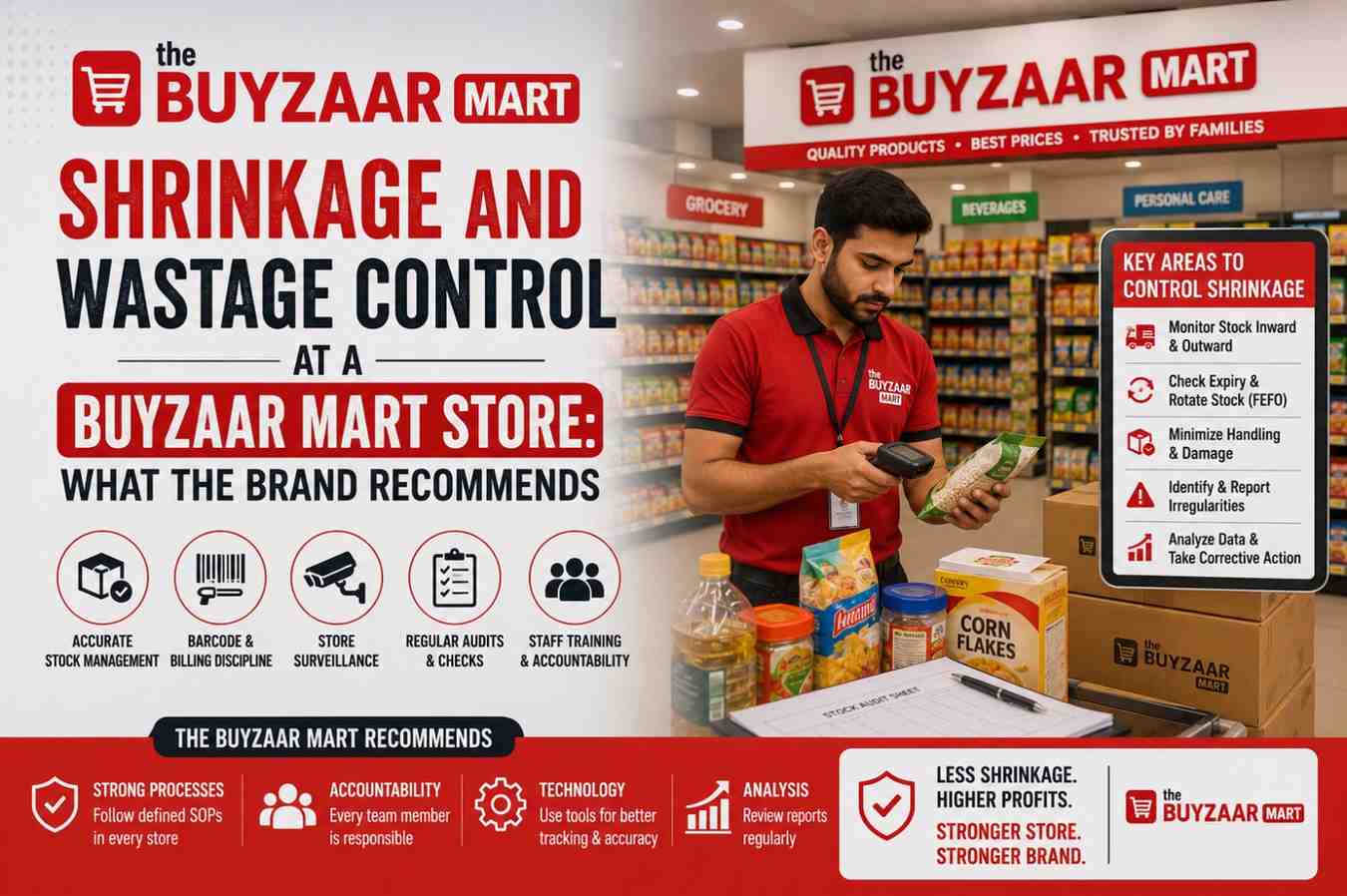
Shrinkage and Wastage Control at a Buyzaar Mart Store: What the Brand Recommends (2026)
Shrinkage and wastage silently drain 2 to 5% of grocery store revenue every month. Here is exactly what Buyzaar Mart recommends to franchise partners for controlling both — category by category, system by system.
There is a line item in every grocery store's monthly P&L that never appears as a single visible number — but shows up silently across dozens of smaller ones. It hides in billing discrepancies, expired products quietly removed from shelves, short deliveries never followed up on, and products that disappear between the stockroom and the shelf without anyone noticing. That line item is shrinkage and wastage, and in an average grocery store it consumes between 2 and 5 percent of total monthly revenue without a single alarm going off. For a Buyzaar Mart franchise store generating ₹8 lakhs per month in sales, a 3 percent shrinkage rate means ₹24,000 vanishing every month — ₹2.88 lakhs every year — from a business that may be targeting ₹1.2 to ₹1.6 lakhs in monthly net profit. That is not a rounding error. That is the difference between a store that is genuinely profitable and one that always feels like it should be doing better than it is. Buyzaar Mart takes shrinkage and wastage control seriously — both because it directly affects franchise partner margins and because it is a core component of the brand's quality and operational standards. Here is what the brand recommends, category by category and system by system.
Understanding the Two Problems Separately
Before getting into solutions, it is essential to understand that shrinkage and wastage are two distinct problems with different causes, different high-risk categories, and different prevention strategies.
Shrinkage refers to inventory loss that results in fewer units in your store than your records indicate should be there. Its three primary sources are:
- •Theft — customer shoplifting and staff pilferage, both of which are more common in grocery retail than most first-time franchise owners expect
- •Billing errors — products scanned at the wrong price, items accidentally left unscanned, manual billing overrides, and cashier errors that result in products leaving the store without generating the correct revenue
- •Receiving discrepancies — short deliveries accepted without checking, damaged products accepted and entered into inventory but never sold, and vendor substitutions that enter stock at incorrect quantities or values
Wastage refers to inventory that enters the store correctly but cannot be sold — primarily because it reaches or passes its expiry date before being purchased. Its primary sources are:
- •Overordering — buying more stock than the store's actual sales velocity can sell before the product expires
- •Poor rotation — new stock placed in front of older stock, leaving older units at the back until they expire
- •Incorrect storage — temperature-sensitive products stored outside their required conditions, accelerating spoilage
- •Damage in handling — products broken, crushed, or compromised during stockroom handling or shelf stacking
Both problems cost money. But they require fundamentally different responses — and addressing one without addressing the other leaves a significant portion of the loss unresolved.
Part One — Shrinkage Control: What Buyzaar Mart Recommends
System 1 — Make the POS System Non-Bypassable for Every Transaction
The single most effective shrinkage prevention tool in a Buyzaar Mart store is also the one already installed on Day 1 — the POS billing system. But it only prevents shrinkage if it is used for every single transaction without exception.
- •Establish a firm store rule: no product leaves the billing counter without being scanned through the POS system — no informal cash transactions, no adding it to the next bill, no favours for regular customers that bypass the system
- •Review your POS system's void and discount report weekly — every voided, manually overridden, or discounted transaction requires a clear explanation. A pattern of voids from a specific cashier during a specific shift is one of the clearest early warning signs of billing-related shrinkage
- •Run a daily sales reconciliation without exception — total POS revenue matched against physical cash in the till plus digital payment settlements. A consistent daily discrepancy of even ₹50 to ₹100, left uninvestigated, normalises billing leakage that compounds into thousands of rupees monthly
- •Never allow staff to process their own personal purchases at the billing counter — always have a second staff member handle any purchase by a team member, logged through the POS system at full price with a clear note
System 2 — Tighten the Inward Receiving Process
A significant share of grocery store shrinkage never involves theft at all — it enters the store through accepted but unchecked deliveries where the physical quantity received is less than what was invoiced and entered into inventory.
- •Assign one specific, trained person to receive every delivery — never allow delivery personnel to place stock directly on shelves or in the stockroom without a proper receiving check
- •Count every unit in every delivery against the delivery invoice before signing acceptance — if the count does not match, document the discrepancy immediately and contact Buyzaar Mart's supply team before accepting the partial delivery
- •Check for damaged outer packaging on every carton — a dented, wet, or torn carton may indicate damaged products inside that will become unsellable wastage if accepted without flagging
- •Enter all received stock into the POS inventory system on the same day as delivery — a gap between physical arrival and system entry creates a window where product can be removed before it is recorded, leaving no audit trail
System 3 — Install and Use CCTV Strategically
CCTV is not just a security tool — it is a shrinkage investigation tool that makes it possible to identify exactly when and how inventory loss is occurring.
- •Cover the billing counter, stockroom entrance, store entry and exit points, and high-value product display areas with visible CCTV cameras — visibility itself is a deterrent that reduces both customer shoplifting and staff pilferage
- •Ensure CCTV footage is stored for a minimum of 30 days — shrinkage patterns often only become apparent when you compare a week of footage against that week's inventory loss data
- •When your monthly physical stock count reveals a significant variance in a specific category, review CCTV footage for that section rather than immediately assuming a process failure — footage regularly reveals specific incidents that explain category-level losses
- •Remote access to CCTV from the franchise owner's phone is strongly recommended — it allows oversight during peak hours and during shifts when the owner is not physically present
System 4 — Conduct Surprise Cash and Stock Spot Checks
Scheduled audits are essential — but predictable. Staff who know exactly when the weekly audit happens can manage behaviour accordingly for that window. Unannounced spot checks are the most effective complement to the regular audit schedule.
- •Conduct at least two unannounced cash drawer reconciliations per week — compare the physical cash in the drawer against the POS running total at a random point mid-shift, not at closing time when any discrepancy could have been corrected
- •Do surprise physical counts of two or three specific high-risk SKUs randomly each week — products in high-shrinkage categories like personal care sachets, small snack packs, and premium branded products should be spot-counted against system inventory regularly
- •The deterrent value of surprise checks is substantial — when staff know unannounced checks happen but cannot predict when, consistent honest behaviour throughout the shift becomes the rational choice
System 5 — Manage High-Risk Shrinkage Categories Specifically
Not all product categories carry the same shrinkage risk. In a Buyzaar Mart store, the categories that warrant specific attention are:
- •Personal care sachets and small cosmetic items — high unit value relative to their size makes them the most common shoplifting target. Position these in clear line-of-sight of the billing counter or staff station, not in back corners of the store
- •Premium FMCG products — items like premium ghee, imported foods, and high-value health supplements carry higher shoplifting risk due to their value. Consider locked display units or counter-based display for the most premium SKUs
- •Small consumables near the billing counter — impulse items at checkout are both the highest revenue-per-square-foot products and the easiest to pocket. Keep the billing counter area well-supervised at all times
Part Two — Wastage Control: What Buyzaar Mart Recommends
System 1 — Order Based on Sales Data, Not Habit or Gut Feel
The most common cause of grocery store wastage is not negligence — it is ordering the wrong quantities based on habit, vendor pressure, or guesswork rather than actual sales data.
- •Use your POS system's weekly sales velocity report as the primary input for every stock order — how many units of each SKU actually sold last week is the most accurate predictor of how many you need this week
- •Build a simple minimum and maximum stock level for every SKU — minimum is the point at which you reorder, maximum is the total quantity you will ever hold at one time. Never order above the maximum regardless of discounts or vendor persuasion
- •Be especially disciplined about seasonal and festive products — overordering for Diwali, Navratri, or Holi on the expectation of higher-than-actual demand is one of the most common wastage events in the grocery franchise calendar. Order conservatively and top up if demand exceeds expectations
System 2 — Implement Strict FIFO Across Every Shelf and Stockroom
FIFO — First In, First Out — is the single most important rotation discipline in grocery retail. It means the oldest stock is always at the front of the shelf and sold first, with new arrivals placed behind existing stock.
- •Train every staff member who touches product — whether stacking shelves or arranging the stockroom — on the FIFO principle until it becomes automatic and non-negotiable
- •When a new delivery of any perishable or near-perishable product arrives, every unit currently on the shelf must be moved to the front before the new stock is placed behind it — this takes an extra two minutes per product and prevents the most common rotation failure
- •Label cartons in the stockroom with the delivery date using a marker — when multiple deliveries of the same product are in storage, the date label makes FIFO sequencing unambiguous even for junior staff
- •Conduct a FIFO compliance check as part of the weekly store audit — walk the high-risk category shelves specifically looking for products where newer manufacturing dates are visible at the front. Correct any non-compliance immediately and retrain the responsible staff member
System 3 — The Near-Expiry Protocol — Act Before the Product Expires, Not After
The most expensive form of wastage in a grocery store is the product that expires on the shelf without anyone noticing until it is too late to recover any value from it. Buyzaar Mart recommends a tiered near-expiry response protocol.
30 Days to Expiry — Move and Promote
- •Move the product to the front of the shelf — maximum visibility, minimum obstruction from products with longer shelf life
- •Consider a visible promotional price reduction of 10 to 15 percent — most customers will choose the near-expiry product over a full-price one if the discount is visible and the product quality is unaffected
- •Alert your WhatsApp customer broadcast group to the offer — a simple message about a special price on fresh stock drives targeted footfall for exactly the customer who buys this product regularly
15 Days to Expiry — Escalate Urgency
- •Increase the promotional discount to 20 to 30 percent if the product has not moved sufficiently at the first discount level
- •Flag the product for potential return under Buyzaar Mart's Hassle-Free Inventory Assurance — initiate the return process with Buyzaar Mart's supply team rather than waiting until the product has actually expired
- •Brief every staff member to actively recommend this product to customers buying from the same category — a verbal recommendation from a trusted store staff member is often more effective than shelf placement alone
At or Past Expiry — Zero Tolerance
- •Remove immediately from the shelf — this is an absolute non-negotiable brand standard. No expired product remains on a Buyzaar Mart shelf under any circumstance
- •Document the removal — product name, SKU, quantity, expiry date — for the monthly wastage report
- •Initiate the return process with Buyzaar Mart's supply team per the Hassle-Free Inventory Assurance policy
System 4 — Temperature and Storage Compliance for Perishable Categories
For Buyzaar Mart Super Mart and Hyper Mart stores carrying dairy, fresh produce, and refrigerated products, improper storage is one of the fastest ways to convert good stock into wastage.
- •Check refrigerator and display cooler temperatures every morning before the store opens — the acceptable range for dairy and fresh products is typically 2 to 8 degrees Celsius. A unit running even 4 degrees above this range can reduce the effective shelf life of dairy products by 30 to 40 percent
- •Never overload refrigerated display units — excessive product stacking blocks cold air circulation and creates warm pockets where products spoil faster even though the overall unit temperature appears acceptable
- •During power cuts — a real operational risk across tier-2 North India — have a backup protocol for refrigerated stock: which products to prioritise, how long the unit maintains temperature without power, and at what point perishable stock needs to be moved or marked for rapid clearance
- •Rotate refrigerated stock following the same FIFO discipline as ambient temperature products, and check the refrigerated section daily for any product showing signs of spoilage, packaging compromise, or temperature damage
System 5 — Track Wastage Monthly and Use the Data
Wastage that is removed and discarded without being recorded is wastage that cannot be managed. Every unit of expired or damaged product that leaves your store needs to be documented.
- •Maintain a monthly wastage log — product name, quantity, expiry date, estimated value, and the reason for wastage (expiry, damage in handling, refrigeration failure, overstock)
- •At month end, calculate your total wastage value as a percentage of monthly purchase cost — the industry benchmark for a well-managed grocery store is under 1 percent. Anything above 2 percent requires an immediate operational review
- •Analyse the log for patterns — if the same three products consistently appear in your wastage log every month, you are consistently overordering those SKUs. Reduce your order quantity for those products by 20 to 30 percent and monitor the result
- •Share the monthly wastage data with Buyzaar Mart's operational support team — the franchise team can identify whether your wastage patterns indicate a supply chain issue rather than a store management issue, and escalate accordingly
The Hassle-Free Inventory Assurance — Your Final Safety Net
Buyzaar Mart's Hassle-Free Inventory Assurance — which covers expired and damaged goods through a return policy rather than leaving the full financial loss with the franchise partner — is designed to function as the final safety net in the wastage control system, not a substitute for the proactive management steps above.
- •The policy works most effectively for franchise partners who use it proactively — flagging near-expiry stock for return before it actually expires, rather than presenting fully expired product after the fact
- •Franchise partners who implement strong FIFO discipline, accurate ordering, and the near-expiry protocol described above will use the policy less frequently, because they will have fewer products reaching expiry in the first place
- •The data generated by every inventory return is reviewed by Buyzaar Mart's supply team to identify systemic overstock or shelf-life issues at the supply chain level — franchise partners who report accurately and promptly contribute to supply improvements that benefit the entire network
Final Thoughts
- •Shrinkage and wastage are the two most consistent silent profit drains in any grocery franchise store — and both are almost entirely preventable with the right systems, disciplines, and team habits in place
- •The POS system, CCTV, FIFO rotation, data-driven ordering, near-expiry protocols, and regular stock count audits recommended by Buyzaar Mart are not complex or expensive to implement — they are operational fundamentals that compound in value every month they are consistently applied
- •A franchise store that controls shrinkage to under 1.5 percent and wastage to under 1 percent of monthly revenue is retaining a combined 2.5 to 4 percent of turnover that a poorly managed store is silently losing — at ₹8 to ₹10 lakhs monthly revenue, that is ₹20,000 to ₹40,000 per month that flows directly to the franchise partner's bottom line
- •Buyzaar Mart's Hassle-Free Inventory Assurance provides the safety net. The operational practices in this guide provide the discipline that means you rarely need to use it
- •The most profitable grocery franchise stores are not the ones with the highest sales — they are the ones with the lowest leakage, because every rupee of shrinkage and wastage prevented is a rupee of margin that goes directly into the owner's pocket
Build a tight, profitable, operationally disciplined store. Apply at thebuyzaarmart.com/franchise or call 9217991727 (Monday to Saturday, 9 AM to 7 PM)
Frequently Asked Questions
What is a realistic shrinkage target for a well-managed Buyzaar Mart store?
A well-managed organised grocery franchise store should target total shrinkage below 1.5% of monthly revenue. Anything above 3% indicates a significant process gap that needs immediate investigation across billing, receiving, and security.
Which categories have the highest shrinkage risk in a Buyzaar Mart store?
Personal care sachets, small premium FMCG products, and items near the billing counter carry the highest shoplifting risk. Dairy, bread, and fresh produce carry the highest wastage risk. Both category types need specific protocols.
How does Buyzaar Mart's Hassle-Free Inventory Assurance work in practice?
Franchise partners flag near-expiry or damaged products for return through the established channel with Buyzaar Mart's supply team. The return is processed and the product value is credited against future purchases rather than being absorbed entirely as a loss by the franchise partner.
Can billing errors really account for significant shrinkage in a POS-enabled store?
Yes — manual overrides, voided transactions, incorrect price entries, and items left unscanned are all sources of billing-related shrinkage that affect even POS-enabled stores. Weekly void and discount report reviews are essential to catching these patterns early.
How often should a franchise partner conduct a full physical stock count?
Monthly — as part of the mandatory monthly store audit. The physical count should be compared against POS inventory records for every SKU, with all variances documented and investigated.