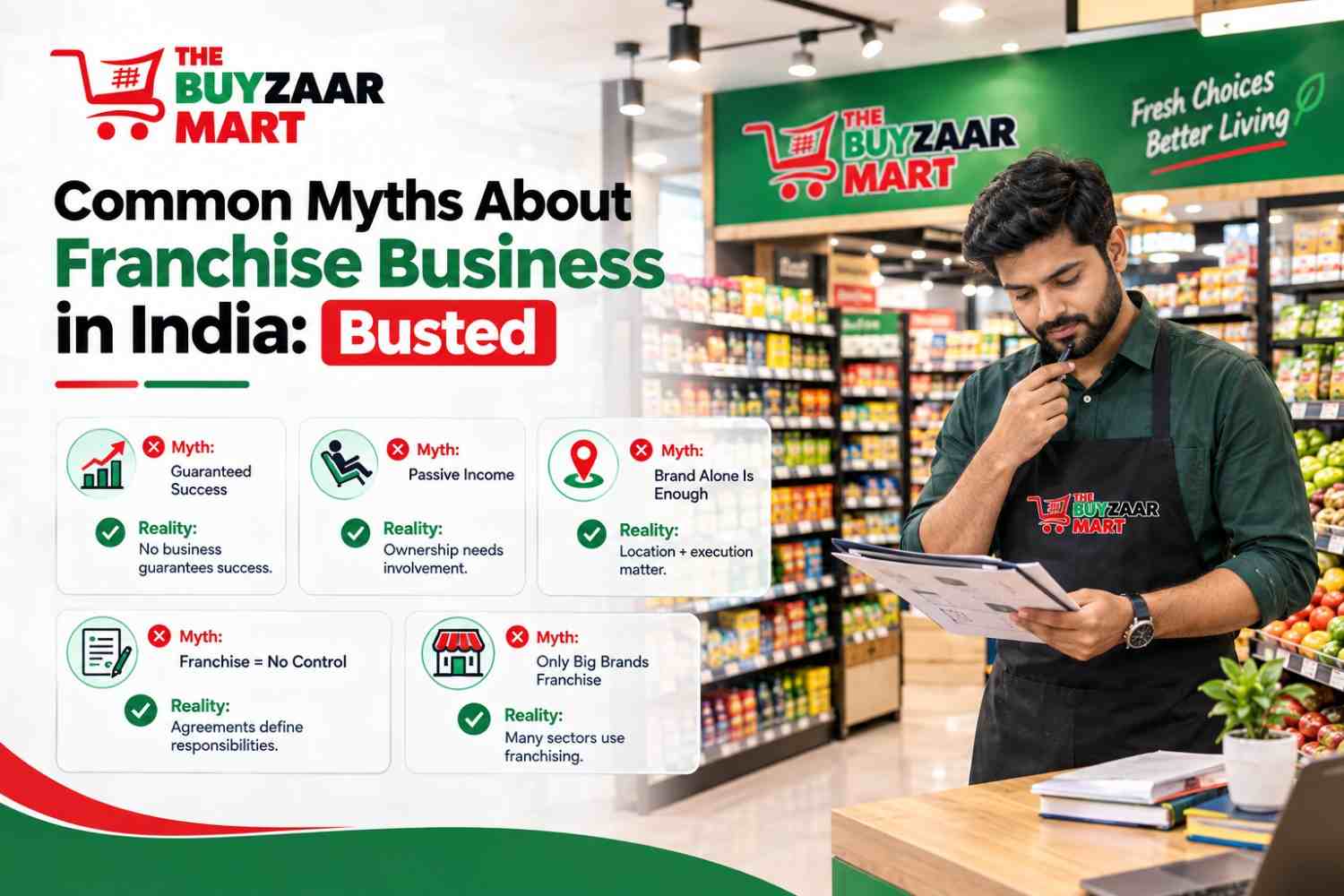
Common Myths About Franchise Business in India: Busted
Busting common myths about franchise business in India — capital needs, control, risk & success factors every aspiring franchise owner should know.
Franchising has become one of the most talked-about paths to business ownership in India, especially in the grocery and retail sector. Yet despite its growing popularity, franchising is still surrounded by misconceptions that stop many potential entrepreneurs from exploring it seriously — or worse, lead others into decisions based on incomplete information. This blog breaks down the most common myths about franchise business in India and replaces them with the reality every aspiring franchise owner should understand before investing.
Why Myths About Franchising Persist in India
- •Franchising is still a relatively newer business model in India compared to traditional trading or manufacturing businesses, leading to gaps in public understanding
- •Many first-time entrepreneurs rely on word-of-mouth or incomplete online information rather than verified franchise documentation
- •The wide variety of franchise models — FOCM, FOCO — often gets oversimplified into a single 'franchise = franchise' understanding, creating confusion
- •Media coverage tends to highlight either extreme success stories or extreme failures, skipping the realistic middle ground most franchise owners actually experience
Myth 1: Franchising Guarantees Instant Success
- •The myth: Buying a franchise automatically means guaranteed profits from day one, simply because it's an established brand
- •The reality: A franchise gives you a proven business model, brand recognition, and operational support — but success still depends on location selection, local market understanding, and day-to-day management
- •Franchise owners who treat the business passively, assuming the brand alone will drive results, typically underperform compared to those who actively manage operations
- •Due diligence on footfall potential, local competition, and demographic fit remains essential even with a trusted franchise brand
Myth 2: You Need Huge Capital to Start a Franchise
- •The myth: Franchising is only for people with large amounts of investment capital
- •The reality: Many grocery and retail franchise models in India today offer accessible entry points, with some starting from as low as ₹15 lakh depending on the format and model chosen
- •Models like FOCM (Franchise Owned Company Managed) and FOCO (Franchise Owned Company Operated) are specifically designed to lower the operational burden on the investor while keeping capital requirements reasonable
- •Comparing investment requirements across multiple franchise brands and formats helps identify options that match different budget levels, rather than assuming franchising is exclusively a high-capital business
Myth 3: Franchise Owners Have No Control Over Their Business
- •The myth: Once you sign a franchise agreement, you lose all decision-making power and simply follow orders
- •The reality: While franchise brands set standards for branding, product sourcing, and operational consistency, franchise owners typically retain control over staffing, local marketing efforts, and day-to-day store management
- •The exact level of operational involvement depends heavily on the franchise model chosen — for example, FOCM structures often involve more brand-side management support, while FOFO (Franchise Owned Franchise Operated) models give owners more direct control
- •Understanding the specific model's structure before signing is key to setting realistic expectations about control and involvement
Myth 4: All Franchise Models Work the Same Way
- •The myth: Every franchise opportunity follows an identical structure and investment pattern
- •The reality: Franchise models vary significantly — FOCM and FOCO each define different levels of ownership, operational responsibility, and profit-sharing arrangements
- •Grocery retail franchises, in particular, often offer multiple format options such as Mini Mart, Super Mart, and Hyper Mart, each with different space, investment, and staffing requirements
- •Evaluating which specific model and format aligns with your available time, capital, and involvement preference is far more important than assuming 'franchise' means one standard setup
Myth 5: Franchising Is Risk-Free
- •The myth: Since the brand is already established, there's little to no business risk involved
- •The reality: All business ventures carry risk, and franchising is no exception — location performance, local competition, and market demand still directly affect outcomes
- •What franchising does reduce is operational uncertainty, since owners benefit from an established business model, brand recognition, and often structured support systems rather than building everything from scratch
- •Reviewing the franchisor's track record, support systems, and existing outlet performance is a critical risk-assessment step often skipped by first-time investors
Myth 6: Franchise Owners Don't Need Business Experience
- •The myth: Franchising is a fully 'hands-off' or beginner-proof investment requiring no prior business knowledge
- •The reality: While franchise systems do simplify many aspects of running a business, owners still benefit significantly from basic business management skills, especially in areas like staff supervision, inventory oversight, and customer service
- •Franchise models with stronger company-side operational support, such as FOCM, can help bridge this gap for first-time entrepreneurs
- •Investing time in understanding the brand's operating manual and training resources significantly improves outcomes, regardless of prior experience level
Myth 7: Bigger Cities Always Mean Better Franchise Returns
- •The myth: Franchise opportunities only make sense in major metro cities with the highest population density
- •The reality: Tier-2 and tier-3 cities are increasingly strong performers for retail and grocery franchises, often with lower competition and rental costs compared to saturated metro markets
- •Local demand patterns, residential growth, and existing retail density matter more than city size alone when evaluating franchise location potential
- •Many grocery franchise brands are actively expanding into smaller cities specifically because of this untapped growth potential
Myth 8: Once Set Up, a Franchise Runs Itself
- •The myth: After the initial setup and launch phase, a franchise store requires minimal ongoing owner involvement
- •The reality: Consistent oversight of staff performance, inventory management, customer service quality, and local marketing remains important throughout the life of the franchise
- •Brand support systems help streamline operations, but they don't eliminate the need for active, ongoing management from the franchise owner
- •Owners who stay engaged with day-to-day performance metrics typically see stronger, more consistent results over time
What Aspiring Franchise Owners Should Actually Focus On
- •Research the specific franchise model (FOCM, FOCO) thoroughly rather than relying on general assumptions about franchising
- •Evaluate location potential based on real local demand data, not just brand reputation
- •Review investment requirements, support systems, and profit-sharing structures in detail before signing any agreement
- •Speak directly with existing franchise owners where possible to understand real day-to-day operational experience
- •Treat the franchise as an active business commitment rather than a passive investment
Separating Myth from Reality Before You Invest
- •Franchising in India offers a genuinely strong path to business ownership, particularly in growing sectors like grocery retail. But like any business decision, it deserves informed evaluation rather than assumptions built on myths. Understanding the real structure, responsibilities, and realistic expectations behind franchise ownership puts aspiring entrepreneurs in a far stronger position to choose the right opportunity and build a successful, sustainable business.
Frequently Asked Questions
Q1. Does buying a franchise guarantee business success?
No, success still depends on location, management, and active involvement, even with an established brand.
Q2. Is a large capital investment always required to start a franchise?
No, many grocery and retail franchise models offer accessible entry points starting from a moderate investment range.
Q3. Do all franchise models offer the same level of owner control?
No, control varies by model — FOCM and FOCO each define different levels of owner involvement.
Q4. Are franchises completely risk-free investments?
No, franchising reduces operational uncertainty but doesn't eliminate business risk entirely.
Q5. Are tier-2 and tier-3 cities good locations for franchise businesses?
Yes, they often offer strong growth potential with lower competition and rental costs compared to metro cities.
Q6. Does a franchise require no ongoing effort after setup?
No, active management of staff, inventory, and customer service remains essential for long-term success.
Related Articles

How to Apply for a Buyzaar Mart Franchise: Step-by-Step Process (2026)
Want to open a Buyzaar Mart franchise in India? Read our complete 2026 step-by-step guide covering eligibility, investment, documentation, and store launch process.
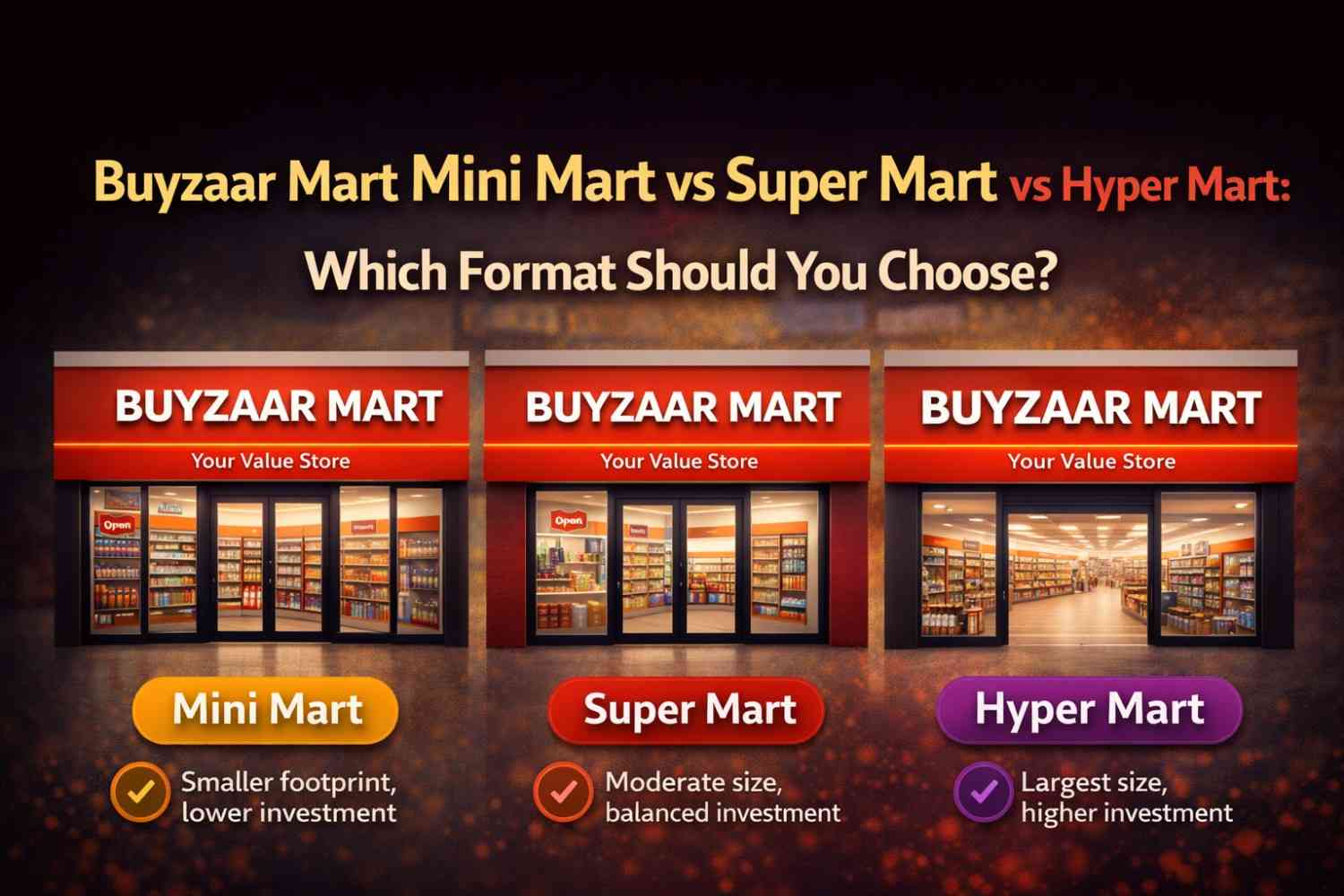
Buyzaar Mart Mini Mart vs Super Mart vs Hyper Mart: Which Format Should You Choose?
Confused between Buyzaar Mart's Mini Mart, Super Mart, and Hyper Mart formats? Compare investment, space, product range & profits to pick the right franchise for you.
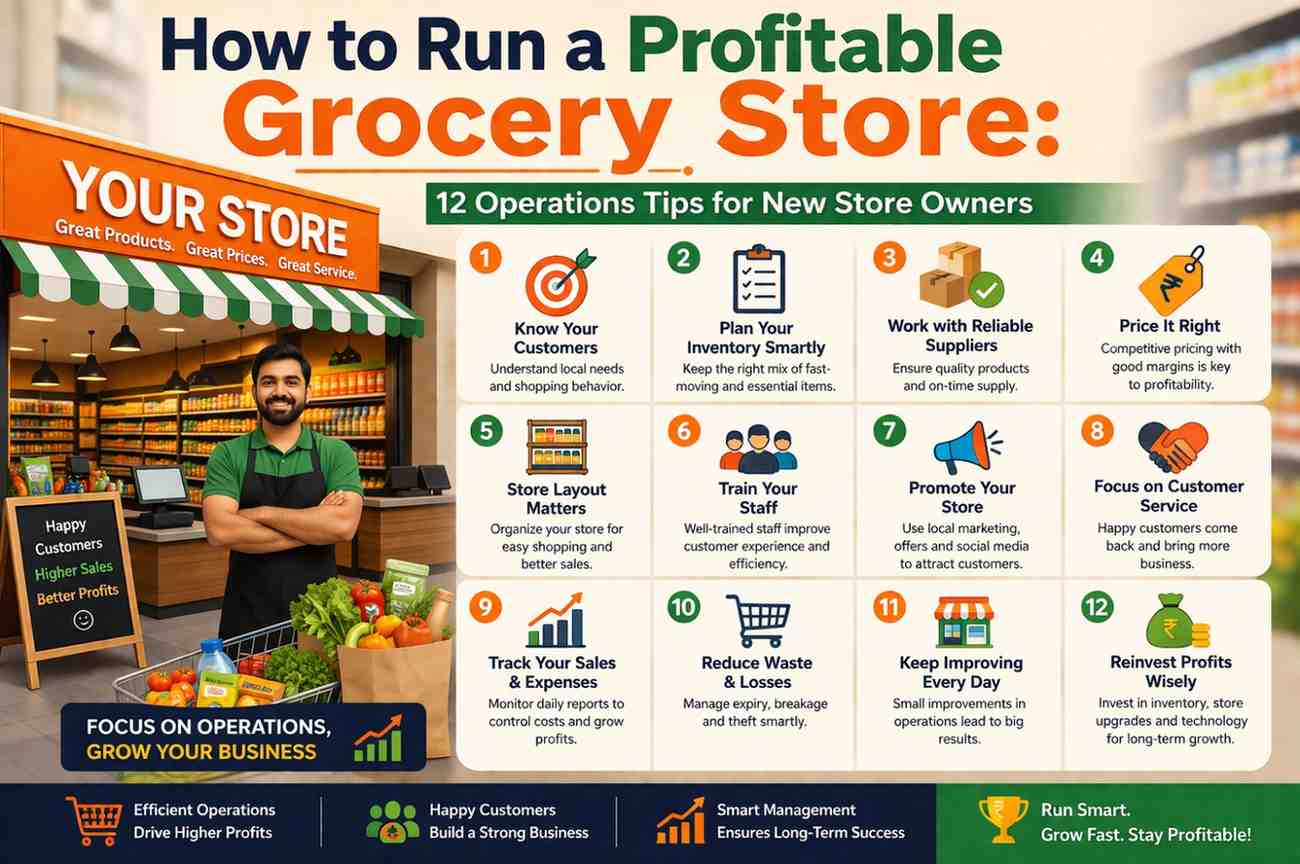
How to Run a Profitable Grocery Store: 12 Operations Tips for New Store Owners
Want to run a profitable grocery store in India? Follow these 12 proven operations tips — from knowing your customers to reinvesting profits wisely. A complete guide for new store owners.