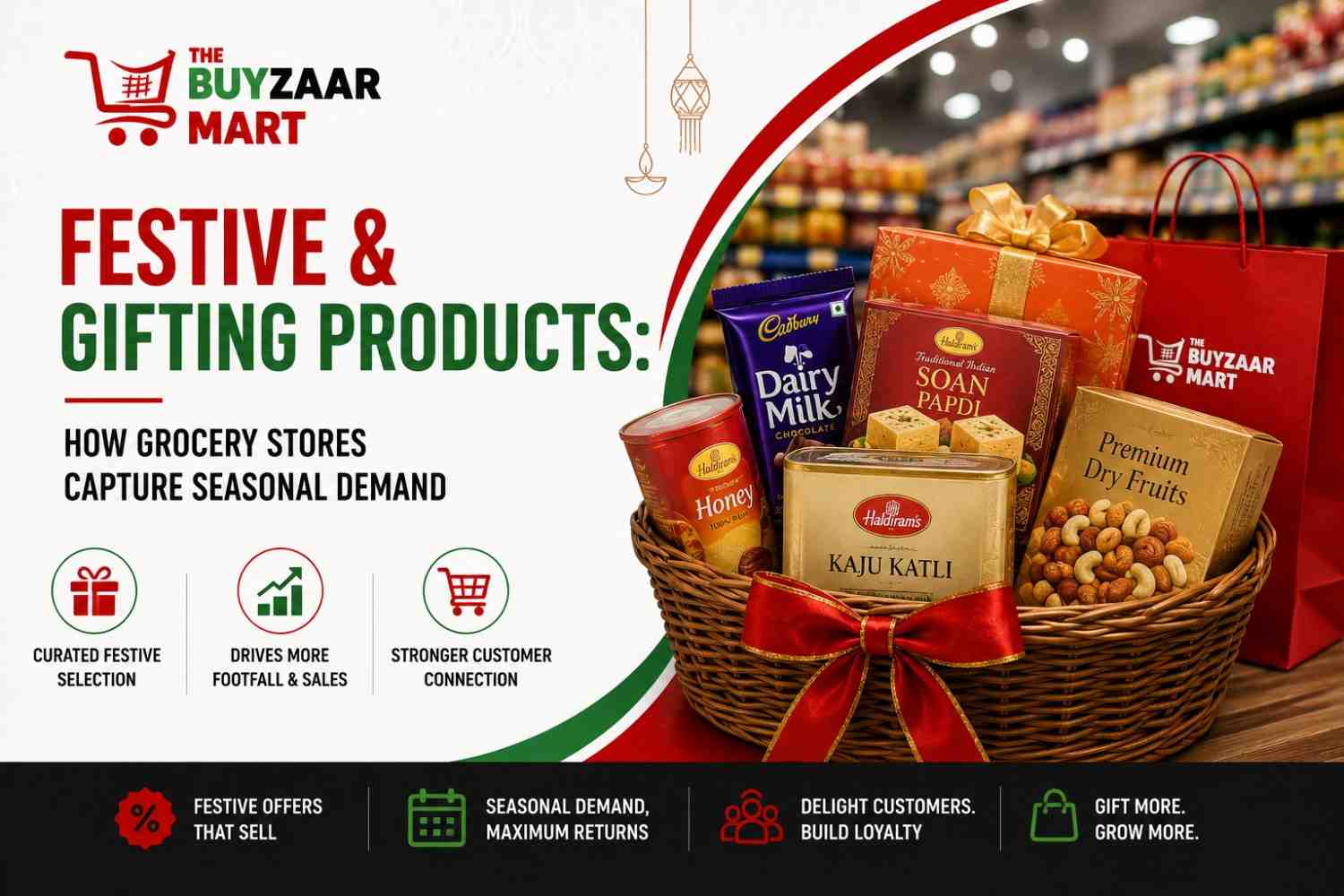
Festive & Gifting Products: How Grocery Stores Capture Seasonal Demand
Discover how grocery stores like The Buyzaar Mart turn festive seasons into revenue opportunities with gifting hampers, seasonal merchandising, and smart FMCG stocking strategies.
Festive seasons in India - Diwali, Raksha Bandhan, Holi, Eid, Christmas, and regional harvest festivals - are not just cultural moments; they are major revenue windows for organized grocery retail. Indian households increase their spending significantly during festive months, and a large share of this spending goes toward gifting products, sweets, dry fruits, decorative items, and premium FMCG combos. Unlike metro shoppers who often turn to malls, e-commerce, or quick-commerce apps for festive shopping, neighbourhood buyers in tier-2 and tier-3 cities still prefer a trusted local store where they can see, touch, and compare gifting products before buying - this is exactly the customer behaviour an organized neighbourhood grocery format is built to serve. For a grocery retail brand like The Buyzaar Mart, festive and gifting demand represents one of the most predictable, high-margin sales opportunities of the year.
Why Festive Demand Matters for Grocery Retail
- •Predictable spike: Unlike daily essentials, festive purchases follow a known calendar, allowing stores to plan inventory, staffing, and promotions well in advance.
- •Higher basket value: Customers buying gifting items typically spend more per visit than they would on routine grocery runs.
- •Repeat footfall driver: A well-stocked festive section brings in customers who might otherwise shop at a mall or online platform.
- •Brand visibility: Festive displays and gifting counters improve a store's local presence and word-of-mouth reach in the neighbourhood.
- •Margin advantage: Gifting combos, hampers, and premium SKUs generally carry better margins than standard grocery items.
- •Cross-selling opportunity: A customer who walks in for a Diwali hamper will often add regular groceries, snacks, or beverages to the same basket, lifting overall bill value.
- •Working capital efficiency: Because festive demand is concentrated in short, well-defined windows, inventory turns faster than in many regular categories - capital doesn't sit idle on shelves for long.
- •Community goodwill: Festive counters, decorations, and neighbourhood offers build an emotional association between the store and local celebrations, which pays off in loyalty well beyond the season itself.
Categories of Festive & Gifting Products That Drive Sales
- •1. Sweets, Dry Fruits & Premium Snacks: Boxed sweets, dry fruit assortments, and premium namkeen packs are the highest-demand category during Diwali and Raksha Bandhan.
- •Pre-packed dry fruit gift boxes often outsell loose dry fruits due to convenience and presentation.
- •Brands offering assorted boxes, including mixed dry fruits, mixed sweets, or sweet-and-namkeen combos, typically perform better than single-item packs, since they simplify the gifting decision for the buyer.
- •2. Ready-Made Gift Hampers: Curated hampers combining chocolates, dry fruits, and home-care products save customers decision-making time.
- •Multiple price tiers, including budget, mid-range, and premium, help capture different customer segments.
- •Pre-assembled hampers reduce the time customers spend deliberating in-store, which is especially valuable during high-footfall festive weekends when billing counters are already under pressure.
- •3. Decorative & Festive Home Items: Diyas, candles, rangoli colours, string lights, and puja essentials see a sharp spike ahead of Diwali.
- •Eid and Christmas bring demand for decorative lighting, table settings, and festive linens.
- •These items typically have thin margins individually but drive significant footfall - customers who visit for decorations frequently pick up groceries and gifting products in the same trip.
- •4. Personal Care & Beauty Gift Sets: Branded personal care combo packs, such as soap, shampoo, and talc sets, are popular as budget-friendly corporate and household gifting options.
- •These sets work particularly well for bulk institutional gifting, since they offer a recognizable, gender-neutral gifting option at a controlled price point.
- •5. Beverages & Festive FMCG Combos: Soft drink combo packs, premium tea and coffee gift sets, and cooking oil combo offers move faster during festive weeks.
- •Combo offers on staples, such as a festive discount on a cooking-oil-plus-ghee bundle, encourage larger basket sizes among regular grocery shoppers, not just dedicated gift-buyers.
- •6. Apparel-Adjacent & Seasonal Non-Food Items: Some grocery formats add seasonal non-food items like festive apparel accessories, gift wrapping supplies, and greeting cards to capture last-mile gifting needs.
- •Gift wrapping paper, ribbons, and gift bags are low-cost additions that let a store position itself as a one-stop festive shop rather than sending customers elsewhere for finishing touches.
Strategies Grocery Stores Use to Capture Seasonal Demand
- •Inventory Planning: Start festive procurement 4-6 weeks in advance to avoid stock-outs during peak demand days.
- •Analyse the previous year's festive sales data to forecast quantities by category.
- •Maintain a buffer stock for fast-moving hamper categories, since demand often spikes unpredictably in the final week before a festival.
- •Visual Merchandising: Dedicate a festive zone near the store entrance so gifting products get immediate visibility.
- •Use tiered shelving and combo displays to make price comparison easy for customers.
- •Refresh window displays and in-store banners at least once per major festival cycle.
- •Bundling & Combo Offers: Create hampers at multiple price points to serve different customer budgets.
- •Bundle slow-moving SKUs with popular items to improve overall sell-through.
- •Local & Hyper-Local Marketing: Run community-level promotions such as early-bird discounts, referral offers, or bulk-gifting deals for local businesses and societies.
- •Use WhatsApp broadcasts and local social media pages to announce festive stock arrivals.
- •Staff Readiness: Train staff on gifting product knowledge so they can guide customers toward the right hamper or combo.
- •Increase billing counter staff temporarily during peak festive days to reduce checkout wait times.
- •Corporate & Bulk Gifting Outreach: Approach nearby offices, schools, and local businesses for bulk festive gifting orders - a segment many neighbourhood stores overlook.
- •Offer customization, such as adding a business's branding or a personal note, as a value-added service for bulk orders.
- •Provide simple advance-order forms or WhatsApp catalogues so corporate buyers can place bulk orders without visiting the store in person, and offer scheduled delivery for large quantities.
How The Buyzaar Mart Approaches Festive & Gifting Demand
- •As a Friendly Neighbourhood Store format, The Buyzaar Mart is positioned to capture festive spending that customers would otherwise take to malls or online platforms.
- •Centralized procurement and supply chain support ensure franchise partners get access to festive-ready inventory without individually negotiating with multiple vendors.
- •Structured store formats - Mini Mart, Super Mart, and Hyper Mart - allow festive merchandising to scale according to store size and local demand.
- •The buyback guarantee on expired and damaged stock reduces the inventory risk franchise partners might otherwise associate with stocking up for a short festive window.
- •POS and inventory tracking systems help franchise partners monitor real-time festive sales trends and reorder fast-moving SKUs without guesswork.
Measuring Festive Season Performance
- •Track sell-through rate by category: Compare how quickly hampers, sweets, and decoratives move relative to opening stock, and use this to fine-tune next year's procurement quantities.
- •Monitor basket value during festive weeks: A rising average basket size indicates that cross-selling and bundling strategies are working.
- •Review footfall-to-conversion ratio: High footfall with low conversion may signal pricing issues, poor product placement, or insufficient staff at billing counters.
- •Compare year-on-year growth by festival: Since each festival draws a slightly different customer base, tracking performance separately for Holi, Raksha Bandhan, Diwali, and Christmas gives a more accurate picture than a single blended festive-season number.
Frequently Asked Questions
Which festivals generate the highest gifting demand for grocery stores in India?
Diwali generates the highest demand overall, followed by Raksha Bandhan, Holi, Eid, and Christmas, depending on the region.
How early should a grocery store start festive inventory planning?
Most organized retail stores begin procurement and hamper preparation 4 to 6 weeks before a major festival.
Do gifting products offer better margins than regular groceries?
Yes, curated hampers and premium combo packs typically carry higher margins compared to standard daily-essential items.
Can a franchise store target corporate or bulk gifting orders?
Yes, reaching out to local offices, schools, and businesses for bulk festive orders is an effective and often underused revenue strategy for neighbourhood stores.
How should a store decide how many price tiers to offer for gift hampers?
Most successful stores use at least three tiers - budget, mid-range, and premium - to serve different customer segments without cluttering the shelf with too many overlapping options.
What metrics matter most for evaluating festive season performance?
Sell-through rate by category, average basket value during the festive window, and footfall-to-conversion ratio are the most useful indicators for planning the next festive cycle.