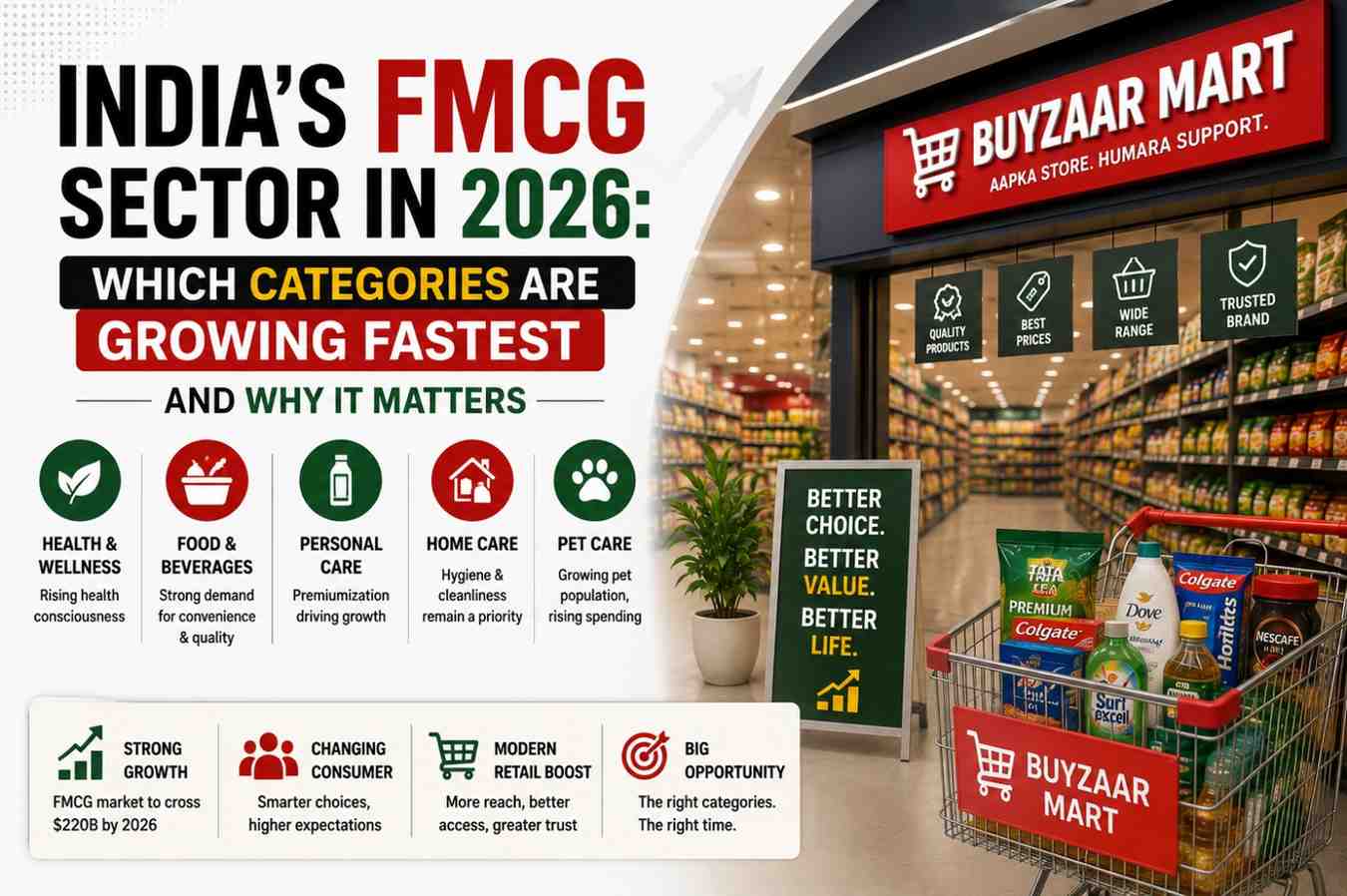
India's FMCG Sector in 2026: Which Categories Are Growing Fastest and Why It Matters
India's FMCG market is projected to hit ₹10.2 lakh crore by 2026. Discover which categories are growing fastest — from health foods to personal care — and what it means for grocery franchise owners across North India.
Walk into any Indian household — from a Delhi NCR apartment to a small town colony in Kanpur — and you will find the same thing. Shelves stocked with packaged atta, branded shampoo, flavoured biscuits, protein drinks, herbal face wash, and ready-to-cook gravies. This everyday reality is the engine behind one of the world's most exciting consumer markets. India's FMCG sector is projected to reach ₹10.2 lakh crore (approximately USD 122 billion) by 2026, growing at a CAGR of 9 to 11%. For grocery franchise store owners, this is not just a macroeconomic headline — it is a direct roadmap for which products to stock, which categories to prioritise on your shelves, and where the next wave of consumer spending is headed.
The Big Picture — What Is Driving Overall FMCG Growth in 2026
- •Rising disposable incomes — Tax reliefs and GST rationalization have increased disposable income, particularly in the middle-class segment, putting more money in the hands of exactly the consumers who shop at neighborhood grocery franchise stores
- •Volume-led growth is back — After years of inflation-driven price growth, consumers are now buying more units and more frequently — which means higher basket sizes and more repeat visits to your store
- •Rural markets are leading the charge — Rural markets grew faster than urban areas for the sixth consecutive quarter, and tier-2 and tier-3 cities across North India are emerging as the new frontline of FMCG consumption
- •Premiumization is accelerating — Consumers are no longer just buying more — they are buying better, with a significant uptick in health-focused products, protein-rich foods, and premium personal care
- •Brand loyalty is strengthening — There is a strong shift toward branded, packaged, and health-focused FMCG products driven by rising awareness, social media influence, and post-pandemic hygiene consciousness
- •Digital payments have normalised buying — India's total value of digital transactions is projected to reach US$ 1 trillion by 2026, meaning consumers are more comfortable spending at organised, tech-enabled stores than ever before
Category 1 — Health Foods and Wellness Products
This is the single fastest-growing FMCG category in India in 2026 and it shows no signs of slowing. The post-COVID consumer has permanently shifted toward products that carry health, immunity, and nutrition claims — from protein biscuits and multigrain atta to Chyawanprash and probiotic drinks. Patanjali, Dabur, Tata Consumer, Nestlé, and HUL's wellness portfolio are all reporting strong volume growth in this segment.
- •Products seeing the sharpest rise include: oats, millet-based snacks, protein bars, herbal juices, immunity boosters, probiotic dairy drinks, and organic staples
- •The health food segment is particularly strong among working women, mothers of young children, and fitness-aware millennials — a demographic that forms a large share of the regular shopper base at neighborhood grocery stores
What this means for your Buyzaar Mart store: Give this category premium shelf placement at eye level. Face health variants of staple products — like multigrain atta next to regular atta — so both options are visible. Stock the top three SKUs in protein snacks, herbal juices, and wellness biscuits and never let them run out.
Category 2 — Home and Personal Care (HPC)
Home and Personal Care categories saw a strong 7.5% consumption growth in Q2 2025, outpacing food categories and making it one of the most consistently growing segments of the entire FMCG market. Within HPC, the fastest-growing sub-categories include premium skincare, hair care, liquid hand wash, floor cleaners, fabric softeners, and hygiene products.
- •India's beauty and personal care market, presently valued at US$ 16.8 billion, is poised to grow at a compound annual rate of 11%, with cosmetics and perfumes growing at an even faster clip
- •HUL plans to invest ₹2,000 crore over two years to expand manufacturing in premium beauty, wellbeing, and home care segments — a clear signal from India's largest FMCG company about where consumer spending is headed
- •The premiumization trend is clearly visible — consumers are trading up from economy to mid-premium variants of shampoos, face washes, and body lotions even in tier-2 and tier-3 markets
What this means for your Buyzaar Mart store: Do not just stock the economy range of personal care products. Add the mid-premium SKUs from HUL, P&G, Marico, and Dabur — they carry higher margins and are increasingly in demand. Keep the homecare aisle well-stocked with premium variants of floor cleaners, dish wash gels, and fabric care products. This is a category where presentation and product variety directly influence buying decisions.
Category 3 — Packaged Foods and Snacks
Food consumption in India grew at 5.5% in Q2 2025, driven by increased volumes in staples and impulse categories. Within packaged foods, the snacks, biscuits, instant noodles, and ready-to-eat segments are growing particularly fast — driven by urbanisation, convenience culture, and the influence of social media food trends.
- •Brands like Haldiram's, Parle, Britannia, ITC's Sunfeast and Bingo, Nestlé Maggi, and Tata Consumer's ready-to-cook range are all aggressively expanding their SKU counts and distribution depth in North Indian markets
- •The impulse snacking category — chips, namkeen, popcorn, and flavoured nuts — is seeing strong double-digit growth particularly in the ₹10 to ₹30 price point that dominates neighborhood store transactions
- •Ready-to-cook and ready-to-eat foods are entering the mainstream across middle-income households as more families have both partners working — convenience is no longer a luxury, it is a practical necessity
What this means for your Buyzaar Mart store: The snacks and biscuits section should be positioned near the billing counter or entrance for maximum impulse purchase conversion. Keep the ready-to-cook range well-stocked — Maggi, Knorr soups, MTR mixes, and Tata Sampann products move consistently throughout the month. Rotate promotional pricing on slow-moving SKUs in this category to drive basket-building.
Category 4 — Beverages — Hot, Cold, and Functional
India's beverage market is undergoing a multi-dimensional growth surge — traditional categories like tea and coffee are growing steadily while newer segments like functional drinks, energy drinks, and flavoured water are exploding.
- •Packaged tea remains the single largest volume category in FMCG and is growing at a consistent pace — with premiumization visible as consumers upgrade to branded premium blends from Tata Tea, Red Label, and Wagh Bakri
- •Packaged juices, nectars, and dairy-based beverages from brands like Real, Tropicana, Amul, and Mother Dairy continue to grow strongly, especially among families with children
- •The functional beverages segment — protein shakes, energy drinks, electrolyte drinks, and probiotic beverages — is the fastest-growing sub-segment within beverages, growing at an estimated 25 to 30% annually
- •Nestlé India reported a 46% year-on-year increase in profit in Q3 FY26 driven by strong volume growth across packaged foods and beverages
What this means for your Buyzaar Mart store: Maintain dedicated, well-organised sections for hot beverages and cold beverages separately. Stock at least two or three functional beverage options from emerging brands alongside established ones — these carry significantly higher margins. Refrigerated beverage display increases impulse purchase rates dramatically — if you have a cooler, keep it stocked and visible from the store entrance.
Category 5 — OTC Healthcare and Hygiene
Over-the-counter categories posted a robust 14.2% increase in value sales in Q2 2025 — making it one of the highest-growth segments in the entire FMCG market. OTC healthcare includes pain relief balms, antacids, cold and cough syrups, vitamin supplements, glucose drinks, antiseptic liquids, and basic first-aid products — all of which are increasingly being purchased at neighborhood grocery stores rather than pharmacies.
- •The post-pandemic consumer has permanently elevated hygiene spending — handwash, sanitizers, and surface disinfectants are now considered household staples rather than occasional purchases
- •Brands like Dabur (Honitus, Pudin Hara), Emami (Zandu, Fast Relief), HUL (Dettol through Reckitt), and Himalaya are all reporting strong growth in their OTC segments sold through grocery retail channels
What this means for your Buyzaar Mart store: A well-stocked OTC section is a genuine footfall driver — customers who come in for a glucose sachet or a pain relief balm often make a full grocery purchase. Keep this section clean, clearly organised, and always in stock. It also carries higher per-unit margins than most staples.
Category 6 — Dairy and Dairy Alternatives
India's dairy market is one of the largest in the world and continues to grow at a healthy 8 to 10% annually — driven by rising protein awareness, urbanisation, and the expansion of cold chain infrastructure.
- •Packaged milk, paneer, curd, butter, ghee, and cheese are all seeing consistent volume growth — with premium variants (A2 milk, probiotic curd, gourmet cheese) growing at two to three times the rate of standard variants
- •Amul, Mother Dairy, Nestlé, Britannia, and Parag Milk Foods are the dominant players actively expanding their distribution in North Indian tier-2 markets
- •The dairy alternatives segment — soy milk, oat milk, and plant-based spreads — is still nascent in North India but showing early adoption among urban educated consumers — a category to watch closely for Hyper Mart format stores
What this means for your Buyzaar Mart store: Dairy is a daily-need category that drives the highest repeat visit frequency of any section in your store. Keep the dairy section fully stocked at all times — a customer who cannot find fresh curd or milk will switch to your competitor. If you have refrigeration capacity, expand into value-added dairy like flavoured yogurt and cheese slices — these carry strong margins and growing demand.
Category 7 — Staples — Premiumization of Everyday Basics
Edible oils, atta, rice, pulses, and spices are the backbone of every Indian kitchen — and while volume growth in staples is more moderate, the premiumization trend is driving significant value growth.
- •Consumers across income segments are upgrading to branded, packaged staples from loose unorganised sources — driven by concerns about hygiene, quality consistency, and standardised grammage
- •Adani Wilmar (Fortune), ITC Aashirvaad, Tata Consumer's Tata Sampann, and Patanjali are the dominant brands aggressively expanding into tier-2 markets across North India
- •The shift from loose atta and oil to branded variants is happening fastest in exactly the type of residential colonies and semi-urban markets where Buyzaar Mart franchise stores are positioned
What this means for your Buyzaar Mart store: Stock branded staples prominently and keep a clean range across standard and premium variants. The margin on branded staples is lower than snacks or personal care — but this category drives visit frequency and basket size more than any other section. Never run out of the top three atta and oil brands your catchment area prefers.
FMCG Category Growth Summary — 2026 at a Glance
| Category | Growth Signal | Key Brands | Store Action |
|---|---|---|---|
| Health Foods & Wellness | Fastest growing — sustained post-COVID shift | Dabur, Patanjali, Nestlé, HUL, Tata Consumer | Eye-level shelf placement; never out of stock |
| Home & Personal Care | 7.5% consumption growth Q2 2025 | HUL, P&G, Marico, Dabur, Emami | Add mid-premium SKUs; strong presentation |
| Packaged Foods & Snacks | Double-digit impulse growth | Haldiram's, Parle, Britannia, ITC, Nestlé | Billing counter placement; promo rotation |
| Beverages — Hot, Cold, Functional | Functional segment growing 25–30% annually | Tata Tea, Amul, Real, Tropicana, Nestlé | Separate hot/cold sections; refrigerated display |
| OTC Healthcare & Hygiene | 14.2% value sales growth Q2 2025 | Dabur, Emami, Himalaya, Dettol | Clean organised section; strong footfall driver |
| Dairy & Alternatives | 8–10% annual growth; premium variants 2–3x | Amul, Mother Dairy, Britannia, Nestlé | Always fully stocked; expand to value-added dairy |
| Branded Staples | Premiumization driving value growth | Fortune, Aashirvaad, Tata Sampann, Patanjali | Standard + premium range; top 3 brands always in stock |
India FMCG Fastest Growing Categories 2026 — Franchise Store Action Guide
Why All of This Matters for Grocery Franchise Owners in 2026
- •Every FMCG category trend described above is a direct shelf opportunity for a well-managed grocery franchise store
- •The shift toward health foods, premium personal care, and branded staples is happening fastest in exactly the tier-2 and tier-3 North Indian markets where Buyzaar Mart is expanding
- •A franchise store that stays aligned with category growth trends — stocking the right products in the right quantities at the right shelf position — will consistently earn better margins, attract more customers, and generate stronger monthly revenue
- •Buyzaar Mart's 50+ FMCG brand partnerships with HUL, ITC, Nestlé, Tata Consumer, Dabur, Patanjali, P&G, Adani Wilmar, Britannia, Haldiram's, and others mean that as a franchise partner, you automatically have access to every high-growth category through a centrally managed supply chain
- •The 18 to 20% gross margin that Buyzaar Mart franchise partners earn is built on a product mix that balances high-volume staples with high-margin personal care, health food, and snack categories — precisely the categories growing fastest in 2026
- •Understanding these trends and communicating them to your customers — through in-store signage, WhatsApp group promotions, and local area marketing — turns a passive storekeeper into an active merchant who capitalises on where the market is going
Final Thoughts
India's FMCG market in 2026 is not just big — it is shifting in very specific, very trackable directions that grocery franchise owners can act on immediately. Health and wellness, premium personal care, packaged snacks, OTC healthcare, functional beverages, and branded staples are the six categories that will define the revenue trajectory of every well-run neighborhood grocery store in India over the next two to three years.
The brands driving this growth — HUL, ITC, Nestlé, Dabur, Tata Consumer, Patanjali, Adani Wilmar — are all Buyzaar Mart supply chain partners, meaning franchise stores are already positioned at the center of this growth story. The opportunity in organised grocery franchise retail in North India in 2026 is not just about opening a store — it is about opening the right store, in the right location, with the right product mix, backed by the right brand. That combination exists — and it is called Buyzaar Mart.
Stock smart. Sell smarter. Build your franchise at thebuyzaarmart.com/franchise or call 9217991727 (Monday to Saturday, 9 AM to 7 PM)
Frequently Asked Questions
What is the projected size of India's FMCG market in 2026?
India's FMCG sector is projected to reach ₹10.2 lakh crore (approximately USD 122 billion) by 2026, growing at a compound annual growth rate of 9 to 11%. Industry experts are pointing toward a volume-led recovery in 2026 — a significant shift after years of price-driven expansion — with the sector eyeing high single-digit volume growth for the year.
Which FMCG category is growing fastest in India in 2026?
Health foods and wellness products is the single fastest-growing FMCG category in India in 2026, driven by the permanent post-COVID consumer shift toward immunity, nutrition, and health claims. OTC healthcare is also growing strongly at 14.2% value sales growth in Q2 2025. The functional beverages segment is growing at an estimated 25 to 30% annually from a smaller base. Home and personal care saw 7.5% consumption growth in Q2 2025.
How should a grocery franchise store stock its shelves based on FMCG growth trends in 2026?
Based on 2026 FMCG growth trends: give health and wellness products eye-level placement and never let top SKUs run out; add mid-premium personal care SKUs from HUL, P&G, and Marico alongside economy ranges; position snacks and impulse items near the billing counter; maintain dedicated hot and cold beverage sections with refrigerated display; keep OTC healthcare well-organised as a footfall driver; always stock dairy fully as the highest repeat-visit category; and carry both standard and premium variants of branded staples.
Why are rural and tier-2 markets important for FMCG growth in 2026?
Rural markets grew faster than urban areas for the sixth consecutive quarter in India, and tier-2 and tier-3 cities are now emerging as the new frontline of FMCG consumption. Rising disposable incomes, digital payment adoption, and post-pandemic hygiene consciousness are all accelerating demand for branded, organized grocery retail in these markets — which is exactly why North Indian cities like Kanpur, Moradabad, Saharanpur, and similar markets are such compelling opportunities for Buyzaar Mart franchise investment in 2026.
What FMCG brands does Buyzaar Mart carry that align with 2026 growth categories?
Buyzaar Mart has direct sourcing partnerships with 50+ FMCG brands covering every high-growth category in 2026: HUL and P&G for personal care and home care; Dabur and Patanjali for health and wellness; Nestlé, Tata Consumer, Britannia, and Parle for packaged foods and beverages; Adani Wilmar and ITC Aashirvaad for branded staples; Haldiram's for snacks; and Amul and Mother Dairy for dairy. Franchise partners access all these brands through a centrally managed supply chain with competitive pricing.
How does understanding FMCG trends help a Buyzaar Mart franchise earn better margins?
Buyzaar Mart franchise partners earn 18 to 20% gross margins — built on a product mix that balances high-volume staples (which drive footfall and basket size) with high-margin categories like personal care, health foods, OTC healthcare, and functional beverages (which are the fastest-growing segments in 2026). Franchise owners who actively align their shelf allocation, ordering, and promotions with FMCG growth trends — rather than passively stocking whatever arrives — consistently achieve stronger monthly revenue and better margin realization.
Related Articles
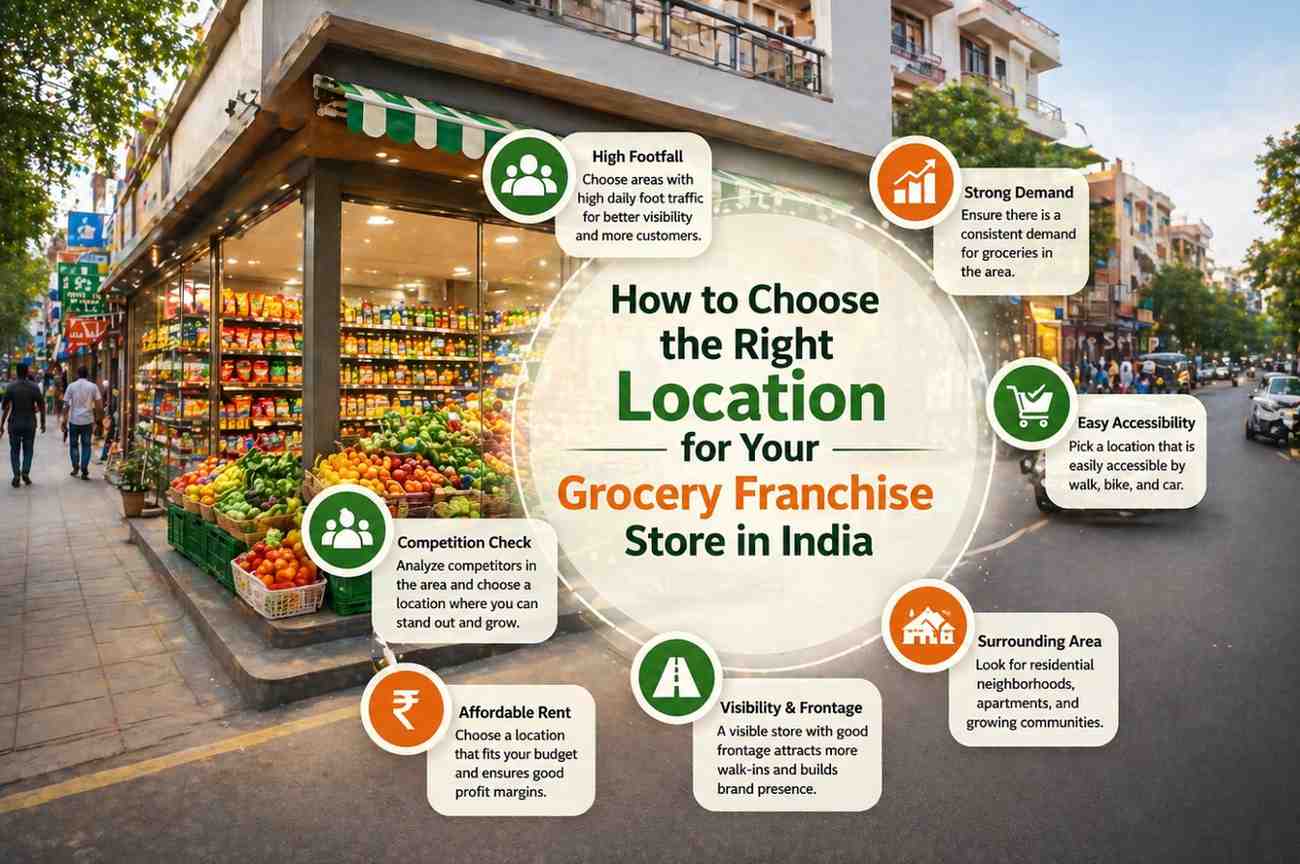
How to Choose the Right Location for Your Grocery Franchise Store in India (2026)
Location can make or break your grocery franchise store. Learn the key factors — footfall, demographics, competition, rent & more — to find the perfect spot for your Buyzaar Mart store in India.
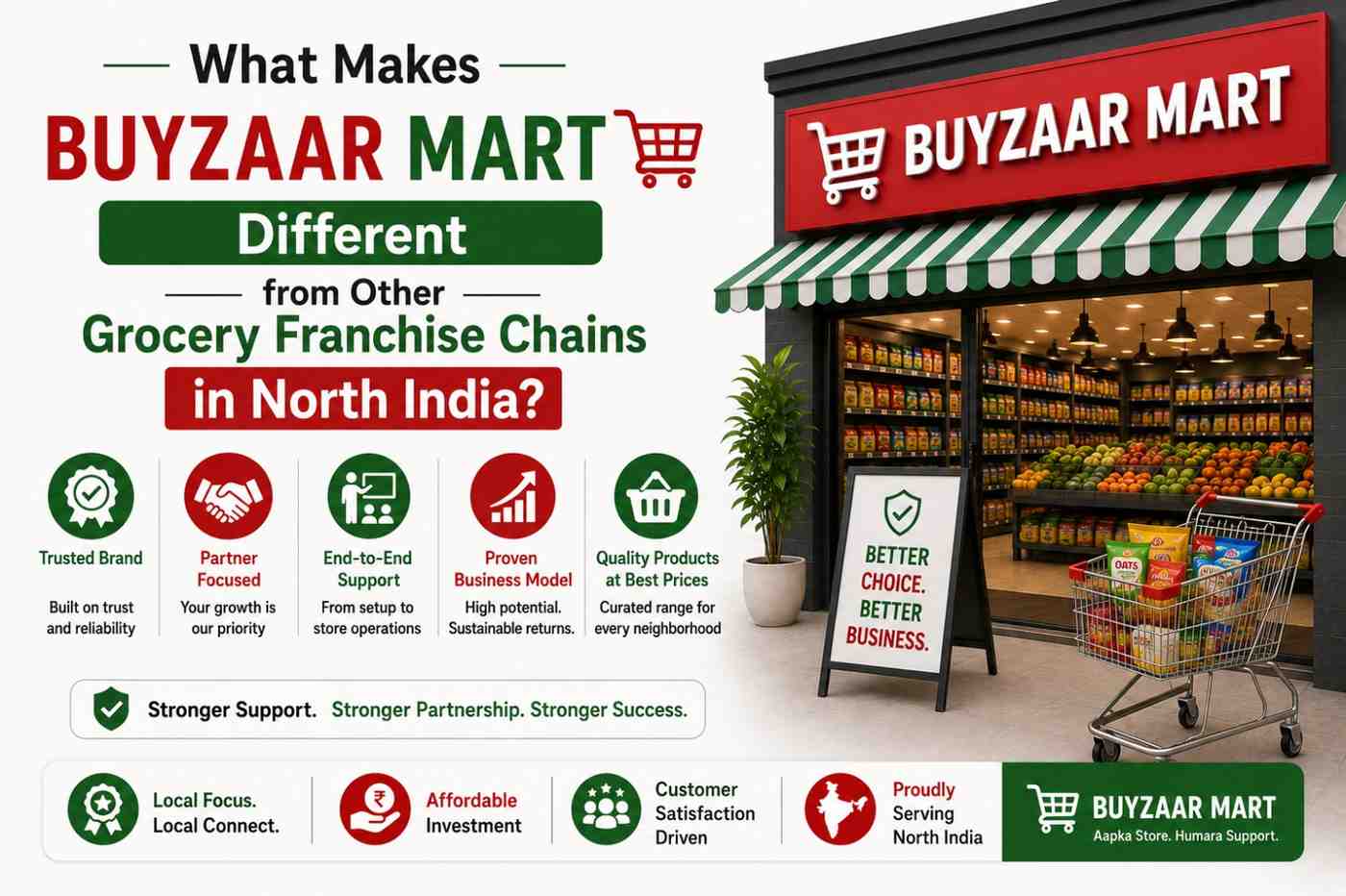
What Makes Buyzaar Mart Different from Other Grocery Franchise Chains in North India? (2026)
Wondering what sets Buyzaar Mart apart from other grocery franchise chains in North India? Discover the key differentiators — from tech-enabled operations and FMCG brand partnerships to franchisee-first support and profit margins.
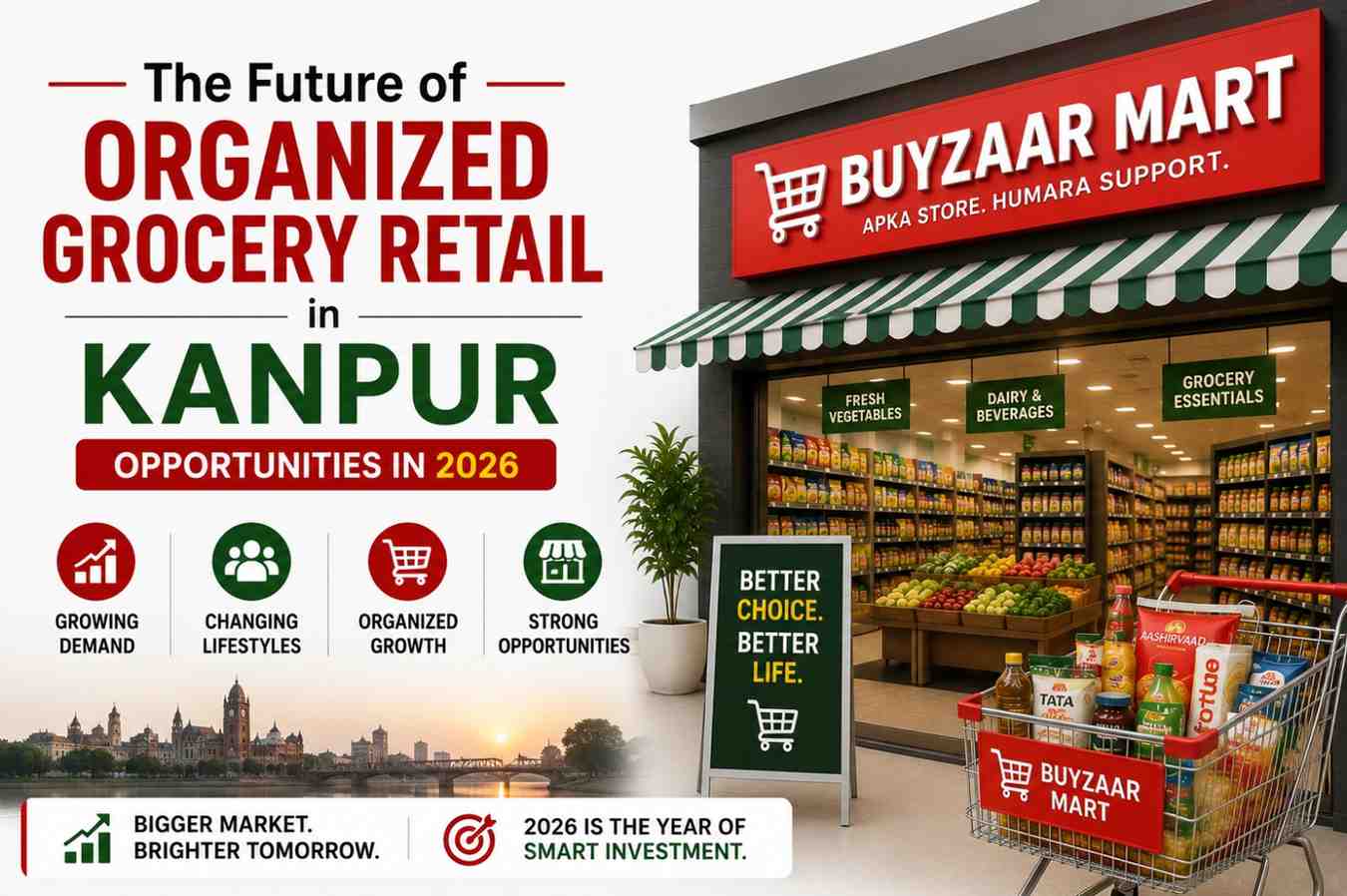
The Future of Organized Grocery Retail in Kanpur: Opportunities in 2026
Kanpur is one of North India's most underserved organized grocery markets. Discover why 2026 is the right time to invest in a grocery franchise in Kanpur and which areas hold the biggest opportunity.