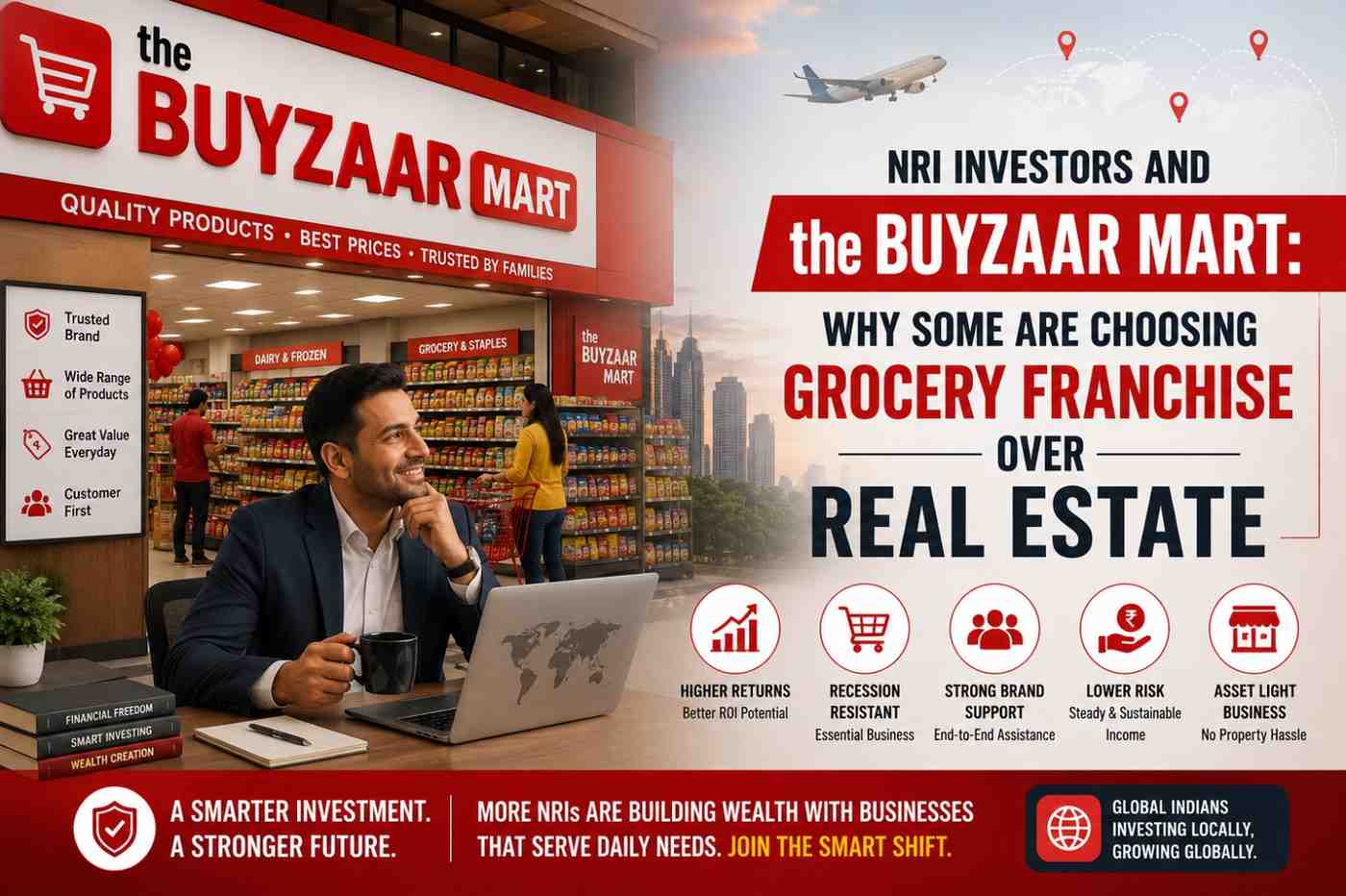
NRI Investors and Buyzaar Mart: Why Some Are Choosing Grocery Franchise Over Real Estate (2026)
NRIs are rethinking where to invest in India in 2026 — and grocery franchises like Buyzaar Mart are entering the conversation. Here's an honest comparison of franchise vs real estate for NRI investors considering India's consumer market.
For the better part of three decades, the default answer to the question of where an NRI should invest in India has been the same: real estate. A flat in Delhi NCR, a plot in the hometown, a commercial space in Gurgaon or Noida — the logic was simple, the execution was familiar, and the emotional pull of owning land in India was powerful. In 2026, that default is being questioned — not because real estate has stopped working, but because a new category of investment is gaining serious consideration for the first time at scale: organised grocery and FMCG retail franchises. Buyzaar Mart is part of this conversation, and for specific NRI investor profiles, a genuinely compelling one. Here is an honest, complete look at why.
The NRI Investment Context in 2026
NRI investment in India has never been larger or more diverse. The share of NRI money flowing into Indian real estate has climbed steadily over the past few years and continues to deepen as the diaspora's financial commitment to India grows. With India on track to become a USD 5 trillion economy in the coming years, NRIs have a rapidly growing market to invest in, backed by improving infrastructure, a relatively stable currency, and strong institutions.
But within this expanding investor pool, a distinct profile is emerging — the NRI who is not looking for another property to manage remotely, is uncomfortable with the illiquidity of real estate, and wants their India investment to generate active, monthly income rather than sitting as a long-term appreciation play they cannot touch for five to ten years. This is exactly the investor profile for whom a grocery franchise investment — operated through a trusted local family member or a hired store manager — makes genuine financial sense.
What Real Estate Actually Delivers for NRI Investors — Honestly
Real estate remains a strong asset class for India-invested NRIs. Rental yields in premium corridors, meaningful capital appreciation in luxury segments over the past few years, and the emotional satisfaction of owning a tangible, permanent asset in India are all real benefits. But the full picture also includes challenges that most NRI real estate marketing never leads with.
- •When an NRI sells property in India, the buyer must deduct TDS under Section 195 of the Income Tax Act — for long-term capital gains this typically works out to roughly 13 to 14 percent once surcharge and cess are included, a significant exit cost that compresses net returns
- •Rental income requires active management from abroad — finding reliable tenants, handling maintenance, managing society disputes, and dealing with rent defaults are operational realities that many NRI landlords consistently underestimate
- •A large share of NRIs consider commercial real estate for portfolio diversification, but good commercial locations require significantly higher capital than a grocery franchise investment
- •Capital stays locked for extended periods — a property bought in 2026 cannot be liquidated quickly without taking a meaningful market price hit, since the asset is illiquid by nature
- •Typical rental yields on a mid-range property translate to a modest annual income before maintenance costs, society charges, property tax, and income tax on rental income are even accounted for
None of this makes real estate a bad investment. It makes it a specific type of investment — long-term, illiquid, appreciation-driven, and management-intensive — that serves one type of investor goal and not another.
What a Buyzaar Mart Franchise Delivers — and for Whom
A Buyzaar Mart grocery franchise is a fundamentally different investment structure. It is not an appreciation asset — it is a cash-flow-generating business that produces monthly income from the first operational month, with a total investment significantly lower than most real estate transactions.
- •Total investment range: Under ₹30 lakhs for a Mini Mart or Super Mart format, covering franchise fee, store interior, initial stock, software licence, and security deposit
- •Gross margin: 18 to 20 percent on sales, built into the supply chain model rather than dependent on market conditions or tenant behaviour
- •Monthly income: A well-run Super Mart in a good location generating ₹8 to ₹12 lakhs in monthly sales can produce ₹1.4 to ₹2.4 lakhs in gross profit before operating expenses — a monthly income yield that real estate at comparable investment levels typically cannot match
- •Rupee depreciation hedge: For an NRI earning in USD, AED, or GBP, a franchise investment means rupee weakness that erodes India-remitted savings is partially offset by a business generating rupee income tied to India's own inflation and consumption growth
- •Exit option: The security deposit component is refundable — unlike a property that requires finding a buyer in a slow market, a well-performing franchise store has genuine business value if the owner wishes to transition or sell the operation
The Model That Makes It Work for NRIs — Remote Ownership Through Delegation
The most common NRI objection to a franchise investment is the obvious one — not being in India to run a store. The answer is the same delegation model that works for any side-business franchise owner, with one structural advantage NRIs specifically benefit from: Buyzaar Mart's centralised support systems handle much of the operational lifting that would otherwise require owner presence.
- •Supply chain management — procurement, delivery scheduling, and inventory replenishment — is handled centrally, so the store manager does not need to source products independently or negotiate with suppliers
- •The POS and CRM system generates real-time daily reports accessible from any device anywhere in the world, letting an NRI in Dubai or London review yesterday's sales, transaction count, and inventory status before breakfast
- •Marketing and brand campaigns are deployed centrally, so the franchise owner does not need to plan or fund local marketing independently
- •Hassle-free inventory assurance — expired and damaged stock taken back by the company — removes one of the biggest risk management headaches from the store manager's and remote owner's plate
What an NRI investor needs to make this work is straightforward: one trusted person on the ground as the local face and daily operational lead, a structured weekly check-in routine reviewing POS reports over video call, and one visit per quarter to India for a personal store audit and relationship management with the Buyzaar Mart team. Most NRIs already visit India at least once or twice a year — these visits now carry an additional business purpose.
The Emotional Dimension — Investing in Your Own Hometown
This is a factor no financial model captures but that resonates deeply with a specific type of NRI investor. Many NRIs from Lucknow, Kanpur, Meerut, Dehradun, Agra, and other North Indian tier-2 cities carry a quiet desire to contribute something tangible to the community they grew up in, beyond remittances to family and occasional charitable donations.
- •A Buyzaar Mart franchise creates three to eight direct employment opportunities for local residents — store manager, billing staff, floor staff, and delivery personnel
- •It brings organised, quality grocery retail to a community that may currently be entirely served by unorganised kirana stores, improving the daily shopping experience for hundreds of families
- •It builds a family business asset back home that a sibling, spouse, or parent can manage, giving them financial independence and a professional role while the NRI provides capital and strategic oversight
- •It creates a reason to return — a tangible anchor in the hometown that makes every India visit purposeful beyond just family time
For many NRIs, this combination of financial return and community contribution makes the grocery franchise conversation genuinely different from another property purchase.
A Direct Comparison — ₹25 to ₹30 Lakh Invested in Both Asset Classes
| Factor | Real Estate (₹25-30L) | Buyzaar Mart Franchise |
|---|---|---|
| Asset Type | Plot / small commercial unit | Operating business |
| Monthly Income | ₹8,000–₹15,000 rental | ₹50,000–₹1,50,000+ net |
| Liquidity | Low — months to sell | Security deposit refundable |
| Management | Tenant finding, maintenance | Store manager + POS system |
| Tax on Income | Rental income taxable | Business income with deductions |
| Growth | Capital appreciation | Revenue grows with locality |
| Community Impact | None | Employment + organised retail |
| Remote Operability | Moderate | High — with right manager |
| Buyzaar Mart Support | N/A | Full — supply chain, marketing, tech |
Who the Buyzaar Mart Franchise Investment Is Best For Among NRIs
- •NRIs with family members in North India who can serve as the store's on-ground operational lead — a spouse, sibling, parent, or trusted relative who benefits from having a structured, supported business to manage
- •NRIs from tier-2 North Indian cities — Lucknow, Kanpur, Meerut, Saharanpur, Moradabad, Agra, Bareilly, Dehradun — who have genuine hometown knowledge, local social networks, and a desire to invest back in their community
- •NRIs looking for monthly rupee income rather than long-term capital appreciation, since the franchise generates cash flow from month one rather than requiring a five to ten year horizon
- •NRIs who already own real estate in India and are looking to diversify into an operating business that provides returns uncorrelated with the property market
- •NRIs planning to return to India in the medium term, for whom a running, established franchise store is a ready-made business to transition back into full-time
Final Thoughts
- •For NRIs who prefer passive income without daily involvement, franchise investment in organised grocery retail sits at one of the most defensible, most demand-resilient ends of the opportunity in 2026
- •Real estate remains a valid and important part of any NRI's India investment portfolio, but for the NRI who wants monthly income, community impact, a family business anchor back home, and exposure to India's consumer growth story rather than just its property market, a Buyzaar Mart franchise offers something meaningfully different
- •The 18 to 20 percent gross margin, the centralised supply chain, the brand marketing support, the POS-enabled remote monitoring, and the hassle-free inventory assurance make Buyzaar Mart one of the most structurally NRI-friendly franchise investments available in North India today
- •The question every NRI investor should ask is not franchise or real estate — it is which of their investment goals each asset class actually serves
Explore the Buyzaar Mart franchise investment opportunity at thebuyzaarmart.com/franchise or write to info@thebuyzaarmart.com. For calls: 9217991727 (Monday to Saturday, 9 AM to 7 PM IST)
Frequently Asked Questions
Can an NRI legally own and operate a franchise business in India?
Yes — NRIs can invest in and own franchise businesses in India through NRO accounts for rupee transactions or via FEMA-compliant investment structures. It is advisable to consult a CA familiar with NRI business investment regulations for the specific structure that suits your situation.
Does the NRI need to be present in India to apply for a Buyzaar Mart franchise?
The initial inquiry and discussion can happen remotely. A trusted representative or family member in India can handle the local aspects of site selection, application, and store setup with Buyzaar Mart's team guidance.
What is the minimum investment for a Buyzaar Mart franchise and how does it compare to real estate?
The Buyzaar Mart franchise investment starts well under ₹30 lakhs for a Mini Mart format — significantly lower than most commercial property transactions in tier-2 Indian cities while generating higher monthly income yields.
How does an NRI monitor their Buyzaar Mart store remotely?
Through Buyzaar Mart's POS system, which generates real-time daily sales reports, transaction data, and inventory alerts accessible from any device globally, combined with regular check-ins with the store manager and quarterly India visits.
Is the franchise investment refundable if things do not work out?
The security deposit component is refundable per the franchise agreement terms. For full details on the investment structure and refund provisions, contact Buyzaar Mart directly at info@thebuyzaarmart.com or call 9217991727.
Related Articles
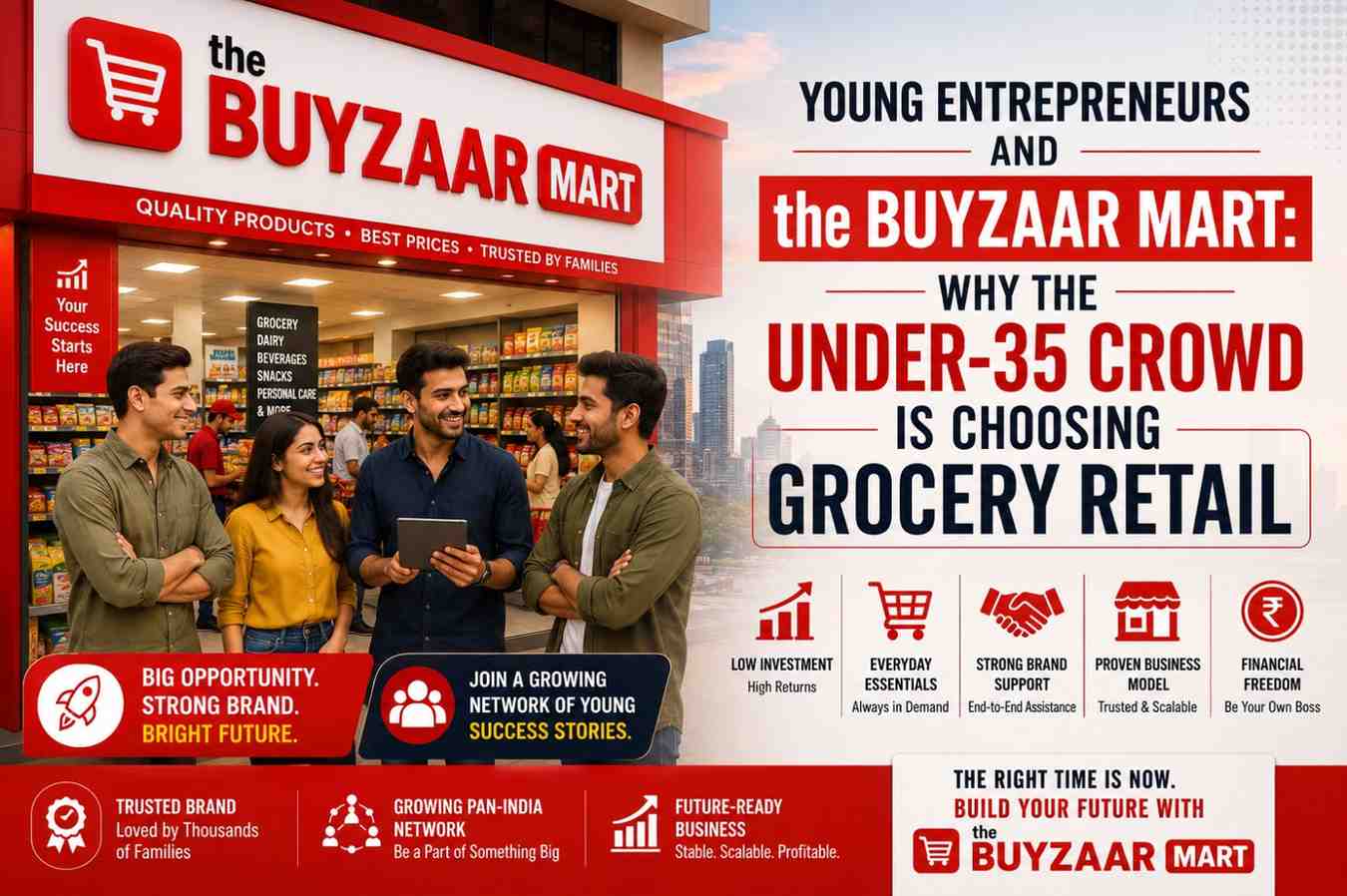
Young Entrepreneurs and Buyzaar Mart: Why the Under-35 Crowd Is Choosing Grocery Retail (2026)
India's under-35 entrepreneurs are skipping the startup hype and choosing grocery franchise businesses instead. Here's why young investors are betting on Buyzaar Mart — and winning.
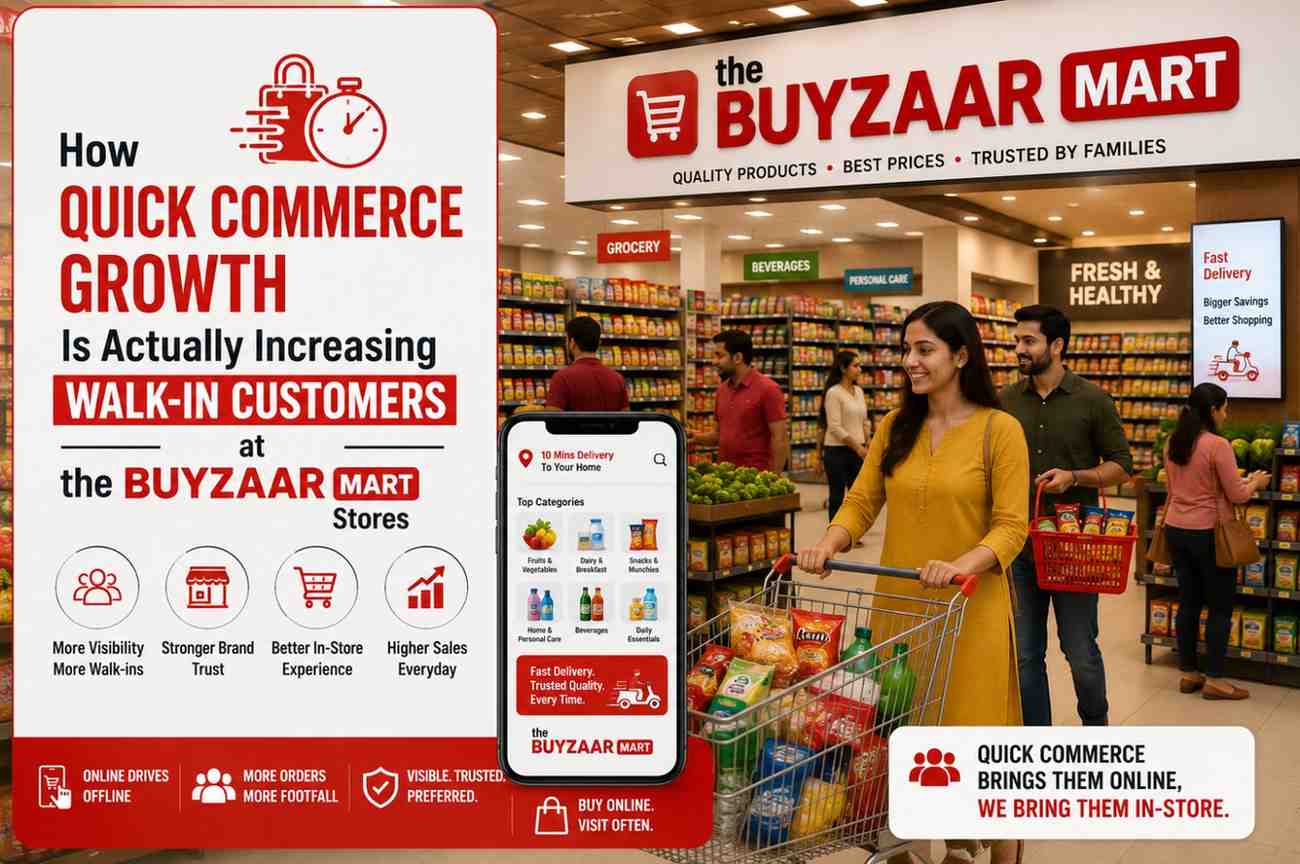
How Quick Commerce Growth Is Actually Increasing Walk-in Customers at Buyzaar Mart Stores (2026)
Everyone assumes quick commerce is killing physical grocery stores. The data and on-ground reality at Buyzaar Mart stores tells a completely different story. Here is why.