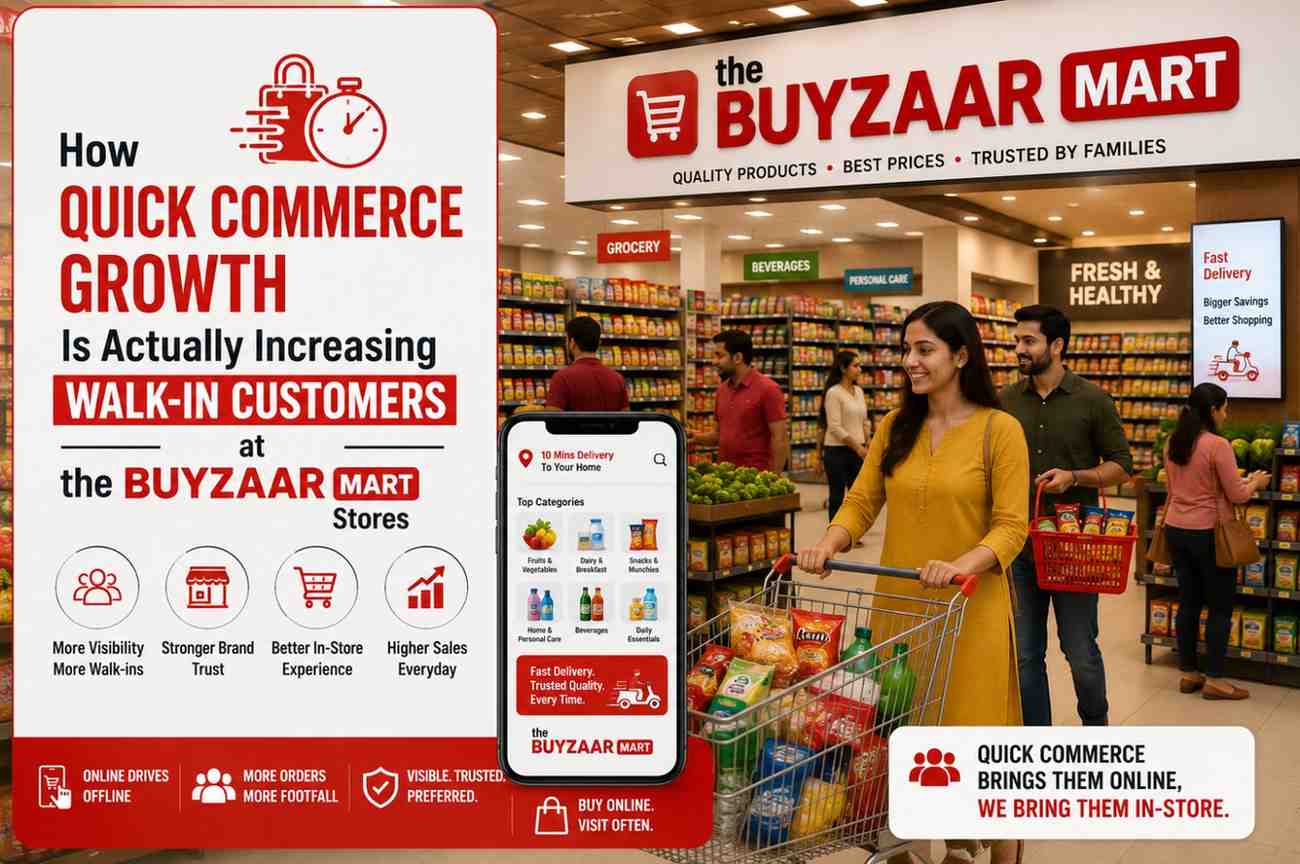
How Quick Commerce Growth Is Actually Increasing Walk-in Customers at Buyzaar Mart Stores (2026)
Everyone assumes quick commerce is killing physical grocery stores. The data and on-ground reality at Buyzaar Mart stores tells a completely different story. Here is why.
The headline that the retail industry expected to write about quick commerce in 2026 was straightforward: Blinkit, Zepto, and Swiggy Instamart are killing the neighbourhood grocery store. That headline has not been written — because the story on the ground is turning out to be significantly more interesting than the threat narrative predicted. India's quick commerce market has grown at an extraordinary pace over the past few years and continues to expand rapidly, with groceries and staples making up the majority of that market. These are not small numbers. Quick commerce is real, it is large, and it is growing. And yet, at Buyzaar Mart franchise stores across North India's tier-2 cities, walk-in customer counts are not declining. In several locations, they are rising — and the reason why is one of the most counterintuitive retail stories of 2026.
First, Understand What Quick Commerce Actually Is — and Is Not
Before examining why quick commerce is not the threat it appears to be for physical Buyzaar Mart stores, it is important to be precise about what quick commerce actually serves.
- •Quick commerce orders now make up a large share of all online grocery orders in India, though they still represent a modest slice of total e-retail spending overall
- •Tier-1 metros hold the overwhelming majority of India's quick commerce market share today, while tier-2 cities are growing fast off a much smaller base
- •Only a small single-digit percentage of Indians currently use quick commerce, mostly urban consumers — a fraction of the adoption seen in some other large markets — which illustrates how much headroom the category still has
Three things stand out from these numbers when read carefully. First, quick commerce is still overwhelmingly a metro phenomenon — the tier-2 cities where Buyzaar Mart franchise stores operate are at the very early edge of quick commerce penetration, not its core market. Second, even at its current scale, it represents a modest share of total e-retail — a meaningful channel, not the entirety of grocery retail. Third, quick commerce thrives on impulse orders and last-minute shopping, a very specific mission that is fundamentally different from the planned weekly grocery purchase that is the backbone of Buyzaar Mart's store revenue.
The Five Ways Quick Commerce Is Actively Helping Buyzaar Mart Stores
1. Quick Commerce Is Converting the Entire Category — Including Walk-In Shoppers
The most underappreciated dynamic in India's quick commerce explosion is that it is not primarily stealing customers from organised physical stores. It is converting customers from the unorganised kirana ecosystem into organised grocery shoppers — and once converted, many of them also walk into organised physical stores.
- •Online grocery purchases jumped sharply during the pandemic years as shoppers shunned in-person shopping — a shift that created a lasting change in grocery shopping behaviour
- •Every consumer who starts using Blinkit or Zepto goes through a process of discovering branded FMCG products, learning MRP prices, and building brand preferences that she then carries into her physical store visits
- •A customer who discovered a particular dal or oil brand on Blinkit, tried it, and liked it will now look for that exact product when she walks into a Buyzaar Mart store for her monthly bulk purchase
- •Quick commerce is doing the hardest part of consumer education — converting unbranded, unorganised shoppers into branded, quality-conscious grocery buyers — and Buyzaar Mart physical stores are one of the primary beneficiaries of that conversion
2. Quick Commerce Serves Top-Up Missions. Buyzaar Mart Serves the Basket Mission. These Do Not Compete
This is the most structurally important point in the entire discussion — and it is consistently missed in the retail media narrative about quick commerce versus physical stores.
- •Quick commerce is built for one specific shopping mission: the urgent, small, immediate need — running out of milk at 9 PM, forgetting salt before cooking, needing a charger before leaving for the airport
- •The basket mission — the planned, comprehensive weekly or monthly grocery purchase that accounts for the majority of household grocery spend — is structurally unsuited to quick commerce. Nobody orders 10 kg of atta, 5 litres of oil, 2 kg of dal, a dozen personal care products, and a full month of household cleaning supplies through an instant delivery app
- •The delivery economics do not support large baskets, dark store catalogues are curated to limit selection, and the customer herself prefers to see, touch, and compare products for a large planned purchase
- •A Buyzaar Mart store and a quick commerce dark store are serving two different missions in the same household's monthly grocery journey — they are not competing for the same purchase
3. Quick Commerce Is a Real-Time Product Discovery Platform for Physical Stores
FMCG companies increasingly launch premium products first on quick commerce platforms, where high-frequency, convenience-focused shoppers are easiest to capture. Impulse and gifted products such as cosmetics, sweets, and seasonal items are adopted quickly through these channels — creating a product discovery dynamic that benefits physical franchise stores in a way that is easy to measure but rarely discussed.
- •When a brand launches a new product variant on an instant delivery app with aggressive promotional pricing, millions of consumers across its active cities see and try that product for the first time
- •The consumers who like it then seek it out in their regular grocery shopping — including during physical store visits
- •A smart Buyzaar Mart franchise owner who monitors what the quick commerce platforms are promoting — which new SKUs, offers, and trending categories — and ensures those exact products are stocked on her shelves is essentially leveraging a competitor's marketing budget to drive her own in-store sales
- •Quick commerce has become one of the most powerful FMCG product launch and discovery platforms in India — and every product discovered on an app becomes a potential demand driver for a Buyzaar Mart store's physical shelves
4. Quick Commerce's Limitations Are Buyzaar Mart's Structural Advantages
Dark stores are specialised fulfillment hubs designed exclusively for processing online orders — unlike traditional retail spaces, they are not open to walk-in customers. This single fact encapsulates the most important structural limitation of the quick commerce model.
- •Dark stores carry limited SKU catalogues, heavily weighted toward the fastest-moving products. A customer looking for a specific regional brand, a particular pack size of cooking oil, or a specific shampoo variant may simply not find it on a quick commerce platform
- •Dark stores offer zero sensory shopping experience — a customer who wants to check the freshness of packaged bread, compare two variants of atta, or pick the largest bunch of coriander cannot do this through an app
- •Quick commerce delivery carries a meaningful cost — delivery fees, platform commissions, and surge pricing during peak demand make quick commerce orders systematically more expensive than the same purchase at a physical store, so price-sensitive middle-income families in tier-2 cities consistently choose the physical store for anything planned and non-urgent
- •Rising operating costs are making small delivery runs less profitable for quick commerce operators, and the deep discounting that once made them attractive to price-conscious consumers is gradually reducing — making the price comparison with physical stores increasingly favourable
5. Quick Commerce Expansion Is Building Grocery Shopping Habits That Drive Physical Store Visits
Time-strapped urban dwellers, particularly millennials and Gen Z, are driving demand for instant deliveries, and cultural shifts toward online shopping have cemented a preference for digital platforms. But here is the paradox within this trend that benefits physical stores: the more a consumer grocery shops through any channel, the more total grocery purchasing she does. Channel expansion creates category expansion, not just channel switching.
- •A household that previously made one large monthly kirana visit and bought broadly from memory is now shopping multiple times per week — some visits on quick commerce apps, some in physical stores
- •The total grocery spend of that household increases because more frequent shopping leads to discovering more products, buying more categories, and maintaining a better-stocked household overall
- •Buyzaar Mart physical stores capture the planned, high-value segments of this increased total spend — the large basket visit, the comparison shopping visit, the festival stocking visit — even as quick commerce captures the top-up moments
What the Tier-2 City Reality Looks Like in 2026
The quick commerce vs physical store debate is most heated in metros like Delhi, Mumbai, and Bengaluru, where dark store penetration is dense and quick commerce is already a routine shopping behaviour for a significant share of the population. In Buyzaar Mart's primary market — tier-2 North Indian cities like Lucknow, Kanpur, Meerut, Dehradun, Saharanpur, and Moradabad — the picture is markedly different.
- •Tier-2 cities are projected to grow quick commerce adoption quickly through the rest of the decade, but currently hold only a fraction of tier-1 metro penetration — quick commerce is arriving in these cities, not dominating them
- •Only a small share of Indians currently use quick commerce nationally, and in tier-2 cities that share is significantly lower than the national average — the vast majority of grocery shopping in Buyzaar Mart's core markets still happens through physical channels
- •The dark store infrastructure required for effective quick commerce — fulfillment hubs strategically located within 2 to 3 km of dense residential clusters — is still being built out in tier-2 cities, and coverage gaps remain significant
- •This means Buyzaar Mart franchise stores in tier-2 cities are operating in a market where quick commerce is educating consumers and building category habits, but physical stores remain the primary, dominant channel for grocery fulfillment
How Smart Buyzaar Mart Franchise Owners Are Using Quick Commerce as an Ally
The franchise owners who are growing fastest in 2026 are not ignoring quick commerce or fighting it. They are using it intelligently to drive their own physical store performance.
- •Monitoring quick commerce platforms weekly to identify which new products are being promoted, and ensuring those SKUs are in stock before regular customers start asking for them
- •Offering WhatsApp-based home delivery for their own regular customers, capturing the top-up convenience mission without ceding it entirely to a dark store competitor
- •Using quick commerce pricing as a reference point to ensure their own shelf pricing is competitive and transparent, eliminating the perception gap that used to exist between physical and digital pricing
- •Communicating in-store availability to their WhatsApp customer groups when a product is frequently out of stock on a quick commerce app, turning a competitor's supply chain problem into a walk-in opportunity
- •Stocking the complete product range that quick commerce platforms cannot match — regional variants, specific pack sizes, fresh produce — as a product depth advantage that drives purposeful physical store visits
Final Thoughts
- •Quick commerce thrives on impulse orders, last-minute shopping, and the immediate gratification of instant delivery — and it is genuinely excellent at those things. It will continue growing and will become an increasingly normal part of how Indian households handle their grocery top-up needs
- •What it will not do — structurally, economically, or behaviourally — is replace the physical grocery franchise store's role in the planned, basket-driven, relationship-anchored, price-sensitive majority of household grocery spending
- •The stores that will suffer as quick commerce grows are the ones that were already fragile — poorly stocked, inconsistently priced, unreliably available, and offering no organised retail experience worth choosing over an app
- •A well-run Buyzaar Mart franchise store — reliably stocked with 50+ FMCG brand products, transparently priced, tech-enabled with POS and CRM, professionally presented, and community-connected — is not threatened by quick commerce. It is strengthened by the overall consumer shift toward organised, branded grocery retail that quick commerce is helping accelerate
- •Quick commerce is not the enemy of the neighbourhood grocery franchise. It is one of the best marketing campaigns the organised grocery retail category has ever had — and Buyzaar Mart stores are positioned to capture the full-basket revenue that campaign generates
Build the physical store your neighbourhood comes back to. Apply at thebuyzaarmart.com/franchise or call 9217991727 (Monday to Saturday, 9 AM to 7 PM)
Frequently Asked Questions
Is quick commerce taking sales away from Buyzaar Mart stores?
In tier-2 cities where Buyzaar Mart primarily operates, quick commerce penetration remains low. More importantly, quick commerce captures top-up missions while Buyzaar Mart captures the planned basket mission — these are different shopping behaviours, not direct competitors for the same purchase.
Should a Buyzaar Mart franchise owner worry about Blinkit or Zepto entering their city?
Not as an existential threat — but as a market signal worth adapting to. The appropriate response is stocking quick-commerce-promoted products, offering WhatsApp delivery for regulars, and ensuring pricing transparency — all of which strengthen the physical store rather than weaken it.
Does quick commerce help or hurt FMCG brand sales in physical stores?
It helps. Quick commerce functions as a product discovery and trial platform — new FMCG variants get discovered on apps and then sought out in physical stores. Franchise stores that stock these products benefit from quick commerce's marketing investment.
Will quick commerce eventually dominate grocery retail in tier-2 cities?
The data suggests quick commerce will grow significantly in tier-2 markets through the rest of the decade — but will coexist with physical stores rather than replace them. The planned bulk purchase, the sensory shopping experience, and the price advantage of physical retail are structural durables that quick commerce cannot eliminate.
How is Buyzaar Mart positioning its franchise stores in response to quick commerce growth?
By ensuring franchise stores have the operational excellence — consistent stock, clean environment, transparent pricing, and community relationships — that makes them the preferred destination for planned grocery purchases while quick commerce handles urgent top-up needs.
Related Articles
NRI Investors and Buyzaar Mart: Why Some Are Choosing Grocery Franchise Over Real Estate (2026)
NRIs are rethinking where to invest in India in 2026 — and grocery franchises like Buyzaar Mart are entering the conversation. Here's an honest comparison of franchise vs real estate for NRI investors considering India's consumer market.
Young Entrepreneurs and Buyzaar Mart: Why the Under-35 Crowd Is Choosing Grocery Retail (2026)
India's under-35 entrepreneurs are skipping the startup hype and choosing grocery franchise businesses instead. Here's why young investors are betting on Buyzaar Mart — and winning.