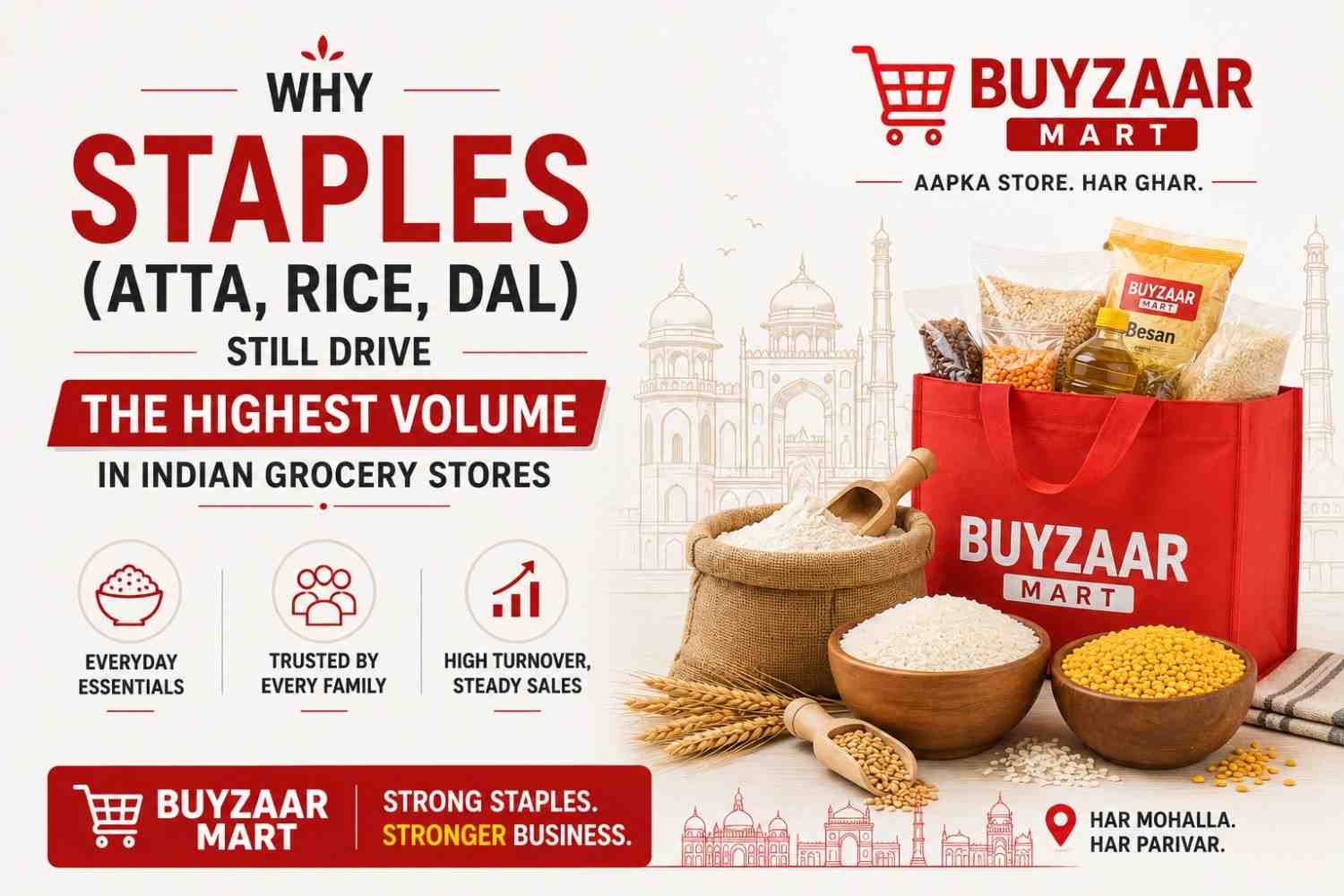
Why Staples (Atta, Rice, Dal) Still Drive the Highest Volume in Indian Grocery Stores (2026)
Atta, rice, and dal are not glamorous — but they are the backbone of every profitable Indian grocery store. Discover why staples drive the highest volume, build repeat footfall, and why no grocery franchise can afford to get them wrong.
Every grocery store owner in India, at some point, gets tempted by the same thought. The margins on atta are thin. Rice is a commodity. Dal prices swing with every monsoon. Why not focus shelf space and energy on personal care, snacks, and beverages — categories where the margins are fatter and the branding is stronger? It is a reasonable question. And it has a very clear answer. Because without staples, your customers have no reason to walk into your store every week. Atta, rice, and dal are not just product categories. They are the foundation of the Indian grocery shopping habit. They are the reason a customer thinks of your store first, visits most frequently, and builds the kind of automatic, reflexive loyalty that no promotional campaign can manufacture. Every other category in your store rides on the footfall that staples generate.
The Numbers — Staples Are Still the Market's Biggest Category
- •Staple ingredients including rice, wheat flour, edible oils, sugar, pulses, and salt account for approximately 55 to 60% of total ingredient retail — more than half of everything sold in Indian grocery stores is a staple product
- •Food grains dominate the Indian grocery market with a 22% share, driven by the fundamental dietary importance of staples including rice, wheat, and pulses in Indian households
- •The India packaged rice market alone reached 13.68 million tons in volume in 2025 — a number that puts the scale of staples consumption in clear perspective
- •The India packaged atta market reached a value of ₹95.1 billion in 2025 and is projected to grow at a CAGR of 12.64% through 2034 — far from a stagnant category, packaged staples are one of the fastest-growing segments in organised grocery retail
- •The Indian grocery market is dominated by essential staples like rice, atta, and salt alongside high-frequency convenience items — this dominance has not shifted despite the rise of premium and lifestyle FMCG categories
- •The food grains segment accounted for the largest market revenue share in India's grocery market in 2024 and continues to hold that position in 2026
Why Staples Drive Volume — The Five Core Reasons
1. They Are Purchased With the Highest Frequency of Any Category
- •Unlike shampoo, which a household buys once a month, or biscuits, which are an impulse purchase — atta, rice, and dal are bought every week, sometimes twice a week in most Indian households
- •A family of four consuming 10 kg of atta per month is making at least two to three atta purchases per month — each one a guaranteed store visit
- •This purchase frequency is what makes staples the most powerful footfall driver in any grocery store — the customer who comes in for atta also buys five other things she did not plan to buy
- •No other category in the store generates this level of automatic, habitual, non-negotiable visit frequency
2. They Are Non-Negotiable Across Every Income Level
- •Snacks are discretionary. Personal care can be stretched. Beverages can be skipped for a week. Atta, rice, and dal cannot
- •Every Indian household — from a daily-wage earner in a Lucknow colony to an IT professional in a Gurgaon apartment — buys staples every single month without exception
- •This makes staples the most recession-proof category in grocery retail — volumes do not fall during economic stress the way discretionary categories do
- •During inflationary periods when consumers cut back on packaged snacks and premium personal care, staple volumes remain stable or even increase as families cook more at home
3. They Are the Category Around Which Customer Loyalty Is Built
- •Customers choose their regular grocery store primarily based on staple availability, price, and quality — not based on which store has the best selection of biscuits
- •A store that consistently has good quality atta in stock, at fair prices, in the right pack sizes — becomes the default store for that household
- •That default store relationship then captures all the household's other purchases — personal care, snacks, beverages, homecare — with minimal additional effort
- •Conversely, a store that runs out of rice or charges inconsistent prices for dal loses the customer permanently — not just for staples but for everything else
4. The Shift from Loose to Branded Is Creating a Volume Surge in Organised Retail
- •Rising concerns about adulteration and contamination in unbranded products are resulting in higher uptake of packaged atta, with organised retail expansion directly driving this shift
- •Increasing urbanisation, growth of organised retail, and higher consumer awareness about food safety are encouraging the shift from loose rice to packaged variants
- •This branded shift is happening fastest in exactly the tier-2 and tier-3 North Indian markets where Buyzaar Mart franchise stores are positioned — consumers are upgrading to Aashirvaad, Fortune, Tata Sampann, and India Gate in large numbers
- •Every consumer who switches from loose dal at a kirana to a packaged Tata Sampann Toor Dal is a customer who now needs an organised franchise store — because the neighbourhood kirana often does not stock the branded variant reliably
- •This transition creates a permanent, structural volume advantage for organised franchise stores over unorganised kirana competitors in the staples category
5. They Are the Category That Defines Your Store's Pricing Reputation
- •In the mind of the Indian grocery shopper, the price of atta and rice defines whether a store is 'fair' or 'expensive'
- •A customer who perceives your staples pricing as honest and competitive will extend that trust to every other category in your store — including higher-margin personal care and snacks
- •A customer who feels overcharged for dal even once will question every price in your store going forward
- •Staples are the price anchor of the entire store — getting this category right in terms of pricing consistency and transparency builds the foundational customer trust that all other categories benefit from
The Premiumization Trend Within Staples — A Growing Opportunity
While volumes remain the primary story in staples, premiumization is creating a significant value growth opportunity alongside the volume story.
- •There is a distinct shift toward unpolished pulses and grains among health-conscious urbanites — products like Tata Sampann Toor Dal ranked third on Amazon bestsellers, showing that premium staple variants have genuine and growing demand
- •Manufacturers are expanding product offerings with premium varieties, fortified rice, and convenient packaging formats — including organic basmati and QR-traceable premium variants targeting consumers willing to pay more for quality assurance
- •In practical terms this means your staples section should carry both the standard range and at least one or two premium variants of key products — regular atta alongside multigrain or whole wheat, standard toor dal alongside organic or unpolished variants
- •Premium staple variants carry significantly higher per-unit margins than standard variants while appealing to the fastest-growing consumer segment — the health-aware, brand-conscious middle-class household
- •Brands like ITC Aashirvaad, Tata Sampann, Patanjali, and Fortune are all aggressively expanding their premium staple portfolios — franchise stores that stock these ranges early benefit from the brand's own marketing investment in consumer awareness
The Edible Oils Story — The Fourth Pillar of Staples
- •No staples strategy is complete without edible oil — the most price-sensitive and volume-critical product in the entire grocery store
- •Edible oil prices rose 12 to 18% in 2024 to 2026 due to global supply constraints — making price consistency and reliable availability even more important to consumers navigating these increases
- •Brands like Fortune (Adani Wilmar), Dhara, and Saffola dominate this category and are all part of Buyzaar Mart's FMCG partnership network — giving franchise stores reliable access to the most in-demand variants
- •Edible oil is bought at least twice a month by most households — making it the second most frequent staple purchase after atta in many North Indian households
- •A store that keeps all three preferred oil variants — sunflower, mustard, and refined — consistently in stock in the most popular pack sizes becomes the automatic choice for the household's monthly oil shopping
How to Manage the Staples Section for Maximum Volume and Footfall
Never Go Out of Stock on Core SKUs
- •The top five staple SKUs in your store — your best-selling atta brand in the 5 kg and 10 kg pack, your top rice variant, toor dal, and your leading oil brand — must never run out of stock
- •A customer who comes in for Aashirvaad 10 kg and finds it unavailable does not wait — she goes to the next store, and if that store serves her well, she will not automatically return to yours
- •Set a minimum stock threshold for each core staple SKU and trigger a reorder the moment stock falls to that level — not when it runs out
Stock the Right Pack Sizes for Your Catchment
- •Pack size preference varies significantly by locality — a colony of nuclear families tends to prefer 5 kg atta packs and smaller dal pouches, while a joint-family dominated neighbourhood buys 10 kg atta and 1 kg dal packets in bulk
- •Observe your first month's sales data closely and adjust your pack size mix accordingly — stocking the wrong sizes means slower inventory turns and higher capital blocked in slow-moving stock
- •For rice, Basmati variants in 5 kg packs dominate urban middle-income households while non-basmati varieties in larger packs serve daily consumption needs in working-class localities
Give Staples Dominant, Accessible Shelf Space
- •Staples should never be tucked into a corner or a hard-to-reach aisle — they are your highest-frequency category and your most important footfall anchor
- •Position atta, rice, and dal on wide, accessible floor-level and mid-level shelving that customers can reach easily with or without staff assistance
- •Heavy staple packs — 10 kg atta, 5 kg rice — should be displayed at floor or bottom-shelf level for easy customer handling and safe stacking
- •Use clear shelf labels with prices prominently displayed — customers comparing staple prices between stores are price-sensitive and make quick decisions based on visible pricing
Use Staples Promotions to Drive Basket-Building
- •A well-timed combo promotion on staples — buy 10 kg atta and get 500 g dal free, or a discount on oil when purchased with rice — drives significantly higher basket sizes without reducing your overall margin meaningfully
- •Festive promotions on staples — during Navratri, Diwali, and month-end salary weeks — generate the highest footfall spikes of any promotional category because every household is stocking up
- •Communicate staples promotions through WhatsApp group broadcast messages to your regular customer list — this is the single most effective low-cost marketing tool for driving planned staple purchase visits
Monitor Staple Margins Carefully
- •Staple ingredients are growing at a 6 to 8% CAGR but intense competition limits the extent of price pass-through, squeezing processor and retailer margins — this means staple margins require active management, not passive acceptance
- •Regularly review your cost price from Buyzaar Mart's supply chain versus your selling price and ensure you are not compressing margins unnecessarily through informal discounting
- •Use your POS system's category margin report to track staple gross margin monthly — any sustained compression below your target signals either a pricing problem or a procurement issue that needs immediate attention
Staples Management — At a Glance
| Staple Category | Top Brands (North India) | Key Pack Sizes | Reorder Trigger | Shelf Position |
|---|---|---|---|---|
| Atta (Wheat Flour) | Aashirvaad, Patanjali, Fortune | 5 kg, 10 kg | When below 20% of weekly average | Floor/mid-level, wide accessible aisle |
| Rice (Basmati & Non-Basmati) | India Gate, Daawat, Fortune | 1 kg, 5 kg (Basmati); 5 kg, 10 kg (Non-Basmati) | When below 2 weeks of cover | Floor level for heavy packs; mid for premium |
| Dal & Pulses | Tata Sampann, local branded | 500 g, 1 kg | Weekly review — never below 1 week stock | Mid-level, clearly labelled by variety |
| Edible Oil | Fortune, Saffola, Dhara | 1 L, 2 L, 5 L | When below 15% of monthly average | Mid-level; all three variants always in stock |
| Sugar & Salt | Uttam, Madhur, Tata Salt | 1 kg, 5 kg | When below 1 week stock | Easily accessible, bottom or mid-level |
Staples Category Management Framework for Grocery Franchise Stores
What Buyzaar Mart Franchise Partners Have That Kirana Owners Do Not
- •Direct supply chain partnerships with Adani Wilmar (Fortune), ITC (Aashirvaad), Tata Consumer (Tata Sampann), and Patanjali — the four dominant brands across atta, oil, dal, and rice in North India
- •Centrally negotiated procurement pricing — giving franchise stores competitive cost prices that most individual kirana owners cannot access through local distributors
- •Hassle-free inventory assurance — near-expiry or slow-moving staple stock can be flagged and managed through Buyzaar Mart's inventory return policy, reducing the risk of capital getting blocked in unsold stock
- •POS-based inventory tracking that sends real-time alerts when core staple SKUs approach their minimum threshold — eliminating the manual guesswork that causes stockouts in unorganised stores
- •Organised, branded shelf display that gives customers confidence in the quality and authenticity of the branded staples on your shelves — a trust signal that loose kirana displays simply cannot provide
Final Thoughts
- •Staples are not the most exciting category in your grocery franchise store — but they are unquestionably the most important one
- •Due to their non-perishable nature and recurring demand, staples account for the bulk of grocery sales — and various platforms continue to focus on this category for competitive pricing, subscription plans, and repeat purchases
- •Every other category in your store — personal care, snacks, beverages, homecare — exists in the customer's mind as a bonus purchase on top of the staple trip she was already making
- •Get staples right — reliable stock, fair pricing, right brands, right pack sizes, properly displayed — and you have built the footfall foundation that the entire rest of your store's revenue sits on
- •Get them wrong — frequent stockouts, inconsistent pricing, wrong variants — and no amount of personal care margin or snack promotion will save your store's customer retention
- •Buyzaar Mart franchise partners enter the staples category with the strongest possible hand — direct brand partnerships, centrally managed supply chains, POS-based inventory tracking, and the trust of a branded store environment that consumers are increasingly choosing over unorganised alternatives
- •Staples built the Indian grocery store. In 2026, they are still building it — one household, one weekly visit, one basket at a time.
Stock smart. Build loyalty from the ground up. Start at thebuyzaarmart.com/franchise or call 9217991727 (Monday to Saturday, 9 AM to 7 PM)
Frequently Asked Questions
Do staples really drive more volume than snacks and beverages in Indian grocery stores?
Yes. Staples account for 55 to 60% of total grocery retail value in India and drive the highest purchase frequency of any category — customers buy atta and dal every week, not just occasionally.
Should I stock both branded and loose staples in my Buyzaar Mart store?
Buyzaar Mart franchise stores focus on branded, packaged staples — which is exactly where consumer demand is shifting as awareness about adulteration and quality grows across North Indian markets.
Why are staple margins lower than other categories?
Staples are price-sensitive and highly competitive. The margin opportunity lies in premium variants, right pack-size mix, and using staples to drive basket-building that increases overall transaction value.
How often should I reorder staples?
Review your top five staple SKUs every week and set a reorder trigger at a minimum stock level — never wait until stock runs out. Staple stockouts are the fastest way to permanently lose regular customers.
Which staple brands move fastest in North Indian markets?
ITC Aashirvaad and Patanjali for atta, India Gate and Daawat for rice, Tata Sampann and local branded variants for dal, and Fortune and Saffola for edible oil are consistently the top performers across North Indian tier-2 and tier-3 markets.
Related Articles
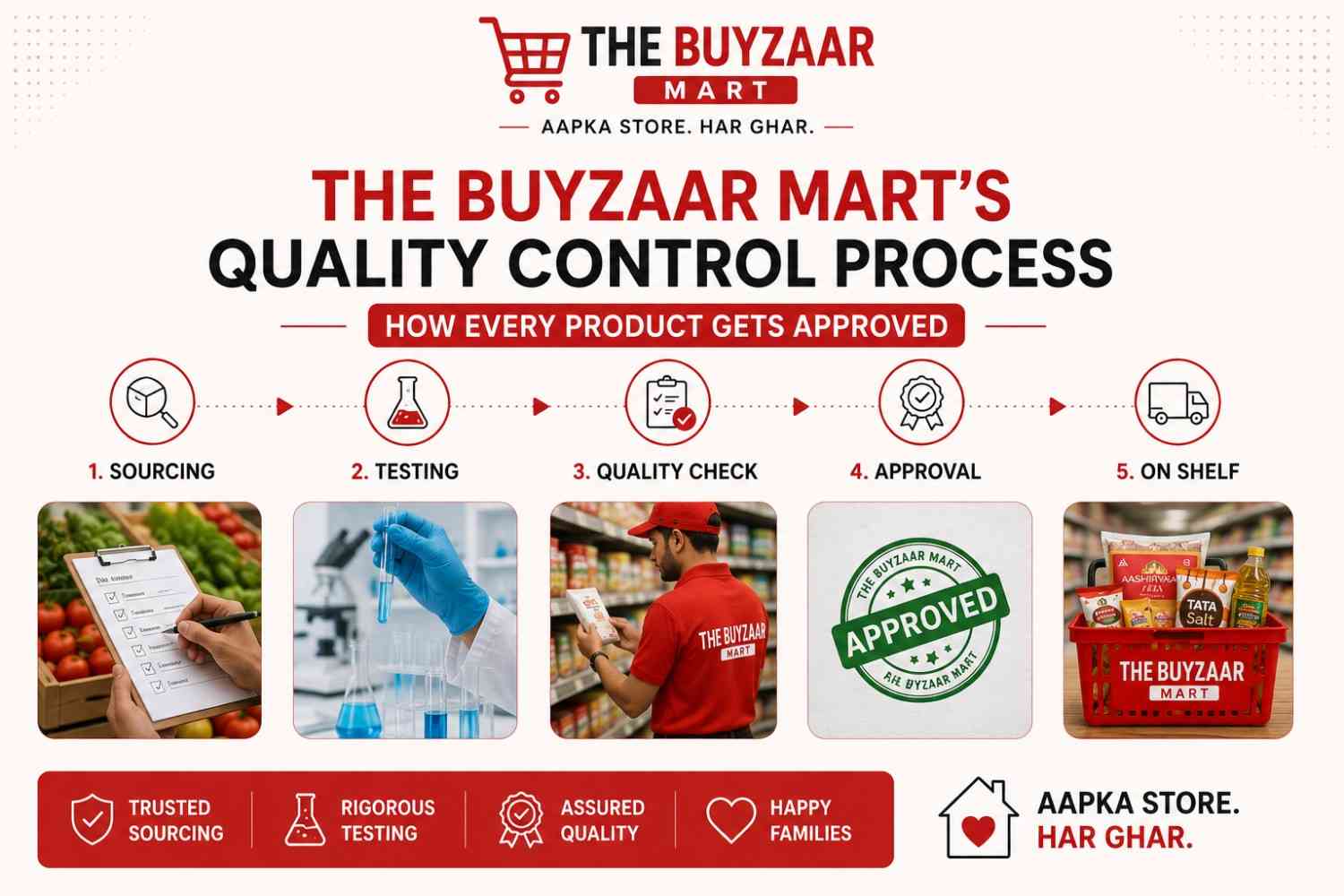
Buyzaar Mart's Quality Control Process: How Every Product Gets Approved (2026)
Ever wondered how Buyzaar Mart decides which products make it to the shelf? Discover the end-to-end quality control process that ensures every product in a Buyzaar Mart franchise store meets the highest standards of safety, authenticity, and customer trust.
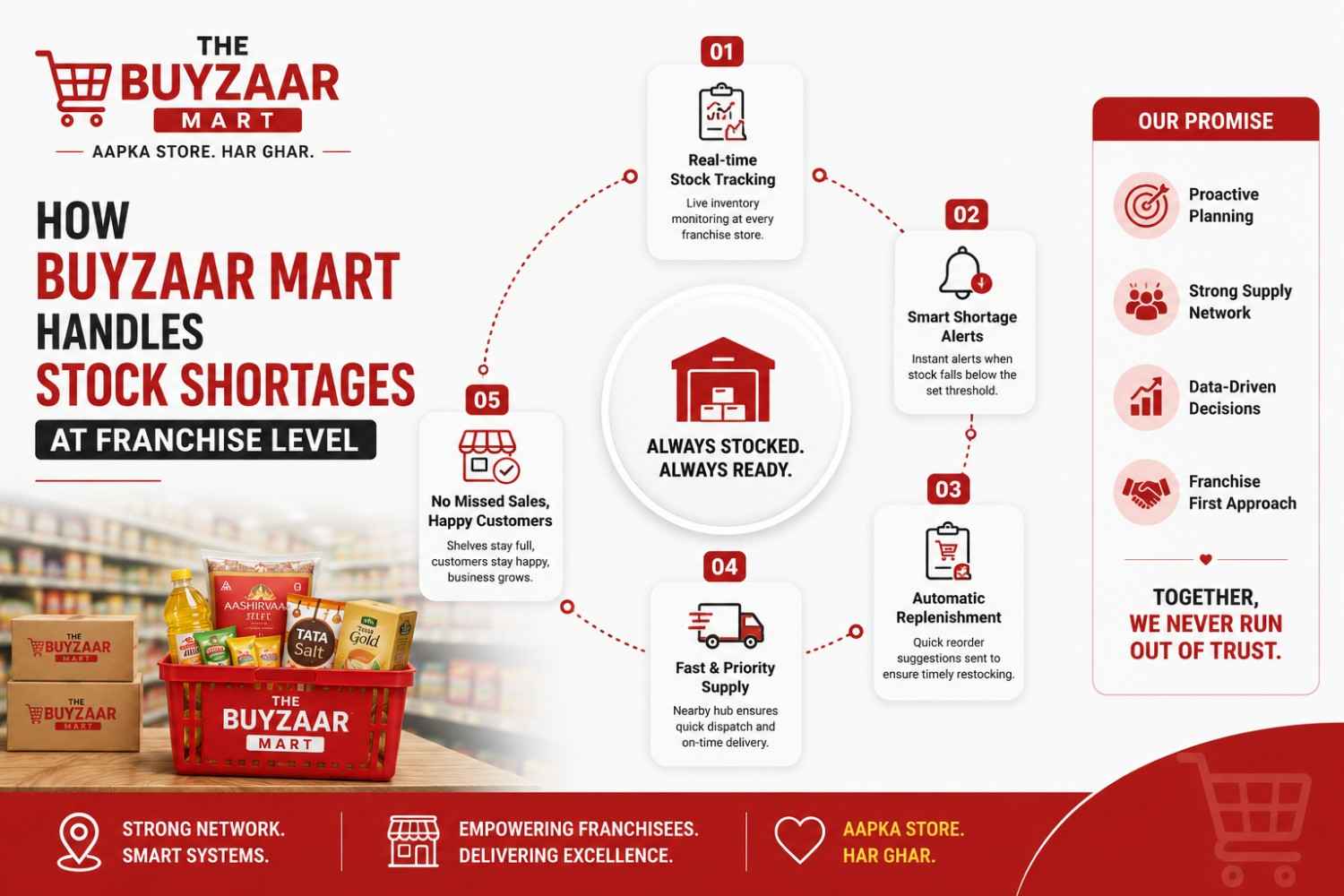
How Buyzaar Mart Handles Stock Shortages at the Franchise Level (2026)
Discover how Buyzaar Mart prevents stock shortages at franchise stores with POS alerts, centralized supply chain, and reorder systems. Apply now.