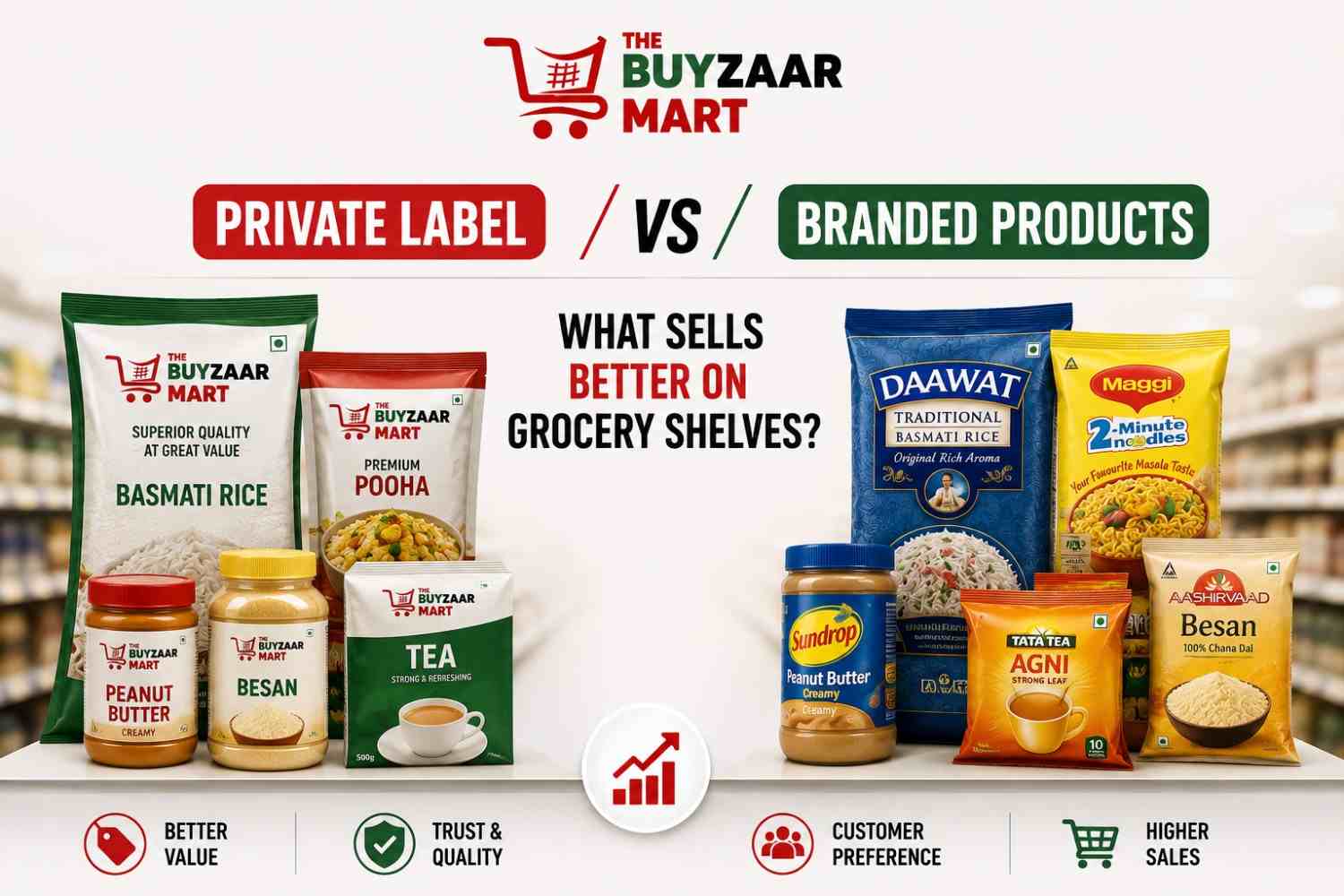
Private Label vs Branded Products: What Sells Better on Grocery Shelves
Private label or branded products — which wins more shelf space and profit in Indian grocery stores? A category-by-category breakdown for franchise owners.
Walk down any aisle in a neighborhood grocery store across Meerut, Lucknow, or Delhi NCR and you'll see the same silent battle playing out on every shelf — a familiar branded biscuit pack sitting right next to a store-label alternative selling for 15-20% less. For grocery franchise owners, this isn't just a stocking decision. It's a margin decision, a trust decision, and increasingly, a customer-loyalty decision. So which one actually sells better — and more importantly, which one should get more shelf space in your store?
What Are Private Label and Branded Products?
- •Branded products are manufactured and marketed by established FMCG companies — think HUL, ITC, Nestlé, Dabur, Britannia, or Amul. These products come with years of advertising, consumer trust, and consistent quality recognition built in.
- •Private label products (also called store brands or house brands) are manufactured on behalf of a retailer and sold under that retailer's own name or a brand exclusive to that store. The retailer controls pricing, packaging, and positioning without the overheads of national advertising.
- •Globally, private label penetration has grown sharply — in the US and Europe, store brands now account for nearly 20% of grocery spending. In India, the shift is slower but accelerating, particularly in staples, packaged snacks, and household essentials.
Why This Comparison Matters for Grocery Store Owners
- •Branded and private label products don't compete only on price — they compete on shelf space, customer trust, and repeat-purchase behavior, all of which directly affect your store's monthly revenue
- •The right mix between the two categories can materially change your gross margin, since private label products typically carry higher margins than branded equivalents
- •Getting this balance wrong — either overloading on unfamiliar private label SKUs or ignoring margin-friendly private label opportunities — can quietly erode profitability even when footfall looks healthy
The Case for Branded Products
- •Instant trust and zero education cost — a customer picking up Tata Salt or Maggi doesn't need to be convinced of quality; the brand has already done that work over decades
- •Higher walk-in demand — many shoppers specifically ask for a product by brand name, meaning stocking out of a popular brand can send the customer straight to a competitor
- •Advertising pull works in your favour — television, social media, and packaging investment made by the brand itself brings customers into your store without you spending a rupee on demand generation
- •Lower risk of unsold inventory — branded staples like atta, oil, and tea move consistently, reducing the chance of dead stock sitting on shelves
- •Category leadership in premium segments — in personal care, health foods, and baby products, shoppers are far less willing to experiment with an unfamiliar name
The Case for Private Label Products
- •Significantly higher margins — because there's no national advertising spend or heavy distributor markup baked into the cost, private label products typically offer better per-unit profitability for the store
- •Price-sensitive shoppers respond well — in categories like pulses, spices, tissue paper, and cleaning liquids, customers are often willing to switch to a lower-priced alternative if quality feels comparable
- •Builds store-specific loyalty — a customer who likes your house-brand product associates that quality directly with your store, not with a manufacturer, which increases the chance they return specifically to you
- •Differentiation from competitors — if every store in your catchment area stocks the same national brands, a well-executed private label range gives your store something competitors can't copy overnight
- •Control over quality and packaging — you decide the grammage, packaging design, and positioning rather than depending on a manufacturer's national strategy
Where Branded Products Still Win — Category by Category
- •Packaged foods and snacks — Haldiram's, Britannia, and Parle dominate because of taste consistency and impulse-driven brand recall near billing counters
- •Personal care and beauty — shoppers rarely experiment with unfamiliar shampoo or skincare brands, making this a branded-dominant category almost everywhere
- •Baby products and health-focused items — trust and safety perception make parents extremely brand-loyal in this segment
- •Dairy — Amul and Mother Dairy have such deep trust built over decades that private label alternatives struggle to gain traction here
Where Private Label Products Can Genuinely Compete
- •Staples like atta, rice, pulses, and salt — where quality differences are harder for the average shopper to detect, and price sensitivity is highest
- •Cleaning and household essentials — dish wash liquids, floor cleaners, and tissue paper, where functional performance matters more than brand prestige
- •Basic stationery and utility items — where the product is largely commoditised
- •Value packs and bulk purchases — price-conscious households buying in larger quantities are more open to a trusted store's own label
Comparison at a Glance
- •Shopper trust: Branded Products — High, built over years; Private Label Products — Builds gradually, tied to store reputation
- •Store margin: Branded Products — Lower, due to distributor markup; Private Label Products — Higher, no advertising overhead
- •Best category fit: Branded Products — Personal care, dairy, snacks, baby items; Private Label Products — Staples, cleaning, tissue, bulk packs
- •Marketing effort needed: Branded Products — None — brand already advertises; Private Label Products — Store must build trust through consistent quality
- •Risk of dead stock: Branded Products — Low for popular SKUs; Private Label Products — Moderate, until repeat purchase habit forms
What This Means for Your Buyzaar Mart Store
- •Don't treat this as an either-or decision — the strongest-performing grocery stores run a deliberate mix, using branded products to drive footfall and private label products to protect margin
- •Place branded staples and popular snack brands at eye level near the entrance and billing counter, since these drive impulse buys and repeat visits
- •Introduce private label options gradually in categories like staples and household cleaning, where price sensitivity is highest and quality perception gaps are smallest
- •Never let a private label product replace a customer's preferred brand outright — offer it as a visible, lower-priced alternative placed right next to the branded version, letting the customer choose
- •Track which private label SKUs get repeat purchases within the first two months — this tells you where your customers are genuinely open to switching and where they are not
Common Mistakes Grocery Store Owners Make
- •Overstocking unfamiliar private label products in categories where brand loyalty is strongest, such as personal care or dairy
- •Pricing private label products too close to branded equivalents, removing the only real incentive a customer has to try them
- •Ignoring packaging quality on private label items — cheap-looking packaging undermines trust even when the product inside is genuinely good
- •Failing to communicate value clearly through shelf talkers or price tags that highlight the savings compared to the branded alternative
Final Thoughts
- •Neither branded nor private label products "win" on their own — the real advantage belongs to grocery store owners who understand exactly which category benefits from which strategy
- •Branded products bring proven demand and customer trust through your door
- •Private label products, placed correctly, protect your margins and build loyalty that's tied directly to your store rather than to a manufacturer
- •A well-run Buyzaar Mart franchise store treats shelf allocation as a strategic decision — not a default one — and that's exactly where sustainable profitability comes from
- •Build a smarter, better-margined grocery store. Explore franchise opportunities at thebuyzaarmart.com/franchise or call 9217991727 (Monday to Saturday, 9 AM to 7 PM)
Frequently Asked Questions
Do private label products actually sell well in Indian grocery stores?
Yes, particularly in staples, household cleaning items, and bulk packs where price sensitivity is high and brand loyalty is comparatively low. Categories like personal care and dairy remain branded-dominant.
Which is more profitable for a grocery store — branded or private label products?
Private label products typically carry higher margins since there's no national advertising cost built into the price. However, branded products drive higher and more predictable footfall.
Should a new grocery franchise store stock private label products from day one?
It's usually better to build branded product credibility first, then introduce private label options gradually in categories like staples and cleaning supplies once the store has an established customer base.
How much shelf space should private label products get compared to branded ones?
There's no fixed ratio, but most well-run stores keep private label focused on staples and household categories while allocating the majority of premium and personal care shelf space to trusted branded products.
Does Buyzaar Mart support franchise partners in balancing branded and private label stock?
Yes, Buyzaar Mart's centrally managed supply chain gives franchise partners access to 50+ FMCG brand partnerships alongside a structured product mix strategy designed to protect both footfall and margin.
Related Articles
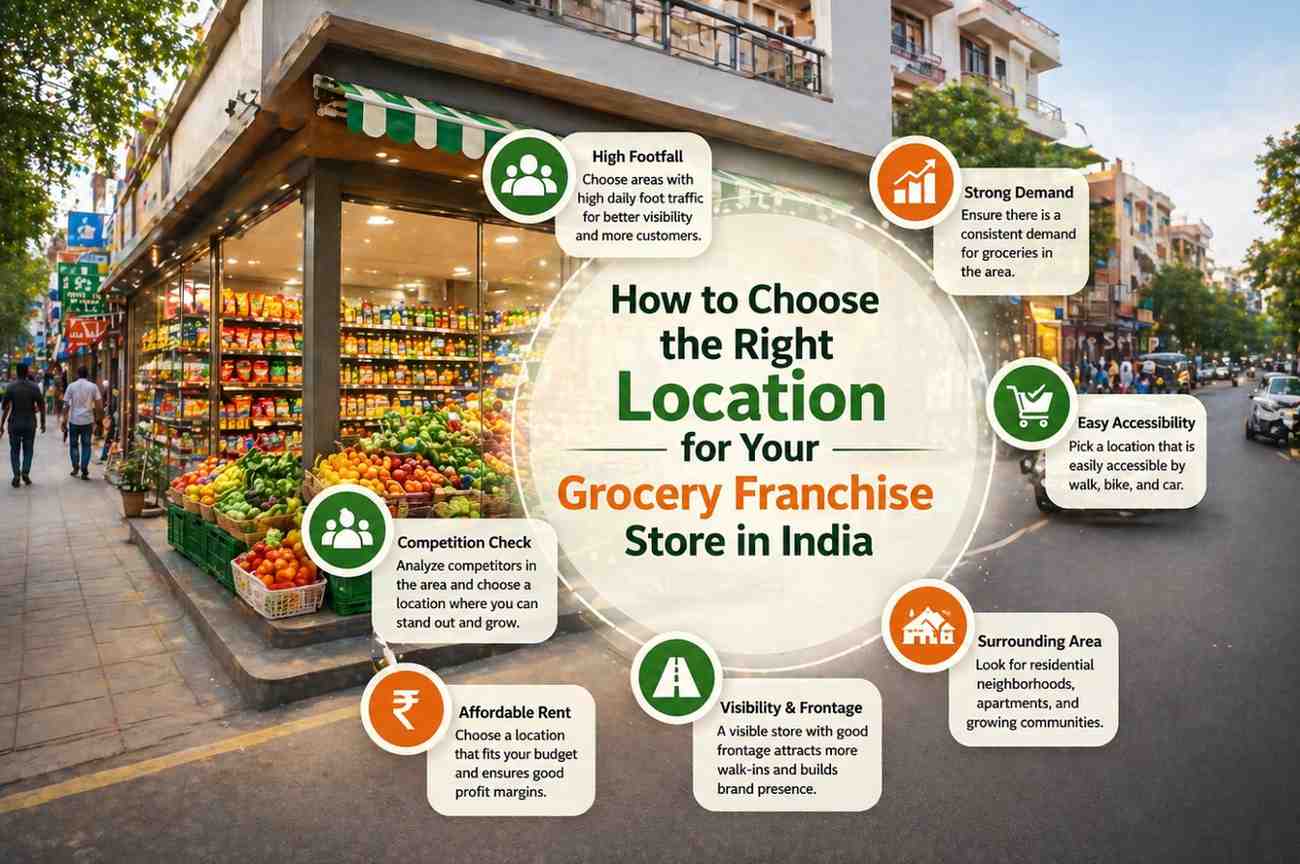
How to Choose the Right Location for Your Grocery Franchise Store in India (2026)
Location can make or break your grocery franchise store. Learn the key factors — footfall, demographics, competition, rent & more — to find the perfect spot for your Buyzaar Mart store in India.
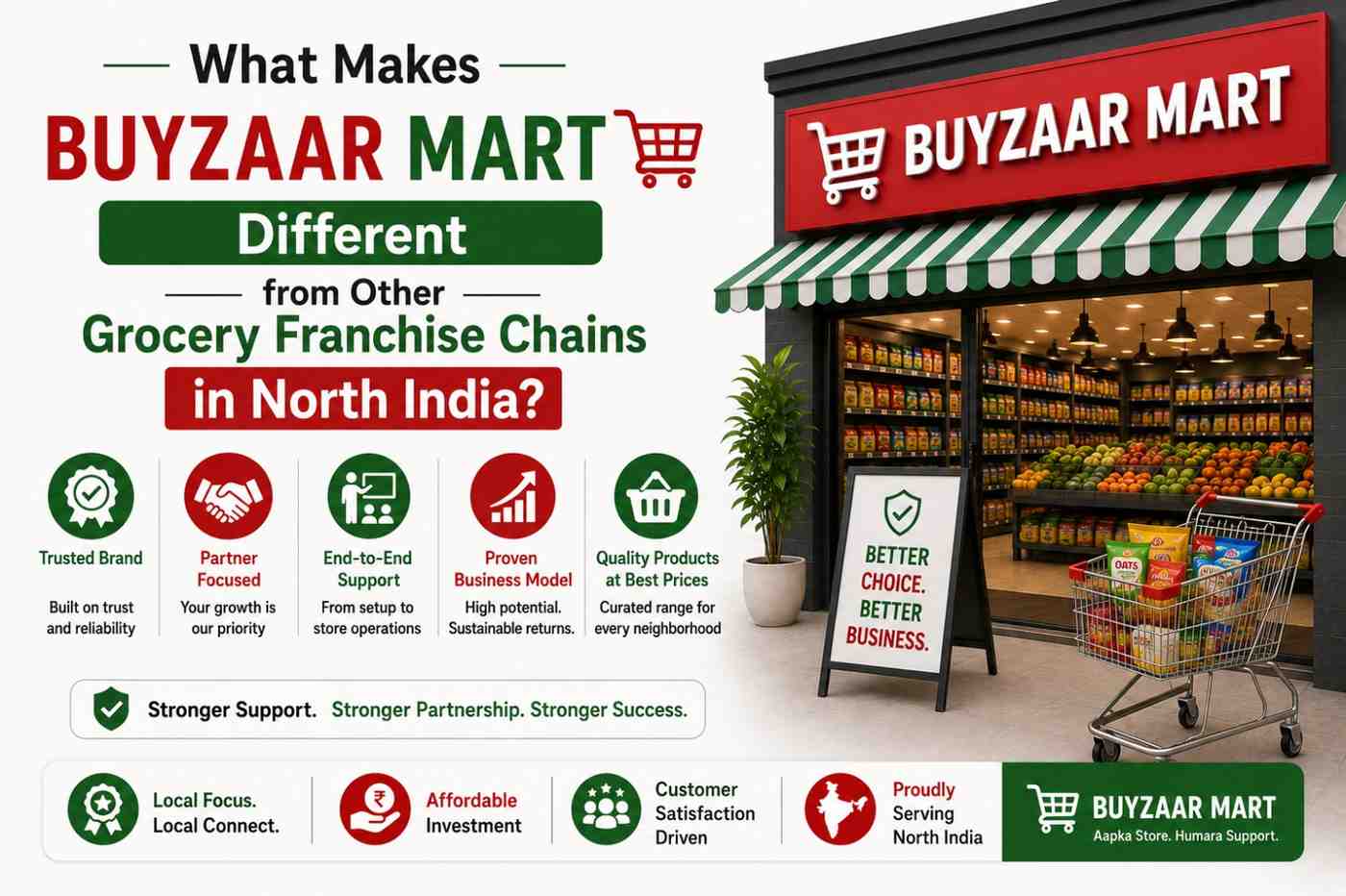
What Makes Buyzaar Mart Different from Other Grocery Franchise Chains in North India? (2026)
Wondering what sets Buyzaar Mart apart from other grocery franchise chains in North India? Discover the key differentiators — from tech-enabled operations and FMCG brand partnerships to franchisee-first support and profit margins.
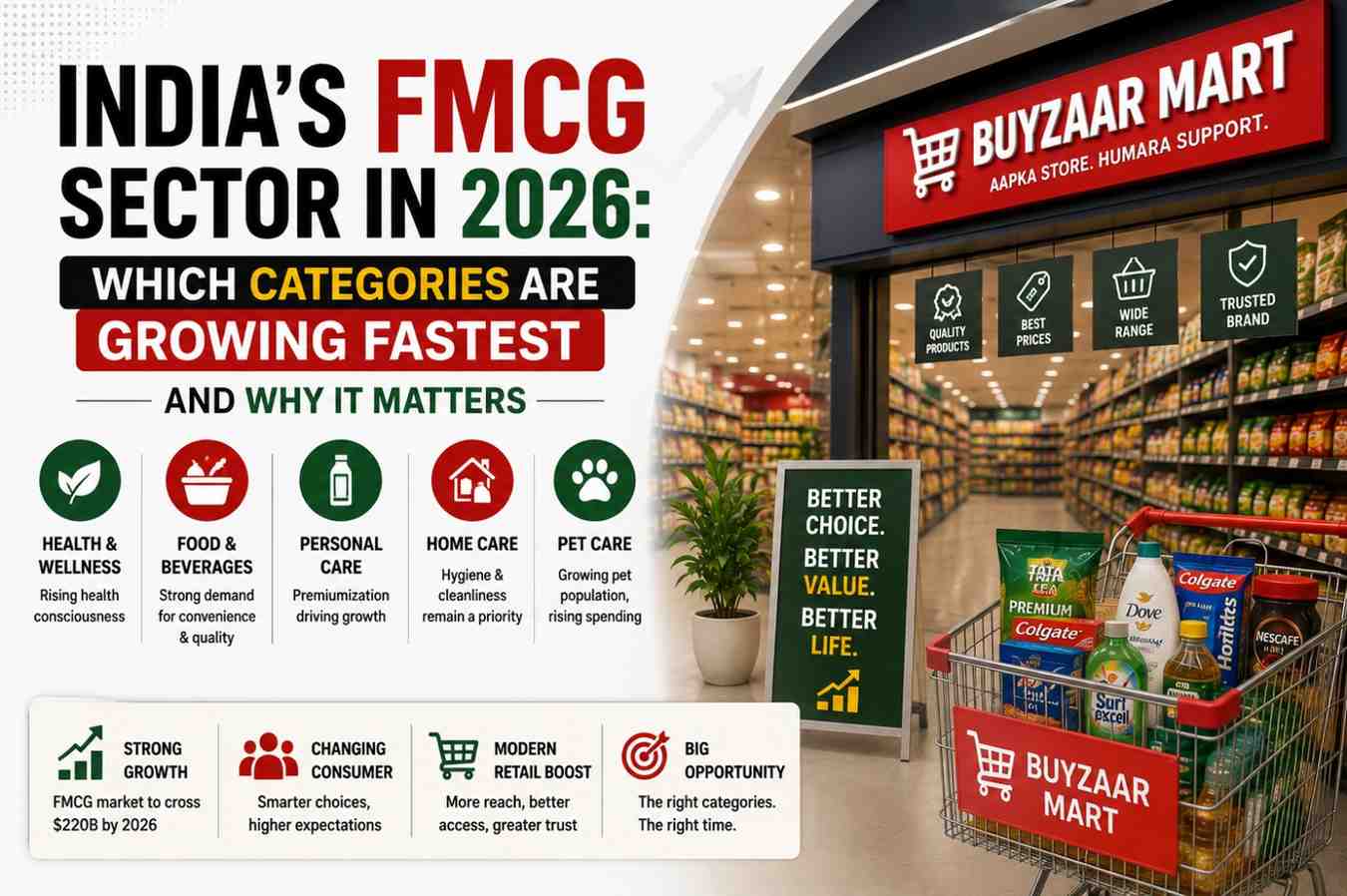
India's FMCG Sector in 2026: Which Categories Are Growing Fastest and Why It Matters
India's FMCG market is projected to hit ₹10.2 lakh crore by 2026. Discover which categories are growing fastest — from health foods to personal care — and what it means for grocery franchise owners across North India.