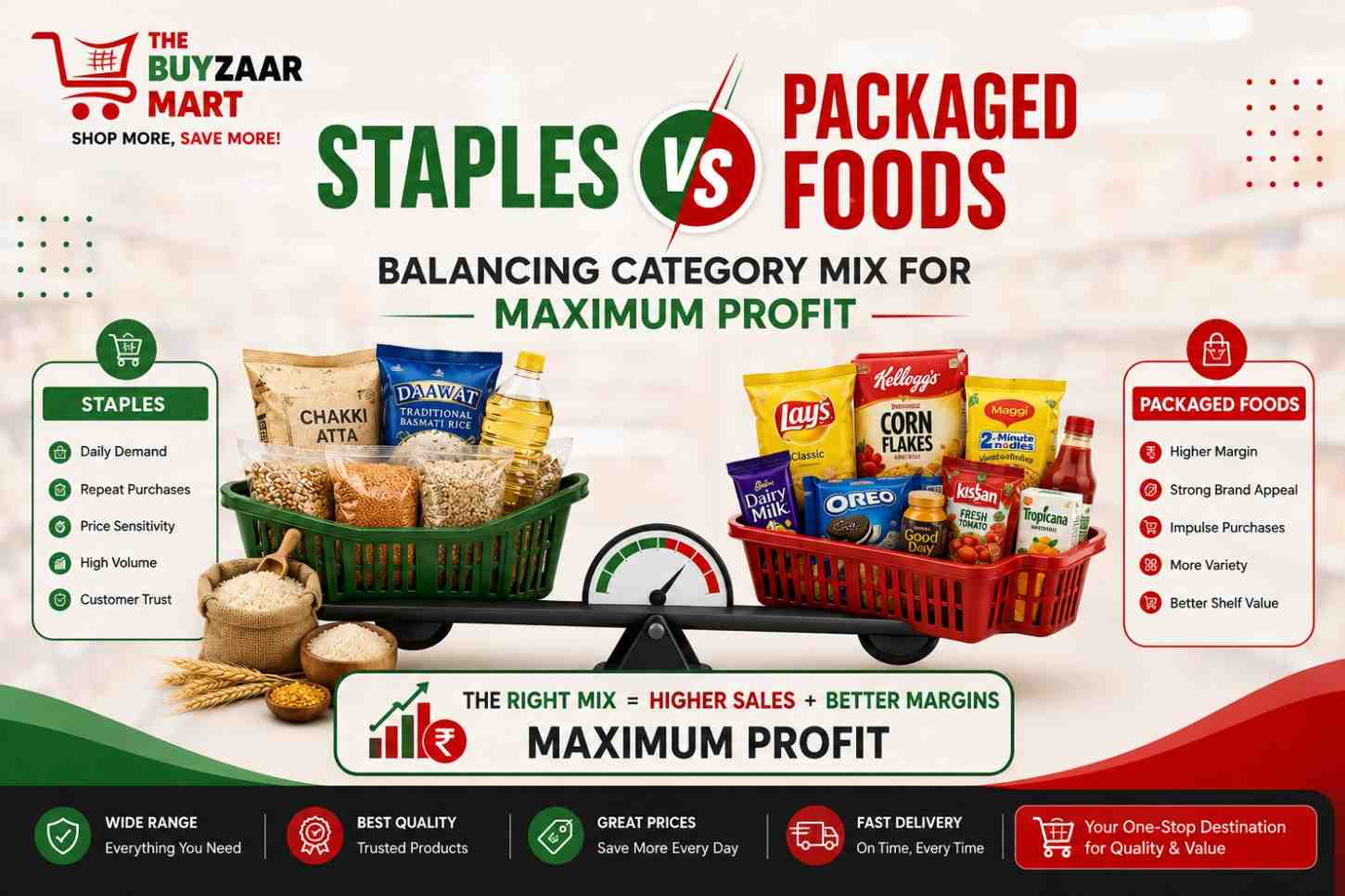
Staples vs Packaged Foods: Balancing Category Mix for Maximum Profit
Learn how to balance staples and packaged foods in your grocery store to maximise footfall, inventory turnover, and overall profitability.
Every grocery retailer eventually faces the same question: how much shelf space should go to staples like atta, rice, pulses, and oil, versus packaged and branded foods like snacks, beverages, and ready-to-eat items? Get the mix wrong, and you either lose daily footfall or leave margin on the table. Get it right, and the two categories work together to drive both walk-ins and profitability. This is one of the most overlooked levers in grocery retail success, and it deserves far more planning than most independent stores give it.
Understanding the Two Category Types
- •Staples and packaged foods behave very differently in a grocery store, and treating them the same way is where most category-mix mistakes begin.
- •Staples - The Footfall Drivers:
- •Include atta, rice, pulses, sugar, edible oil, and salt.
- •Bought frequently and in bulk by nearly every household.
- •Typically carry thinner margins due to price sensitivity.
- •Bring customers into the store on a predictable, repeat basis.
- •Anchor the store as a dependable destination for everyday needs.
- •Packaged Foods - The Margin Drivers:
- •Include snacks, beverages, ready-to-eat meals, biscuits, and instant foods.
- •Higher margins, often 15-25% compared to single-digit margins on many staples.
- •Purchases are more impulse-driven and brand-influenced.
- •Strongly influenced by promotions, placement, and packaging.
- •Help lift the average basket value on every single visit.
Why Category Mix Directly Impacts Profitability
- •A grocery store's profit isn't decided by any one category alone.
- •Profit comes from how staples and packaged foods complement each other across the basket.
- •Profitability also depends on how well the store turns visit frequency into total revenue.
- •Staples create consistent footfall; packaged foods convert that footfall into higher basket value.
- •A store overloaded with staples sees high volume but thin overall margins.
- •A store overloaded with packaged foods may see strong margins but inconsistent, low-frequency visits.
- •The right balance lets low-margin staples subsidise traffic while high-margin packaged foods subsidise profit.
- •Basket-level profitability, not category-level profitability, is what should guide the mix.
Inventory Turnover: The Hidden Half of the Equation
- •Margin percentage alone can be misleading.
- •A category with a lower margin but much faster turnover can generate more profit per square foot per month than a high-margin category that moves slowly.
- •Staples typically turn over faster because they are essential, repeat purchases.
- •Packaged foods vary widely in turnover - a popular snack brand may sell out weekly, while a niche imported item may sit for months.
- •Slow-moving packaged SKUs quietly erode profitability through locked-up capital and shelf space.
- •Tracking turnover by SKU, not just by category, reveals which items genuinely deserve their shelf space.
- •A high-margin item that turns over slowly can be less profitable than a low-margin item that turns over quickly.
Ideal Category Mix Ratios for a Grocery Store
- •While exact ratios vary by locality and store format, most well-performing organised grocery stores work within these broad bands:
- •Staples and daily essentials: approximately 40-50% of shelf space.
- •Packaged and branded foods: approximately 25-35% of shelf space.
- •Fresh produce and dairy: approximately 10-15% of shelf space.
- •Household and personal care: remaining shelf space.
- •These ratios are directional starting points, not fixed rules.
- •Actual allocation should be reviewed against local sales data every few months rather than set once and left unchanged.
Pricing Strategy Across the Two Categories
- •Pricing decisions should differ meaningfully between staples and packaged foods because customers respond to price differently in each category.
- •Staples: Keep pricing competitive and transparent, since customers actively compare staple prices across stores.
- •Staples: Use staples as a trust-building category rather than a primary profit centre.
- •Packaged Foods: Price closer to MRP where brand loyalty is strong, since impulse buyers are less price-sensitive.
- •Packaged Foods: Use limited-period offers and combo pricing to drive incremental basket additions.
- •Avoid discounting packaged foods as aggressively as staples, since it compresses the category's natural margin advantage.
Cross-Merchandising: Making the Two Categories Work Together
- •Smart placement can turn a staples purchase into a packaged-foods purchase without any additional footfall.
- •Place snacks and beverages near billing counters to capture impulse decisions at checkout.
- •Position ready-to-eat and instant food items near staples like rice and pulses, since they appeal to the same meal-planning mindset.
- •Use end-cap displays for packaged food promotions rather than staples, since staples are already sought out deliberately.
- •Bundle staple and packaged items during festive periods - for example, atta and ready-mix sweets together.
Seasonal and Festive Demand Shifts
- •Category mix should not stay static through the year.
- •Demand patterns shift sharply around festivals and seasons.
- •Festive periods increase packaged food, gifting-item, and dry-fruit movement significantly.
- •Summer months typically lift beverage and instant-food sales.
- •Monsoon and winter tend to favour packaged snacks and hot-beverage categories.
- •Staples demand stays relatively stable year-round but spikes briefly around major festivals.
- •A fixed category mix that ignores these shifts leaves both footfall and margin opportunities on the table.
Factors That Should Shape Your Category Mix
- •No two localities behave identically, so the mix has to be adjusted based on real conditions rather than a fixed formula.
- •Locality income profile: Higher-income catchments typically absorb more packaged and premium SKUs.
- •Household size and composition: Family-heavy neighbourhoods lean more toward bulk staples.
- •Store format and size: A Mini Mart cannot carry the same depth as a Super Mart or Hyper Mart.
- •Seasonal demand shifts: Festive periods increase packaged food and gifting-item movement.
- •Competitor presence: Nearby kirana stores or supermarkets influence which categories need stronger differentiation.
Common Category-Mix Mistakes Retailers Make
- •Many independent stores lose profit simply because their category planning is reactive rather than data-driven.
- •Overstocking staples without tracking actual sell-through, leading to locked-up capital.
- •Under-investing in packaged foods despite their higher margin potential.
- •Ignoring shelf placement - packaged foods perform better at eye level and near billing counters.
- •Not rotating SKUs based on seasonal or festive demand.
- •Treating category mix as a one-time decision instead of an ongoing, data-led process.
- •Copying a competitor's mix directly instead of adapting it to local buying behaviour.
How a Structured Retail Model Simplifies Category Mix
- •This is exactly the kind of decision where an organised, data-backed retail system has a clear advantage over ad-hoc stocking.
- •Centralised sales data helps identify which SKUs are actually driving profit versus just occupying shelf space.
- •Structured procurement ensures the right staple-to-packaged ratio is maintained without manual guesswork.
- •POS-linked inventory tracking flags slow-moving stock before it locks up working capital.
- •Category planning is guided by demand patterns across similar stores and localities, not just one outlet's history.
- •Standardised planograms remove the guesswork of where each category and SKU should be placed.
- •At The Buyzaar Mart, category mix across Mini Mart, Super Mart, and Hyper Mart formats is planned using this kind of structured, data-led approach - helping franchise partners avoid the trial-and-error that independent store owners often go through.
Quick Comparison: Staples vs Packaged Foods
- •Purchase Frequency: Staples - high and repeat; Packaged Foods - moderate, often impulse-led.
- •Margin Level: Staples - low to moderate; Packaged Foods - moderate to high.
- •Role in Store: Staples - footfall driver; Packaged Foods - profit driver.
- •Price Sensitivity: Staples - high; Packaged Foods - moderate, brand-influenced.
- •Inventory Turnover: Staples - generally fast; Packaged Foods - varies widely by SKU.
- •Shelf Space Ideal: Staples - 40-50%; Packaged Foods - 25-35%.
Building a Profitable, Balanced Grocery Store
- •The most successful grocery retailers don't choose between staples and packaged foods - they use both strategically.
- •Staples keep the store relevant to daily household needs and bring in consistent traffic.
- •Packaged foods convert that traffic into stronger basket value and healthier margins.
- •The real skill lies in reviewing this balance regularly.
- •The category mix should be adjusted to local demand and seasonal shifts.
- •Data, not guesswork, should guide shelf allocation and pricing.
- •For entrepreneurs entering grocery retail, this is also one of the strongest arguments for a structured, franchise-backed model over an independent setup.
- •In a structured franchise model, category mix decisions are already benchmarked, tested, and refined across multiple stores rather than being figured out from scratch.
Frequently Asked Questions
What percentage of a grocery store should be staples?
Most well-performing stores keep staples at around 40-50% of shelf space, adjusted based on locality and household demand patterns.
Are packaged foods more profitable than staples?
Generally yes - packaged foods carry higher margins, but staples are essential for driving consistent footfall.
Does inventory turnover matter more than margin?
Both matter together. A fast-turning, lower-margin item can generate more monthly profit than a slow-moving, high-margin one.
How often should category mix be reviewed?
Ideally every few months, using actual sales and sell-through data rather than a one-time fixed plan.
Does category mix vary by store size?
Yes. Mini Mart, Super Mart, and Hyper Mart formats each support different depth and breadth across categories.
Why do franchise stores manage category mix better than independent stores?
Franchise models use centralised sales data and structured procurement, removing the guesswork independent owners often face.
Related Articles
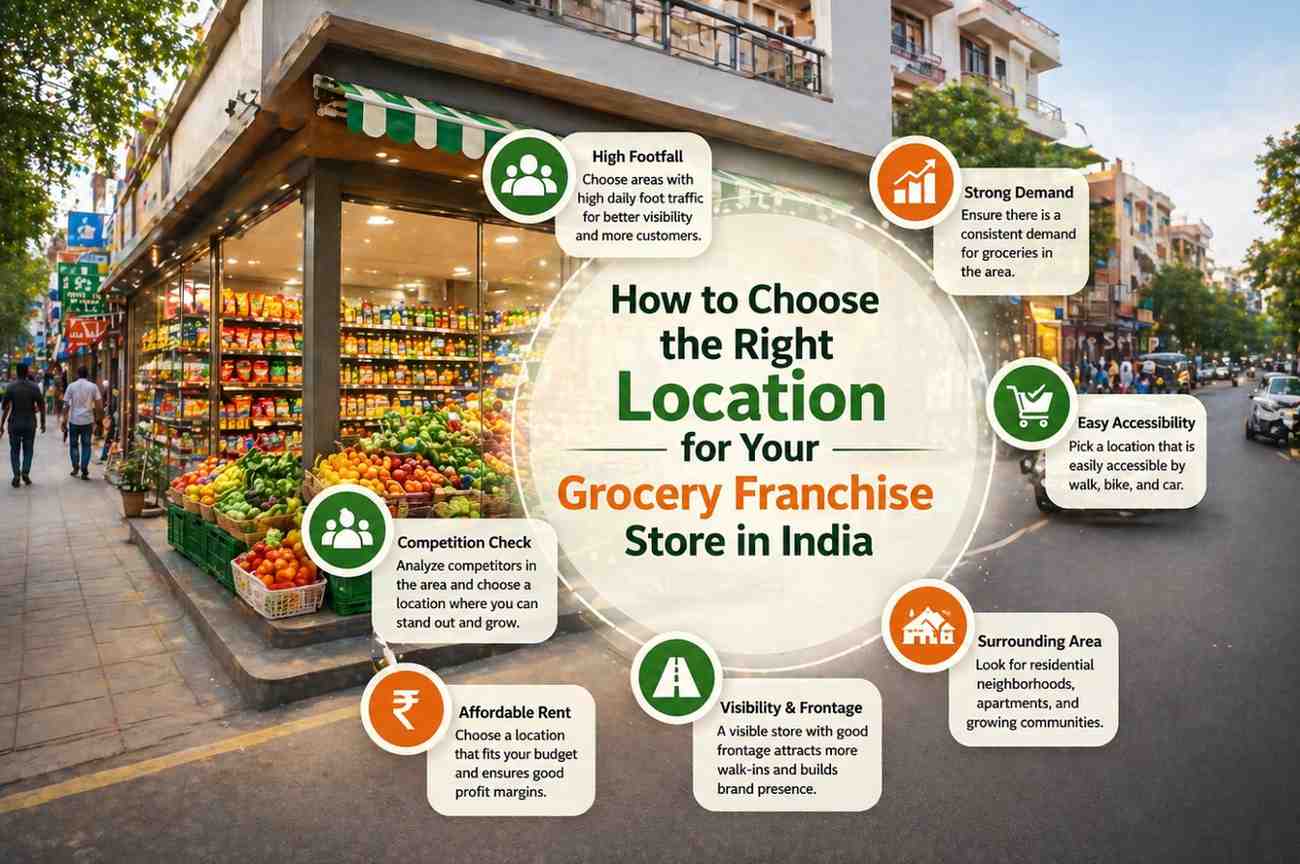
How to Choose the Right Location for Your Grocery Franchise Store in India (2026)
Location can make or break your grocery franchise store. Learn the key factors — footfall, demographics, competition, rent & more — to find the perfect spot for your Buyzaar Mart store in India.
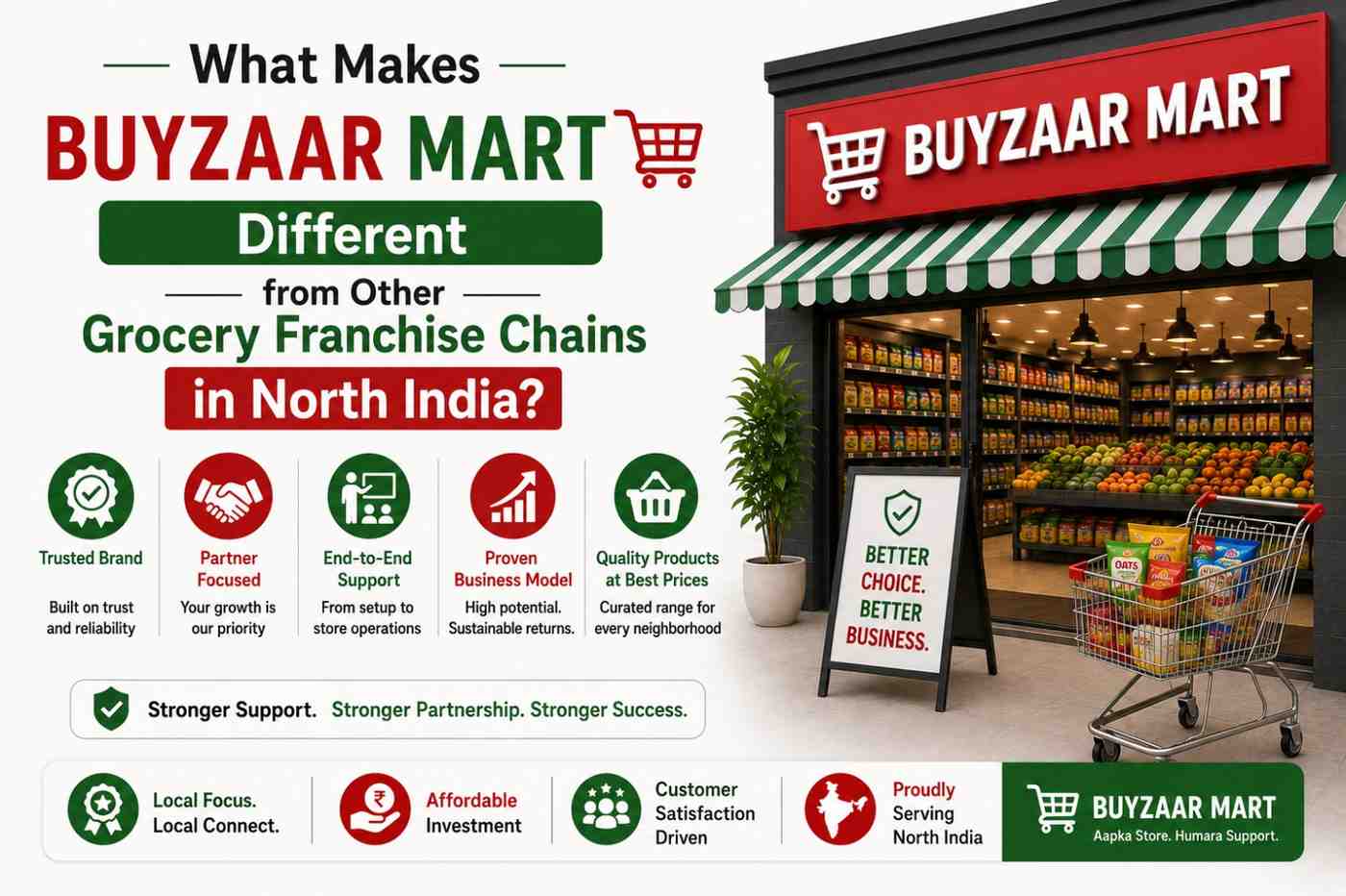
What Makes Buyzaar Mart Different from Other Grocery Franchise Chains in North India? (2026)
Wondering what sets Buyzaar Mart apart from other grocery franchise chains in North India? Discover the key differentiators — from tech-enabled operations and FMCG brand partnerships to franchisee-first support and profit margins.
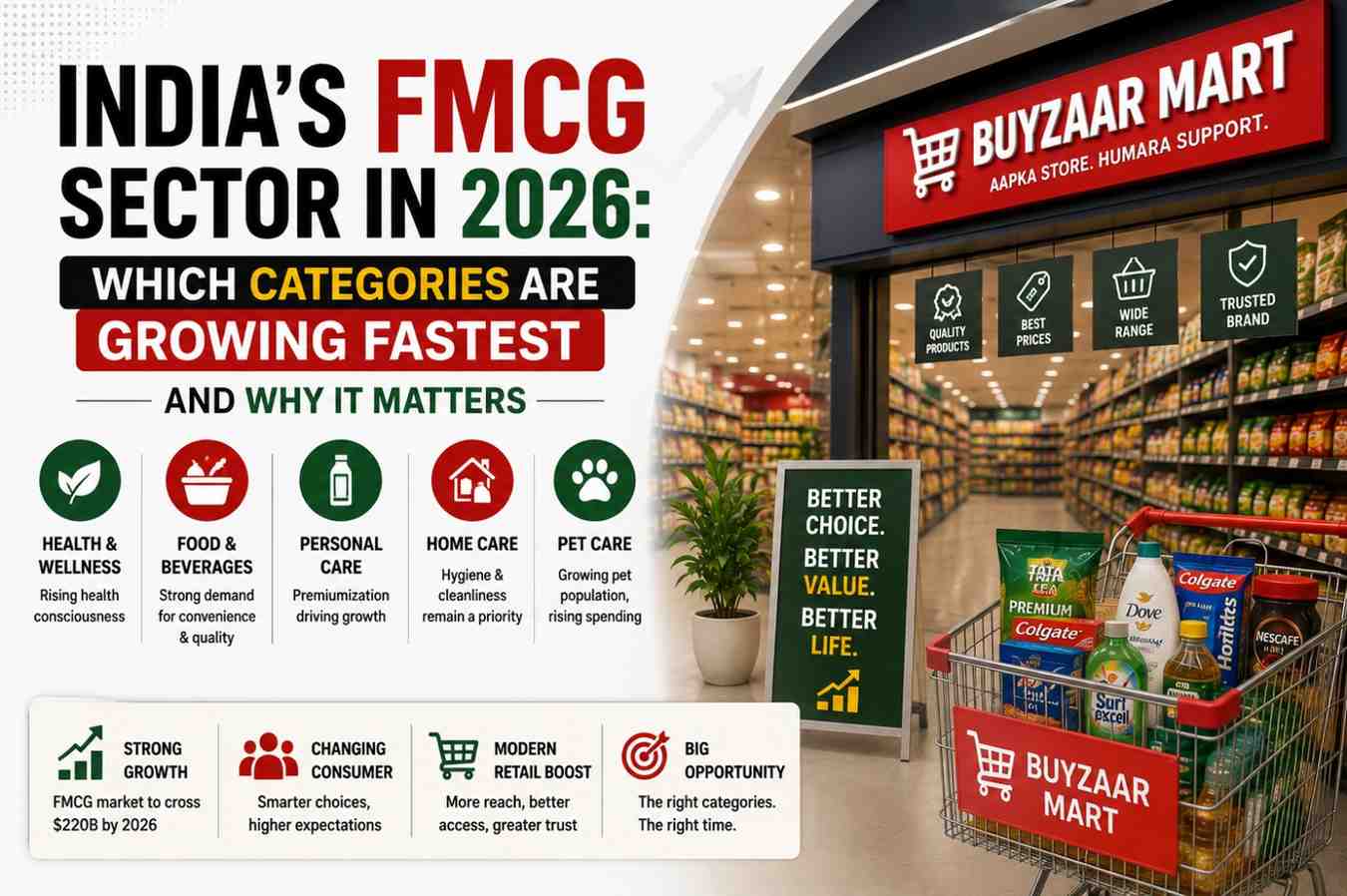
India's FMCG Sector in 2026: Which Categories Are Growing Fastest and Why It Matters
India's FMCG market is projected to hit ₹10.2 lakh crore by 2026. Discover which categories are growing fastest — from health foods to personal care — and what it means for grocery franchise owners across North India.